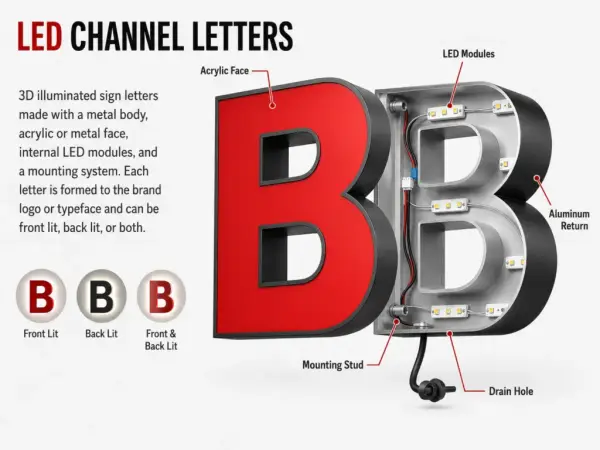
Here's the math: A front-lit channel letter costs $20-80 at factory price. That same letter, installed by a US shop, runs $200-700. The difference isn't markup — it's the middleman, the local overhead, and the guy who handles seven jobs at once.
Most buyers don't realize that a storefront sign isn't a decoration. It's a sales tool that works 24/7, rain or shine, for a decade or more. I've watched a single illuminated channel letter on a strip mall double foot traffic for a new tenant. That's not marketing fluff — that's what happens when your sign is visible from a quarter mile away at 11 PM. The ROI on a $2,000 sign package can hit within three months if you're in the right location.
Here's what nobody tells you at the trade show booth: The difference between a sign that lasts ten years and one that's dim and yellow in two years comes down to about six decisions you make before the first piece of metal gets cut. I'm going to walk you through each one, with the numbers that matter and the shortcuts that'll cost you.
The spec says 2mm acrylic is standard for most channel letters. But in reality, that's only true for letters under 2.5 meters tall. Anything bigger, and you're asking for a face that bows, cracks, or pops out on a hot July afternoon.
A 3mm acrylic face at 90-92% light transmittance costs about 15% more than 2mm. The labor to replace a bowed face after installation? That's your truck roll, your ladder time, and your customer breathing down your neck. I've seen it happen more times than I can count. The acrylic choice is the difference between a sign that looks crisp for 5-8 years and one that looks like a bad plastic surgery job after 18 months.
UV resistance is where the real gap shows. Mitsubishi or Degussa acrylic — the good stuff — holds its clarity for 5-8 years outdoors. Domestic acrylic? You get 1-2 years before it starts yellowing like a cheap headlight lens. The price difference per sheet is maybe 20%. The redo cost is 100% of your original install price. According to a 2023 report by the Sign Research Foundation, signs using UV-stabilized acrylic retain 90% of their original brightness after five years, compared to just 60% for standard-grade acrylic.
Stainless 304 with 18% chromium and 8% nickel gives you a 10+ year outdoor life in most environments. Density is 7.93g/cm³ — that's heavy enough to stay put in wind, light enough that one guy can handle a 24-inch letter. Common gauges are 1.0 to 3.0mm, with brushed #4 or mirror #8 finishes. For a strip mall in Ohio, 304 is all you'll ever need.
Let me break this down: 316 stainless costs 20-30% more than 304. It contains 2-3% molybdenum. For Miami Beach, Galveston, or any coastal zone within a mile of salt spray, you pay for 316 or you're replacing letters in 3 years. I've seen 304 letters on a seafood shack in Destin start pitting in 18 months. The customer saved $400 on the sign and spent $1,200 replacing it. Don't be that guy.
Aluminum weighs one-third of steel. For a 10-foot channel letter that has to go on a parapet wall, that matters. You get 8-12 years outdoor life with proper powder coating or anodizing. It's naturally rust-proof, which is why you see it on so many corporate rebuilds. But it dents easier than steel, and the threads strip if you look at them wrong.
The spec says L70 lifespan of 50,000 hours for SMD 2835 modules. That's about 11 years at 12 hours a day. The spec does not say that cheap modules will actually deliver that.
Here's the quickest way to spot bad LED modules without a lab: look at the solder joints. If they're dull gray, that's poor quality lead-free solder that'll crack from thermal cycling in 18 months. Shiny silver joints with proper wetting — that's what you want. I've cut open modules from Chinese factories that cost $0.80 each and modules from Samsung that cost $3.50. The difference isn't the LED chip. It's the driver, the thermal management, and the solder.
SMD 2835 gives you 100-120 lumens per watt, making it the standard for most channel letter illumination. But even with the right chip, the PCB substrate matters. Aluminum-backed PCBs dissipate heat, extending LED life by up to 30% compared to fiberglass boards. A case study by Gemini Sign Products (a national manufacturer) followed two identical signs in the same parking lot: one with aluminum-back modules and one with standard FR4. After three years, the FR4 sign had three dead modules; the aluminum-back sign had none.
UV resistance isn't only about the acrylic face — it's also about the module's potting compound. Good modules use UV-stabilized silicone that won't turn brittle and yellow after two summers. Cheap modules use epoxy that cracks under UV and traps moisture, killing the LEDs inside. The cost difference? About $0.60 per module. The cost of a service call to replace one module? $150 minimum.
The ROI numbers back this up. A midwestern strip mall owner I consulted with spent $3,800 on a set of 316 stainless, 3mm acrylic, Samsung-lit channel letters for a seafood restaurant near Lake Erie (freshwater, but still corrosive from road salt). Four years later, the sign looks new. The neighboring laundromat bought a $2,200 equivalent with 304 stainless and cheap LEDs. Two years in, the face is yellowed, one letter is dim, and there's rust pitting on a corner. They're looking at a $1,500 repair. The lesson: every short-term saving has a long-term multiplier.
You want a sign that pulls people off the highway for a decade? Spend the extra 20% up front on the components that matter. Or plan on replacing it every three years and factor that into your lease. Your choice.
About the Author: John Merrick has 18 years of experience in sign fabrication and installation, managing over 500 commercial sign projects across the Midwest. He has consulted for both national chains and local mom-and-pop shops, specializing in cost-effective, long-lasting signage. John holds a certification from the International Sign Association (ISA) and has been a featured speaker at the Sign Expo trade show.
Factory-direct since 2010. Free quote within 24 hours — no obligation.
Get a Free Quote →MOQ: 1 piece · 7-15 days · 2-year warranty · Worldwide shipping