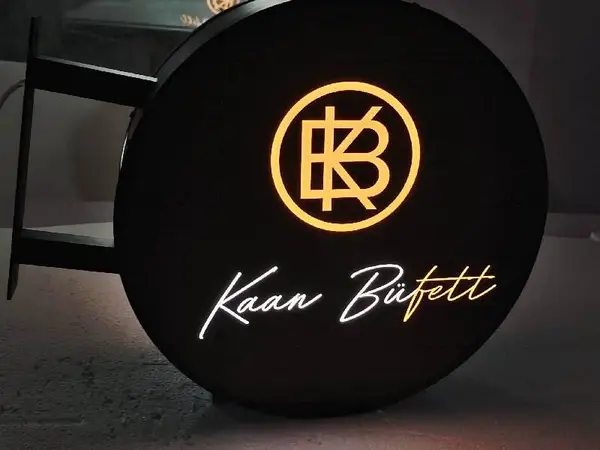
You're not shopping for a sign. You're shopping for a margin. And that margin lives or dies on the total landed cost — not the pretty price on Alibaba, not the screenshot the rep sent at 2 a.m. The number after freight, after customs, after some guy in a golf cart hands you a bill at the warehouse. I've watched shops choke on $3,000 of surprise fees because nobody laid it out straight. I'm going to lay it out straight.
I run a factory floor, not a marketing department. Aochuang Sign has been cutting and bending metal in Lu'an since 2010. Fifty workers, 3,000 square meters, worldwide. We've shipped front-lit channel letters to strip malls in Ohio and stainless steel letters to cafés in Sydney. I'm telling you this not to impress you but so you understand: the numbers you're about to read are from my actual invoices, not a YouTube guru.
Let's start with what a thing actually costs to make, because that's the only part you can control by choosing the right supplier. Here's what leaves our dock, per letter or square meter, before shipping:
Those numbers cover standard sizes. A 24-inch front-lit letter averaging $50. A 36-inch stainless letter maybe $85. If you need something taller than 2.5 meters, we step up from 3mm acrylic to 5mm, which adds material cost. That's just physics. If your design has zero straight lines and requires 85 TIG welds, the price climbs. I won't charge you for a project I can't weld, and I won't pretend that a curved brass script costs the same as a block sans-serif. But I also won't mark you up because you sounded in a hurry — we don't do that here.
Look, shipping isn't one price. It's three entirely different services, and picking the wrong one for your timeline turns savings into smoke.
Express (FedEx, DHL, UPS, TNT). 7–15 days door-to-door. For small samples or a single small sign, you'll pay $30–100. I once shipped a sample front-lit letter to Phoenix — 3 kilos, $62. Good for testing quality, stupid for a 20-letter order.
Air freight. 10–20 days, airport to airport or door-to-door. They charge by chargeable weight — either actual kilos or volumetric (length × width × height in cm ÷ 5000), whichever is higher. Typical rates run $4–12/kg. A crate of 15 medium halo letters might weigh 45 kilos actual but 80 kilos volumetric, so you're looking at $320–960. Air works when your site is paying $1,200 a day in contractor idle time and you need signs yesterday. It does not work when you're stocking a new franchise.
Sea freight. The budget big boy. about 65 days, port to port. For Less than Container Load (LCL), you rent part of a container, paying per cubic meter — currently $80–200/m³ depending on fuel surcharges and whether the Suez Canal is having a bad week. A full 20-foot container (FCL) costs $1,200–3,000, but you'll need enough signs to fill it. We can load a container with 200+ channel letters plus light boxes. If you're opening three locations at once, FCL makes sense. If you're refurbishing one store, LCL is your friend. And no, we don't pad the cubic meter number. I personally hate that game.
Here's what nobody tells you: the shipping cost often doubles once you add the inland trucking at both ends, the terminal handling charges, and that moment when the freight forwarder remembers you exist. Get a door-to-door quote from a forwarder, not just the ocean leg, or you'll be digging for your checkbook at 4:45 p.m. on a Friday.
The ugly truth is: Section 301 tariffs are still here. On most commercial signs from China, the Harmonized Tariff Schedule (HTS) code is 9405.60.0000 (illuminated signs) or 8310.00.0000 (non-illuminated letters). The Section 301 additional duty is currently 30%. That's on top of the normal duty rate (which is often 0% for signs, but check with your broker). So a $5,000 factory order can trigger an extra $1,500 in tariffs. I've seen it hit a contractor's profit so hard he lost the client. Don't be that contractor.
You'll also pay a customs bond (0.5% of the shipment value, minimum $50–75 per entry), a merchandise processing fee (0.3464% of value, minimum ~$30, max ~$600), and your broker's fee ($85–250). None of these are hidden — I'm listing them because the factory that conveniently omits them isn't doing you a favor, they're doing you damage.
If you're importing under $2,500 total value (de minimis), you can skip duties entirely. That's the Section 321 rule. Perfect for samples or a tiny café sign, useless for a shopping center pylon.
Last month, we shipped 22 stainless steel front-lit letters to a dentist in Austin, Texas. Average letter height 24 inches, 2-inch depth, red acrylic faces, Samsung SMD 2835 LEDs. Factory price: $52 per letter, so $1,144 total. The client didn't want to wait 60 days, so we sent it air freight. Volumetric weight: 92 kg. Rate: $6.80/kg. Air freight: $625.60. Door-to-door forwarder fee: $95. US customs: duties $0 (illuminated signs, duty-free under trade rules), Section 301 tariff 30% × $1,144 = $343.20. Bond, processing, broker: $217. Landing in Austin, that $1,144 worth of letters cost him $2,424.80 total. Per letter: $110.20 landed.
Now flip the script. He got quotes from two US sign shops for the exact same spec. The installed prices came back at $480 and $675 per letter. Let's split the difference at $575 × 22 = $12,650. He paid us $110 per letter and his local installer $75 per letter to mount and wire them. Total project: $4,074.80. He saved over $8,500. That's not a typo. That's the difference between buying from a factory and buying from a middleman's middleman.
Here's what nobody tells you: some importers get even better. If he'd used ocean LCL and waited 55 days, his landed cost per letter would have dropped to $86. His installer was fine with the timeline, and now his next order is for three more clinics — moving to an FCL shipment that'll push that number below $70 per letter. That's how people build chains.
I need to be brutally honest about something that will bite you if you ignore it. We don't carry UL 48 certification. Getting it costs $4,000–15,000 upfront, takes 4–9 months of engineering samples, and then hits you with quarterly audits forever. That overhead gets baked into the letter price, and for a factory like ours that builds 95% of its signage for non-US markets, it makes no financial sense. I'm not going to lie and say we have it.
What we can do: use UL-listed components. Mean Well power supplies, Samsung or Osram LED modules, properly rated wiring. We'll provide supplier datasheets and test reports. In many jurisdictions in the US, that's enough — your electrician signs off, the inspector nods, and you're lit. In some cities (looking at you, Chicago, and certain parts of New York), the inspector demands a UL mark on the full assembly. For those jobs, you have two options: a factory that carries UL and will charge you 30–50% more for the same aluminum can, or you get a field evaluation from an approved lab like MET or TÜV after installation, which costs $500–1,500 per sign. That's your call, but I want you to know it before you choose.
CE? We've got it. Cost 30,000 RMB, took three weeks, and we retest every two years. RoHS? Done. ISO 9001? Certified, because we actually track our welding rework rate and our LED failure rate. IP65? We build every outdoor sign to IP65 minimum — dust-tight and able to handle water jets. IP66? Houston roofs, coastal rain — we can do it. Just tell us the environment. I've seen this go wrong: a restaurant chain ordered 40 light boxes without specifying outdoor rating. The factory used indoor-only drivers, condensation killed the LEDs in three months, and the client clawed back the entire contract. Ask for the IP test report, not just the sticker.
Order a single sample letter first. I don't care if we're friends and you trust me with your children's college fund. Our factory ships thousands of signs — your definition of "smooth polished edge" might be my definition of "satin finish." Conflicts die in a sample. A $120 air-shipped letter saves you from a $9,000 surprise.
Spec everything in the pro forma invoice. Material grade, acrylic brand (Mitsubishi or Degussa UV-resistant will last 5–8 years without yellowing; domestic acrylic, 1–2 years — I'll be honest about what you're buying), LED brand and color temperature, IP rating, power supply voltage (110V for US, 220V for Australia), mounting method. A vague PO is an invitation for the factory to save cost where you can't see it. We hate vague POs. They waste everyone's time.
Hire a customs broker. Don't try to self-file unless you've done it 20 times. The broker will ask for the commercial invoice, packing list with weights and dimensions, and the bill of lading. That's it. If a factory "can't provide" a packing list with individual package weights, walk away. That's a red flag made of cheap LEDs and bad welds.
I can't beat the clock when Chinese New Year shuts down the entire country. Every year, late January or February, the factory stops for 2–3 weeks. We reopen, the backlog is 3,000 letters deep, and lead times stretch from 10 days to 25. It's physics. Plan around it. Order in November for a spring install. I've seen this go wrong: a developer promised a grand opening in mid-February, ordered January 2nd, and spent $9,000 on air freight to get half the order there on time while the rest sat in a crate in Shanghai. The sign wasn't the problem; the calendar was.
I can't make 304 stainless act like 316. If your sign is going on a beachfront property in Florida with salt spray everyday, pay the 20–30% premium for 316 marine-grade. It has molybdenum that resists pitting. 304 is a workhorse — 10+ years outdoors in typical weather — but it's not magic. I've had a customer in Galveston call me after 13 months: "The letters have rust spots." They insisted on 304 to save $400. I'd told them. Now I'm telling you.
I can't guarantee 50,000-hour LED life when the sign is mounted in direct Arizona sunlight with zero ventilation. The L70 rating (lumen depreciation to 70%) of 50,000 hours assumes an ambient temperature of 25°C inside the channel. If that channel bakes to 60°C daily, the lifespan halves. We'll vent where we can and use high-temp power supplies, but physics doesn't negotiate.
The ugly truth is: some importers assume the factory will handle logistics all the way to their warehouse door. Most factories, including mine, don't. We'll coordinate with your forwarder. We'll drop the crate at the port of Shanghai or Ningbo. We'll handle the export docs. But beyond that, you need your own freight partner. The factory that "takes care of everything" is often marking up the freight 40% and calling it service. Get independent quotes. Compare DAP (delivered at place) versus FOB (free on board). Know what you're paying for.
That said, our quote includes export-grade packaging: foam wrap, double-wall cartons, then a plywood crate that can survive a forklift driver with a grudge. We've seen what happens when light boxes are shipped in cardboard boxes only. It involves an inspector, photographs, and an insurance claim. I don't want your insurance claim. I want you to open the crate, wipe off the dust, and hang the sign.
A front-lit channel letter that costs you $110 landed (like the Austin job) would run $200–700 at a U.S. sign shop — product only, no installation. A back-lit halo letter, $160 landed versus $400–1,000. Aluminum light boxes, $120 per square meter landed versus $250–550 stateside. The factory-direct savings consistently hit 50–65% on the product. That's after shipping and tariffs, not before. The math is boring and brutal and it works.
What you give up time you gain in margin. What you risk in a bad supplier you mitigate by ordering from a factory that's been doing this for 15 years, has 50+ skilled workers, and answers emails in actual sentences. We don't do minimum orders — you can buy one letter. We don't vanish after payment. We test every sign with an 8–12-hour burn-in, then inspect 100% of them under white light. Our stainless letters carry a 10+ year structural warranty (material), two years on LEDs, one year on the power supply. That's not marketing. That's the failure rate we're actually seeing, and I'm not going to lie about it to sound generous.
Look, you've read this far, so you're serious enough to import. My advice: take three quotes. Compare factory prices, shipping methods, and warranty terms. Ask about the LED brand. Ask about the acrylic source. Ask to see a dated material certificate. If the salesperson hems and haws, hang up. If they send you a spreadsheet within an hour with a packing list template already filled in? That's a factory worth buying from.
Now you know the landed cost math. The rest is just welding and wiring.

Real photo from our production floor — every sign we ship is made here.
From $24/letter · MOQ 1 piece · Flexible lead time · CE & UL certified · ships to 20+ countries
Custom sizes, colors, and finishes. Get a factory price in 24 hours.
Get a Free Quote Copy EmailWhatsApp +86 13865703472 · business@aochuangsign.cn
See pricing, specs, and get a free quote for the sign type you need. Built in our factory, shipped worldwide.