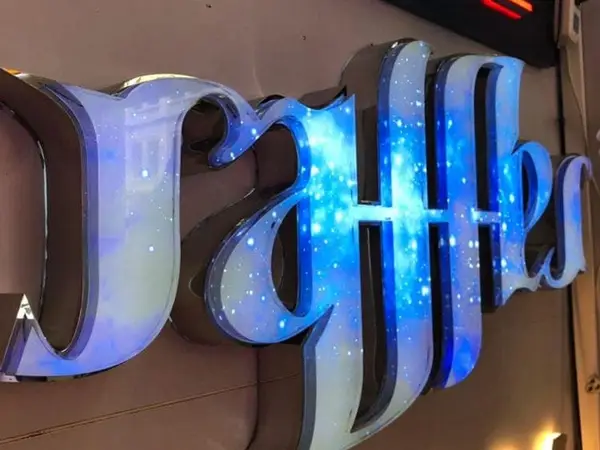
You're staring at a quote for $6,000 on a set of ten front-lit channel letters. Your gut says that's insane. Your business partner says it's "the going rate." I say let's break it down like a mechanic looking at a transmission rebuild – part by part, with the numbers that actually matter.
I've spent fifteen years in this industry. I've watched sign shops pay $800 for a single 304 stainless steel letter from a domestic fabricator. Same material. Same Samsung LEDs. We ship that same letter for $120. Not $800. Not $500. One hundred and twenty. That's not a discount. That's the difference between factory-direct manufacturing and a retail markup that would make a diamond dealer blush. But here's the catch: the math only works if you understand exactly what you're paying for – and most buyers don't realize how the pricing sausage gets made.
Let's start with a baseline. Factory-direct prices for front-lit channel letters? $20 to $80 per letter. That's the range for a standard 304 stainless steel letter, 6 to 12 inches tall, with SMD 2835 LEDs and an acrylic face. Back-lit (halo) letters push that to $35-$120. Stainless steel non-lit runs $15-$40. Now go to a local sign shop or national chain. You'll see $200 to $700 per letter. For the same thing.
Here's the math: a typical ten-letter storefront sign with front-lit letters at $600/letter retail = $6,000. Factory direct at $60/letter average = $600. That's a 90% difference on the product alone. But hold on – the factory price is FOB (free on board), meaning you pay for shipping, customs, and possibly tariffs. Even after adding $300 for air freight and 30% Section 301 tariff, you're at roughly $1,100. Still an 82% savings. That's not a typo. That's the reality of a supply chain with three layers of middlemen.
Most buyers don't realize that the retail price includes the sign shop's overhead – the rent, the sales guy's commission, the truck that breaks down, the guy who installs it on a Saturday. A local fabricator's material cost might be the same as a factory's, but their labor rate is $60-$100/hour compared to $8-$12/hour in a well-run Chinese factory. And the factory's buying power on LED modules? They're ordering 50,000 units at a time, not 50. That drives component cost down 30-40% right there.
The spec says a front-lit channel letter requires a 3mm acrylic face, 304 stainless steel backs, and IP65-rated LED modules. That's the base. But your local shop isn't just selling you materials. They're selling you their time: design consultation, permit filing, installation, and a warranty that's often worth less than the paper it's printed on. I've seen markup structures that look like this: material cost $300, then multiply by 2.5 for labor and overhead, then add 20% profit, then tack on a "project management fee" of $150. Suddenly your $120 letter costs $750.
Now I'm not saying local shops are crooks. They've got real costs. A TIG welder who can make a clean seam on 1.2mm stainless steel is hard to find and commands $35/hour. Their CNC router payment is $2,000 a month. But here's the brutal honesty: most of them are buying from the same factory you could buy from directly, then reselling it to you at a 400% markup. They just don't want you to know that.
Quickest way to spot this: ask where they source their LEDs. If they say "we use Samsung 2835s" but can't tell you the exact module brand or lumen output (100-150 lm/W), they're buying commodity modules and slapping a brand name on the quote. Or worse – they're using cheap domestic modules with a lifespan of 12-18 months. I've seen it a hundred times. Dull gray solder joints on the module? That's a giveaway. Proper lead-free solder is shiny silver. Dull gray means you're replacing it in two years.
Let me break this down: a $60 front-lit letter from a reputable Chinese factory like Aochuang Sign (founded 2010, 3,000m² facility, CE/ROHS/ISO 9001 certified) includes:
That $120 price? It assumes a 10-letter order, standard font, no complex curves. Add $5-$10 per letter for custom shapes. Add $20-$40 for halo (back-lit) versions. But the base is still a quarter of what you'd pay domestically.
Here's another hard fact: 316 stainless costs 20-30% more than 304. For a strip mall in Ohio, 304 is fine. For Miami Beach, pay for 316 or you're replacing letters in 3 years. That's not a upsell. That's marine-grade corrosion protection because of the 2-3% molybdenum content. Coastal humidity eats 304 like a salt lick. Don't learn this the hard way.
Everyone focuses on the product price and ignores the logistics. And that's where the landmines are.
Shipping options: Express (DHL/FedEx) for small samples – 7-10 days, $30-$100. Air freight for full signs – about 10 days, $4-$12 per kilogram. Sea freight for large orders – about 65 days, $80-$200 per cubic meter for LCL (less than container load), or $1,200-$3,000 for a full 20-foot container. If you're ordering a single 10-letter sign, air freight is the only practical choice. That adds $300-$600 to your total – still cheaper than domestic retail, but you need to budget for it.
Here's the brutal honesty about sea freight: LCL is a nightmare. Your crate gets handled 6-8 times between the factory dock and your door. Every touch is a chance for a forklift tine to punch through the crate. I've seen letters arrive with crushed acrylic faces because a 500kg pallet was stacked on top. That's not the factory's fault. That's freight forwarders who don't care. You need to pay for crating that's overbuilt – 1/2-inch plywood, internal foam blocks, and "fragile" stickers in red. And still hope the dock worker's had his coffee.
Now tariffs. US Section 301 tariffs on Chinese imports are around 30% of the declared value. Your $600 sign order becomes $780 at customs. Plus brokerage fees ($50-$150), plus any duties on the specific HS code (channel letters fall under 9405.40 – electric lamps and lighting fittings, often duty-free but subject to 301). You need a customs broker who knows sign industry codes. Most don't. I've seen people pay double duty because a broker classified LEDs as "lighting fixtures" instead of "sign components." Ask the factory to provide a proper HS code and commercial invoice with correct valuation.
Certification is another hidden killer. UL 48 (safety standard for electric signs) costs $4,000-$15,000 per model, takes 4-9 months, and requires quarterly factory audits. Most Chinese factories don't have UL. They'll offer CE instead. CE marking costs 20,000-50,000 RMB (about $3,000-$7,000) and takes 2-8 weeks. But here's the thing: CE is accepted in the EU, not the US. For US installation, your local inspector will demand UL or ETL listing. ETL is UL's cheaper cousin – 10-30% less cost, same testing standards. If the factory claims "UL Listed," ask for the actual certificate number and verify it on UL's website. I've caught three factories this year alone faking UL certificates. Don't be that guy.
I'm not saying buy everything from China. There are valid reasons to pay the premium. If you need a sign installed in three days because your grand opening is Saturday – call the local shop. They'll have it fabricated in 24 hours and installed Friday. Factory direct takes about 5-15 days minimum for production, plus shipping. You can't expedite customs.
If you need ADA-compliant tactile signs (Grade 2 Braille, 48-60 inch mounting height, non-glare finish) – local fabricators who do ADA work have the templates and know the code variations by state. A Chinese factory can do it, but they might not know that California requires raised characters minimum 1/32 inch while Texas uses 1/16. You'll waste four weeks on a redo.
But if you're buying a set of standard channel letters for a strip mall, a restaurant, or a retail store – and you've got 4-6 weeks of lead time – factory direct is a no-brainer. The same $6,000 U-channel letter set that a local shop quotes? Factory direct delivers it for $1,200-1,500 landed. Plus installation cost locally, which is another $500-$1,000. Still half the price.
And if you're doing multiple locations? You should be ordering direct. Volume pricing on a 50-letter order drops per-letter cost by another 15-20%. The factory's laser cutter doesn't care if it's cutting one letter or a hundred. The setup cost is the same. Your per-unit savings increase with scale. That's why national chains like Walgreens and Starbucks buy direct. They're not stupid.
Here's a final tip: ask the factory for a sample letter. Any reputable factory will send you a single completed letter at cost – around $50-80 including shipping. When it arrives, take it to a local sign shop and ask them to quote duplicating it. Then compare. I've done this test myself. The local quote was $350 for a letter that cost $60 from the factory. That experience is worth a thousand words in this article.
No, but "quality" isn't a monolith. A factory that uses Mitsubishi acrylic, Samsung LEDs, and TIG welding produces a sign that outlasts most domestic work. The difference is you're buying from a catalog online versus a local guy who'll fix it if it breaks. Factory direct is fine if you accept

Real photo from our production floor — every sign we ship is made here.
Products mentioned or relevant to this topic — factory-direct, custom built.
From $24/letter · MOQ 1 piece · Flexible lead time · CE & UL certified · ships to 20+ countries
Custom sizes, colors, and finishes. Get a factory price in 24 hours.
Get a Free Quote Copy EmailWhatsApp +86 13865703472 · business@aochuangsign.cn
See pricing, specs, and get a free quote for the sign type you need. Built in our factory, shipped worldwide.