You know the drill. A restaurant owner wants a sign that pops. Something that screams "Eat Here" from across the street. They've seen the halo-lit letters on every new build. And they want it cheap.
But here's the problem. Most sign shops push the cheapest LED modules to win bids. They save 20% upfront. Then they spend the next two years chasing callbacks. A half-lit "E" during Friday dinner rush. A flickering "S" after a rainstorm. The restaurant owner doesn't care about your module sourcing. They care about their reputation.
I've been on both sides of this table. I've sold signs that lasted eight years. I've seen signs fail in twelve months. The difference isn't luck. It's knowing exactly what goes into that letter. And what doesn't.
This article covers the real numbers. The code gotchas. The module specs that matter. And the design trends that actually drive foot traffic. No fluff. Just factory-floor wisdom from 15 years in this industry.
Let's start with the numbers that matter. Not the list price. The total cost of ownership over five years.
A front-lit acrylic channel letter from a factory like Aochuang Sign runs $20 to $80 per letter. Halo-lit (reverse) letters jump to $35 to $120 per letter. Stainless steel non-lit letters are $15 to $40. That's the factory price, FOB China. You're looking at 50-65% savings over US retail installed pricing, which runs $200 to $700 per letter for front-lit, and $400 to $1,000 for halo-lit.
But here's where the math gets interesting. Energy costs. A single neon letter running 12 hours a day draws around 60-80 watts. An equivalent LED letter draws 8-12 watts. Over five years, at $0.12/kWh, you save roughly $150 to $250 per letter in electricity alone. That's a free letter or two.
Then there's maintenance. Cheap LED modules from unknown sources have a real lifespan of 12 to 18 months. Quality modules using Samsung or Osram chips (like those from Lan Jing) last 5+ years. The difference? A $50 module swap versus a $500 service call and a dark sign for three days.
Your module choice determines everything. Brightness, color, longevity, and your call-back rate.
| Module Type | Lumens per Watt | Best Use | Typical Lifespan | Cost Premium |
|---|---|---|---|---|
| SMD 2835 | 100-150 lm/W | Standard front-lit letters | 50,000+ hours (L70) | Baseline |
| SMD 5050 | 60-80 lm/W | RGB color-changing effects | 30,000-40,000 hours | +30-50% |
| SMD 5730 | 40-60 lm/chip | Highest brightness, halo-lit | 50,000+ hours | +20-30% |
For a restaurant storefront, especially one with kitchen exhaust or direct sun exposure, you need IP65-rated modules minimum. That's dust-tight and protected against water jets. If the restaurant is within three blocks of a coastline, go IP66. Salt spray kills electronics fast.
Color temperature matters more than most shops admit. 3000-3500K (warm white) works for upscale dining and hospitality. It feels inviting. 4000-5000K (neutral white) is for corporate chains and fast-casual. It reads as clean and modern. 6000-6500K (cool white) is for industrial applications and highway signs. Don't use it on a restaurant unless you're lighting a gas station.
The real trick? Conformal coating. Industrial-grade modules with a clear acrylic coating resist moisture, salt, and chemical vapors from kitchen exhaust. It adds 20% to the module cost. It eliminates 80% of your field failures.
Restaurant storefronts are brutal environments. Heat from kitchen exhaust. Grease in the air. Direct sun on the south face. Rain, snow, and the occasional pressure washer.
Acrylic faces work fine for most applications. Mitsubishi or Degussa acrylic offers 90-92% light transmittance and lasts 5-8 years before yellowing. Domestic acrylic? You get 1-2 years before it turns yellow. The difference in cost is maybe 15%. The difference in your client's satisfaction is everything.
For the letter bodies, aluminum is the workhorse. It weighs one-third of steel. It naturally resists rust. Outdoor life is 8-12 years. Common thickness is 1.0-1.6mm (0.040-0.063 inches). If the sign is over 2.5 meters tall, step up to 5mm acrylic and 2.0mm aluminum.
Stainless steel 304 is for clients who want that premium look. Ten-plus years outdoor life. 18% chromium, 8% nickel. Finishes include brushed #4, mirror #8, or PVD coating. For coastal restaurants, you need stainless 316. It contains 2-3% molybdenum and handles salt spray. Expect a 20-30% cost premium over 304.
One hard-won lesson: never use steel fasteners on aluminum letters. Galvanic corrosion will eat the connection in 18 months. Use stainless steel or aluminum fasteners. Your installer will thank you.
Mounting on stucco is different from brick. Brick is different from metal studs. Know your substrate before you drill.
For stucco, use masonry anchors and a silicone sealant bead around every hole. For brick, pre-drill with a carbide bit and use expansion anchors. For metal facades, self-tapping stainless screws with a neoprene washer work well.
Wiring is where most code violations happen. NEC Article 600 governs electric signs. You need a dedicated 20-amp circuit for most channel letter installations. Low-voltage systems (12V or 24V) are safer and more efficient for long runs. But they require proper voltage drop calculations. A 24V system can run 50 feet with 18-gauge wire. A 12V system starts dropping voltage at 15 feet.
If the sign is within 5 feet of a kitchen exhaust vent, you need a heat shield or increased clearance. Grease buildup on LEDs causes overheating and premature failure. Install a drip shield if there's any chance of grease condensation.
This is the part that makes sign shop owners sweat. And it should. A permit rejection costs you time and money.
For restaurant signs near heat sources, NFPA 70 (NEC) requires that all wiring and components be rated for the ambient temperature. If the sign is within 3 feet of a grease-producing appliance, you may need a listed exhaust hood and increased clearance. Check local amendments—many cities have stricter rules.
UL 48 listing is the gold standard for electric signs in the US. It costs $4,000 to $15,000 and takes 4 to 9 months. Quarterly audits follow. ETL is a UL alternative that's 10-30% cheaper and faster. Both are accepted by most local authorities having jurisdiction (AHJs).
CE certification (20,000-50,000 RMB, 2-8 weeks) is fine for export to Europe. It doesn't mean much in the US. Don't let a factory tell you CE equals UL. It doesn't.
Section 301 tariffs add roughly 30% to the cost of Chinese-made signs. Factor that into your pricing. It's not going away.
Halo-lit (reverse) letters are the current darling of restaurant design. They project light onto the wall behind the letter, creating a floating effect. It's subtle. It's upscale. And it works.
Front-lit letters are still the workhorse. Bright, direct, visible from 500 feet. Best for fast-casual and quick-service restaurants where you need to grab attention fast.
Custom fonts are where you differentiate. A sans-serif letter set in 18-inch tall aluminum with white LED modules says "modern and clean." A script font in 12-inch halo-lit brass says "old-world charm." The restaurant's brand should dictate the font. Not your module inventory.
Animated effects are growing. Not the obnoxious flashing of the 90s. Subtle transitions. A slow color shift from warm to cool over 30 seconds. A gentle pulse during dinner hours. These catch the eye without annoying neighbors.
One trend I see working: combining front-lit and halo-lit in the same sign. The main word is front-lit for visibility. The tagline is halo-lit for elegance. It costs more. It also gets more comments from customers.
Every sign needs maintenance. Your job is to set expectations upfront.
Clean the acrylic faces every 3-6 months. Use a mild soap and water. No ammonia-based cleaners—they craze the acrylic. For stainless steel, a stainless cleaner and a microfiber cloth prevent fingerprints and corrosion.
Replace individual LED modules when they fail. Don't replace the whole letter. Keep a stock of 5-10 modules per sign. A module swap takes 15 minutes. A new letter takes a week.
Flickering usually means a failing power supply. Not a bad module. Test the power supply first. Replace it if it's over 3 years old. A good power supply costs $30. A service call costs $150.
Dimming over time is normal. LEDs don't burn out. They gradually get dimmer. At 50,000 hours (L70), they're at 70% of original brightness. That's about 11 years at 12 hours per day. Plan for a full module replacement at year 10.
Yes. But it's not always worth it.
If the existing letters are in good shape—no rust, no cracked acrylic—you can swap neon tubes for LED modules. You'll need to remove the old transformers, install new LED drivers, and mount the modules inside the letters. Total cost: $30-60 per letter in materials. Labor: 1-2 hours per letter.
If the letters are over 10 years old, the acrylic is probably yellowed. The aluminum may have corrosion. The wiring is likely undersized for LED loads. In that case, a full replacement is cheaper and faster than a retrofit that fails in 18 months.
One rule of thumb: if the existing sign was installed before 2015, replace it. The LED technology and module density have improved dramatically since then.
Some states offer rebates for switching to LED signage. California's Title 24 requires high-efficacy lighting. The Energy Policy Act of 2005 offers a tax deduction for energy-efficient commercial building improvements. That includes signage.
Check with your local utility. Some offer per-sign rebates of $100-500 for LED conversions. It's not a huge number. But it's a selling point for your client.
Building a restaurant channel letter sign that lasts—and keeps your client happy—comes down to a few non-negotiable choices:
The upfront savings of cheap components evaporate the first time you get a callback. Do it right the first time. Your reputation—and your client's business—depends on it.
Quality LED modules (Samsung or Osram chips) last 5+ years in real-world conditions. The L70 rating is 50,000 hours, which translates to about 11 years at 12 hours per day. Aochuang Sign offers 2 years on LEDs and 1 year on power supplies. Cheap modules from unknown brands fail in 12-18 months. Always ask for the warranty in writing.
You can retrofit if the letters are structurally sound and less than 10 years old. Remove the neon transformers, install LED drivers, and mount modules inside the letters. Cost: $30-60 per letter in materials. If the acrylic is yellowed or the aluminum is corroded, replace the whole sign. A retrofit on a bad substrate wastes everyone's time.
Factory-direct pricing runs $20-80 per letter for front-lit, $35-120 for halo-lit. US retail installed pricing runs $200-700 per letter for front-lit, $400-1,000 for halo-lit. A 10-letter sign at 18 inches tall will cost $2,000-7,000 installed. Expect a 50-65% savings by importing direct from a factory like Aochuang Sign.
Aluminum faces are more durable and weather-resistant. They last 8-12 years outdoors. Acrylic faces offer better light diffusion (90-92% transmittance) and are lighter. For restaurant signs over 2.5 meters, use 5mm acrylic and 2.0mm aluminum. For signs near kitchen exhaust, use aluminum. The heat will craze acrylic over time.
Yes. Some states like California offer rebates through Title 24. The federal Energy Policy Act of 2005 offers a tax deduction for energy-efficient commercial improvements. Check with your local utility for per-sign rebates of $100-500. It's not huge, but it helps sell the upgrade to cost-conscious restaurant owners.
Sources & References:

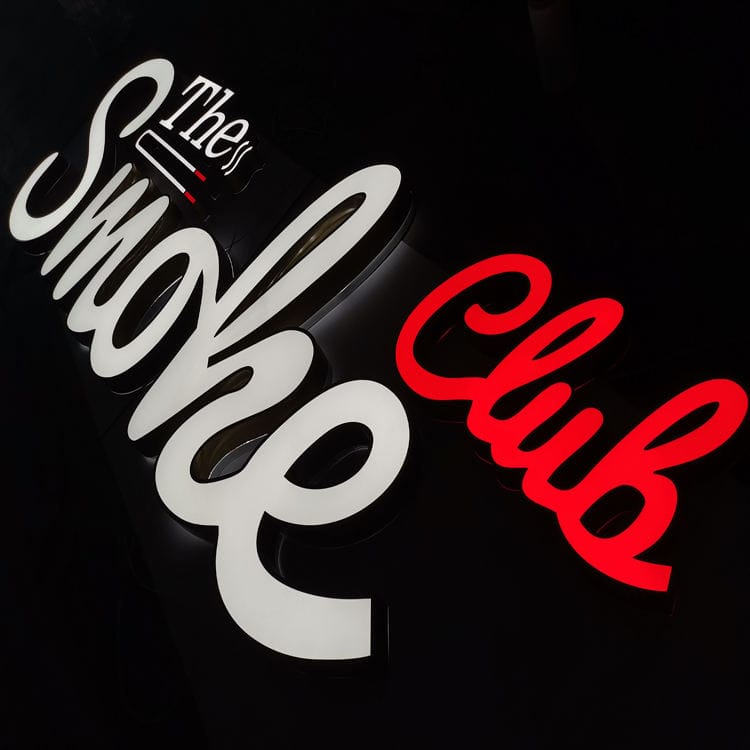
Real photo from our production floor — every sign we ship is made here.
Products mentioned or relevant to this topic — factory-direct, custom built.
From $24/letter · MOQ 1 piece · Flexible lead time · CE & UL certified · ships to 20+ countries
Custom sizes, colors, and finishes. Get a factory price in 24 hours.
Get a Free Quote Copy EmailWhatsApp +86 13865703472 · business@aochuangsign.cn
See pricing, specs, and get a free quote for the sign type you need. Built in our factory, shipped worldwide.