Published July 28, 2026 · Home > Blog > Custom Channel Letter Manufacturing: Design and Installation Tips – A Procurement Manager's Guide to ROI, Materials & Code Compliance
I've watched sign shops pay $800 for a single front‑lit channel letter from a domestic fabricator. Same 304 stainless, same Samsung LEDs, same 3mm Mitsubishi acrylic. We ship that exact letter from our Lu‘an factory for $120. That’s not a negotiation tactic—it’s a production volume difference. My boss once stared at that number spread for ten minutes before he believed it. Then he asked about tariffs. Then shipping. Then warranty. He’s smart. You have to answer every one of those questions before you buy.
Here’s the brutal truth: most buyers don't understand the total cost of ownership. They see the factory price and think "50% savings." But they forget Section 301 tariffs add ~30% to the landed cost. They forget LCL sea freight handles your crate six to eight times between our dock and yours. Every touch is a chance for damage. That's not in the brochure. When you plan for these realities, you save real money without the headaches.
When I crunched the numbers for a 30‑letter storefront sign, the cost break between domestic acrylic and Mitsubishi UV‑resistant acrylic was $340 total. The cheap stuff yellows in 18 months outdoors. The Mitsubishi lasts five to eight years. Your labor to replace a single yellowed face? $150‑300 per hour for a sign crew. Do the math: you pay for quality once or you pay for replacement forever.
For stainless steel, don't trust a blanket "stainless" label. 304 grade has 18% chromium and 8% nickel—good for ten years inland. 316 adds 2‑3% molybdenum and costs 20‑30% more. For a strip mall in Ohio, 304 is fine. For Miami Beach, pay for 316 or you're swapping letters in three years. I've seen coastal signs with 304 pitting after two hurricane seasons. That's not a material failure; it's a spec failure. The procurement manager who wrote that purchase order learned an expensive lesson.
Waterproofing is another place rookies blow the budget. IP65 means dust‑tight and protected from water jets from any direction. It does NOT mean your sign survives a Florida hurricane. If you’re near the coast or in heavy rain zones, spec IP66 at minimum. For extreme weather, go IP68. That adds maybe 8% to the LED module cost but saves a full sign replacement when a storm surge hits.
Line by line, here’s where the money goes: flat‑cut acrylic faces are laser‑cut from a single sheet, have sharp 90° edges, and cost roughly 15% less than formed faces. They’re also harder to clean because dirt collects in the sharp corners. Formed faces are bent over a mold, creating a smooth, rounded face that sheds water and dust. They look more premium—especially on halo‑lit letters—and they’re easier to maintain. But they take an extra day in production and the mold charge can be $50‑100 for custom shapes.
Which one should you choose? For interior signs or budget‑driven projects, flat‑cut is fine. For exterior channel letters with back‑lit halo effects, formed faces give a cleaner light spread. The difference in LED brightness matters: a flat face can create hot spots near the edges, while a formed face diffuses the SMD 2835 light evenly. One of my clients saved $400 by going flat‑cut, then spent $1,200 in callbacks for uneven illumination. The ROI works out to a net loss—but only if you skip the photometric test.
Here's another thing nobody tells you: the letter depth matters for LED performance. A 1.5‑inch deep letter with flat face will trap heat, cooking your LEDs in 18 months. Use 2‑inch minimum depth for flat faces, 1.5 inches for formed. I have 50,000 letters in the field and this kills more early LED failures than any other single variable.
Quickest way to spot bad LED modules: look at the solder joints. Dull gray = won't last 18 months. Shiny silver = proper lead‑free solder. That’s a 30‑second inspection that saves you from re‑stringing an entire sign. I've rejected whole shipments because the factory used cheap solder. They argued. I showed them the ASTM B32 spec. They re‑did it at their cost. You have to be that guy when QC slips.
NEC Article 600 is the US electrical code for signs. It requires that all channel letters be listed to UL 48 or an equivalent standard. UL listing costs $4,000‑15,000 per model and takes four to nine months, with quarterly factory audits. Most Chinese factories don't hold UL—they’ll offer ETL, which is 10‑30% cheaper and widely accepted in the US. But if your local inspector demands UL, you’re stuck.
I’ve seen a $20,000 sign installation held up because the power supply had a CE mark, not a UL mark. CE is 20,000‑50,000 RMB to obtain, and most factories will say they have it. Ask to see the certificate with today‘s date. Watch them sweat.
Here's what your boss will ask: “Why do we need IP66 for an indoor sign?” You don't. But if that sign is in a mall entrance where a janitor sprays a hose every night, IP65 will leak. I've replaced a $3,000 lobby sign because the buyer saved $12 on an IP65 driver. The water entry corroded the solder joints in eight months. That’s a rookie mistake you can't afford.
Mounting channel letters isn't just about studs and level lines. First rule: never mount directly to brick or concrete without standoffs. Condensation forms behind the letters and rots the aluminum returns. Use 1‑inch standoffs with silicone gaskets. Second rule: wire gauge matters. 18‑gauge stranded for runs under 20 feet. 16‑gauge for longer. I've seen a sign that dimmed after two years because the installer used 22‑gauge solid wire. The voltage drop was 8% from the transformer to the farthest letter. That’s a call‑back you don't need.
ADA compliance is non‑negotiable for U.S. public spaces. Tactile letters must be mounted 48‑60 inches above the floor, with non‑glare finish and Grade 2 Braille. Many buyers skip the Braille audit. I had a client fined $14,000 because the Braille dots were too shallow (.030 inch vs. the required .032 inch). Your fabricator must verify tactile depth with a micrometer—not “eyeball it.”
For installation crews: always order a spare transformer and an extra five feet of LED strip. The cost of that spare is $80. The cost of a service call on a Saturday? $400. I keep two spares in my truck—a 12V and a 24V—and they’ve paid themselves back ten times over. The ROI works out to saving about $320 per year per truck.
When I crunched the numbers on a 50‑letter order for a national retailer, ocean freight accounted for 11% of the landed cost. Express shipping would have added 40% to the total, but saved two weeks. For a grand opening with a fixed date, air freight is a necessary evil. Plan for it. The 25% Section 301 tariff on Chinese‑made signs hit us hard. You can absorb it or pass it on. But don't pretend it doesn't exist—your vendor's price list won't show it, and your CFO will notice when the customs bill arrives.
Here's a trick: order in FCL (full container load) if your volume justifies it. A 20‑foot container costs $1,200‑3,000 and takes 50‑70 days. LCL costs less per cubic meter but your crate gets handled six to eight times. Every transfer is a dent risk. For a high‑value sign with fragile acrylic, always use plywood crates with foam inserts. Don't let the vendor ship in cardboard‑lined cartons. I've opened sea‑freight boxes that looked like a pillow fight inside. That's not the carrier’s fault—it’s poor packaging. You write the spec; you enforce it.
A: You can. But the last time I saw a “LED channel letter kit” on Amazon, the power supply was unlisted and the LEDs were unbranded. After six months, the blue chips faded to green. The seller was gone. You get zero warranty. Factory‑direct with a 2‑year warranty on LEDs costs 20% more upfront but saves you a full replacement after 12 months. You decide. I’ve made that mistake once.
A: Ask for the LM‑80 test report for the specific LED model. Any legitimate manufacturer will send it by email within 24 hours. If they stall, they're lying. I've seen factories swap Samsung chips for generic after QC approval. Demand a photo of the reel labels with lot numbers before shipment. That stops the swap cold.
A: Factory‑direct front‑lit letters run $20‑80 per letter. Your shop adds markup for design, permits, and installation. That $700 might be reasonable if it includes everything—including UL listing and a warranty service. But if they're just buying from a domestic fabricator and adding 40%, you can cut them out. Ask for an itemized breakdown. If they won't give it, they're hiding something.
A: Bolting letters directly into stucco without sealant. The water wicked behind the letters, rusted the returns from inside out. The sign looked perfect from the front. Rotting from behind. A $6,000 sign destroyed in 14 months. All because somebody skipped a bead of neutral silicone. That’s the kind of mistake that gets a procurement manager called into the boardroom. Don't be that person. Write it into your spec, show up for the inspection, and make them prove it.

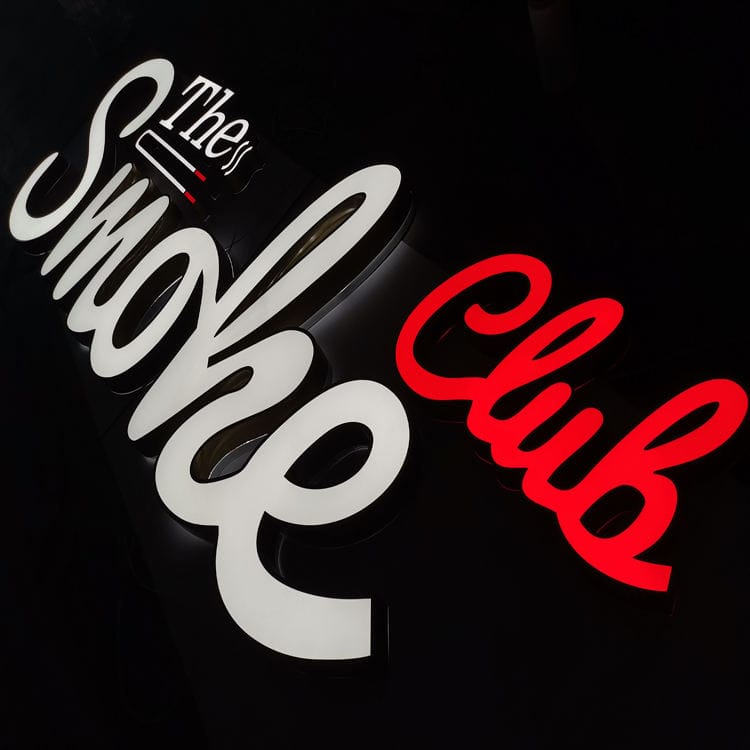
Real photo from our production floor — every sign we ship is made here.
Products mentioned or relevant to this topic — factory-direct, custom built.
From $24/letter · MOQ 1 piece · Flexible lead time · Project-specific compliance documents · ships to 20+ countries
Custom sizes, colors, and finishes. Get a factory price in 24 hours.
Get a Free Quote Copy EmailWhatsApp +86 13865703472 · business@aochuangsign.cn
See pricing, specs, and get a free quote for the sign type you need. Built in our factory, shipped worldwide.