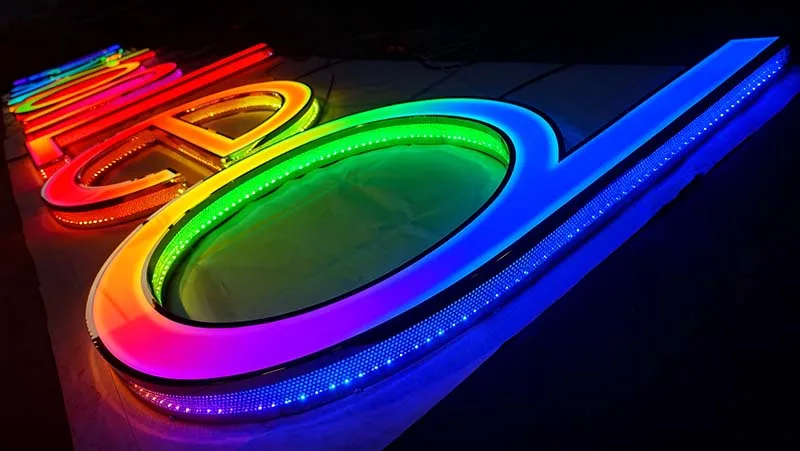
Here's what nobody tells you: the sign shop that quoted you $4,500 for that front-lit
channel letter job is paying about $900 for the actual letters. They're not crooks. They're running a business with overhead, insurance, a truck, and a guy named Carlos who's been with them twelve years and deserves his paycheck.
But you're not a walk-in customer. You're a sign shop owner, contractor, or importer who's ready to order in volume. So let's talk about what this stuff really costs.
---
**The Price Gap Is Real, and It's Bigger Than You Think**
Front-lit channel letters run $20-80 per letter from factories in China. Same specs, same LEDs, same 304 stainless backs — the typical US retail installed price is $200-700 per letter. That's a 10x markup before you even get to installation.
Back-lit halo letters? Factory price $35-120 per letter. US retail installed? $400-1,000 per letter. Do the math.
Look, I've watched sign shops pay $800 for a front-lit letter that we ship for $120. The markup isn't evil. It's how they keep the lights on. But if you're buying at retail, you're paying for their showroom, their sales guy's commission, and that fancy design software subscription nobody actually knows how to use.
---
**What Factory Pricing Actually Looks Like**
Here's a realistic wholesale price sheet from our floor at Aochuang Sign. These are real numbers, in US dollars, per letter:
- Front-lit channel letters: $20-80
- Back-lit halo letters: $35-120
- Stainless steel non-lit: $15-40
- 3D fabricated letters: $40-120
- Aluminum letters: $10-25
- Acrylic light boxes: $80-250 per square meter
- Neon flex signs: $30-200 per sign
The range depends on size, material, LED brand, and how many hoops you want us to jump through. A small 6-inch stainless letter with cheap LEDs runs maybe $15. A 3-foot illuminated logo with Samsung modules, halo-lit, brushed 316 stainless, that's a $300+ piece before packaging.
---
**The 10-Step Process That Justifies (or Doesn't) Every Dollar**
Every sign goes through this at our facility. This is what you're paying for:
1. Design confirmation — 1 day. We argue with your artwork file.
2. Laser cutting — ±0.1mm precision, 1-2 days.
3. Bending and TIG welding — 1-2 days. This is where cheap shops cut corners.
4. Grinding and polishing — 1-2 days. The difference between "sharp" and "sharp, then smooth."
5. Acrylic face CNC routing — 1 day.
6. LED module assembly — 1-2 days.
7. Sealing with neutral silicone — 1 day. Not acid cure. Neutral.
8. Aging test — 8-12 hours with all LEDs burning.
9. 100% QC inspection — every single unit, not a sampling.
10. Export packaging — foam, carton, plywood crate. Because boats are violent.
Total: about 5-15 days. That's the honest lead time. If someone promises 48-hour turnaround on custom channel letters, they're either lying or shipping you garbage.
---
**The Ugly Truth About LED Quality**
This is where I make enemies.
Cheap LED modules cost a fraction of quality ones. They'll quote you "50,000 hour L70 lifespan" and deliver chips that die in 14 months. I've seen it. That's the industry's dirty little secret. Those cheap Chinese modules you bought on AliExpress? They're probably using lower-binned chips that can't handle heat.
Quality modules — Samsung, Osram, or our domestic brand Blueview (which is actually excellent) — genuinely last 5+ years in outdoor conditions. L70 rated 50,000 hours means the output drops to 70% after that time. That's the standard.
SMD 2835 modules run 100-150 lumens per watt. That's the industry workhorse. SMD 5730 gives you 40-60 lumens per chip at higher brightness — use that for taller signs where visibility matters more.
Color temperature matters too. 3000-3500K for hospitality and restaurants. 4000-5000K for corporate and retail. 6000-6500K for industrial and highway signs. Get this wrong and your client's brand colors look like garbage.
---
**Materials: Where You Can Save and Where You Absolutely Shouldn't**
Stainless steel letters are the bread and butter of outdoor signage. 304 stainless with 18% chromium and 8% nickel gives you 10+ year outdoor life. That's fine for most applications. Use 1.0-1.2mm for indoor and standard outdoor. Go 1.5mm or thicker if the letters are over 2.5 meters or in high-wind zones.
Here's what nobody tells you: 316 stainless costs 20-30% more than 304. It contains 2-3% molybdenum and resists chloride corrosion. For a strip mall in Ohio, 304 is fine. For Miami Beach, paid for by the ocean — use 316 or you'll be doing warranty calls in year three.
Acrylic is another trap. Mitsubishi or Degussa UV-resistant acrylic lasts 5-8 years in sun. Domestic acrylic? 1-2 years before it yellows like a smoker's teeth. The price difference is maybe 30%. Worth it. Common thicknesses are 2mm, 3mm, and 5mm. Over 2.5 meters, always spec 5mm or the face will sag.
Aluminum is my recommendation for budget-conscious buyers. Weighs one-third of steel, naturally rust-proof, 8-12 year outdoor life. 1.0-1.6mm thickness. Powder coated or anodized — skip the brushed finish on exterior signs unless you like repainting every two years.
---
**The "I've Seen This Go Wrong" Section**
I've seen this go wrong: an importer ordered 200 steel channel letters with "304 stainless" in the spec but didn't require mill test certificates. The factory sent 201-grade steel — 50% less nickel, half the corrosion resistance. By the time the sign shop installed them on a beachfront property, they were rusting within eighteen months. The importer got sued, had to replace all 200 letters at his own cost, and ate $40,000 in losses.
Here's the fix: if the price seems too good, ask for material certificates. Real 304 stainless has a density of 7.93 g/cm³. Everything else this obvious gets fudged by factories who assume you don't check.
The second most common failure I see: people obsessing over IP ratings without understanding what they mean. IP65 means dust-tight and protected against water jets. That's your minimum for outdoor. IP66 handles powerful water jets — better for coastal areas or where pressure washing is common. IP68 means submersible, which is overkill for 99% of signs but worth knowing if your client has a pool.
IP65 sounds impressive. It means water jets from any direction. It does NOT mean your sign survives a Florida hurricane.
---
**Shipping and Tariffs: The Hidden Cost Nobody Quotes You**
Factory pricing is one thing. Getting it to your warehouse is another.
Express shipping (DHL, FedEx, UPS) runs $30-100 for small packages and arrives in about 5-15 days. Air freight is $4-12 per kilogram, about 10 days transit. Sea freight is where the real savings are for volume: $80-200 per cubic meter for LCL (less-than-container-load), or $1,200-3,000 for a full container.
The US Section 301 tariff on Chinese-made signs sits around 30%. I can't help you avoid that — anyone who claims they can is setting you up for a customs nightmare. Factor it into your landed cost calculation. Even with it, you're still saving 30-50% versus domestic manufacturing.
Know your entry terms. DDP (Delivered Duty Paid) means we handle everything, and you know your full cost upfront. FOB means you take ownership at the port and handle customs yourself. If you're new to importing, DDP sounds more expensive but often isn't once you factor in broker fees and your own time.
---
**Certifications: Don't Get Scammed**
CE marking costs factories 20,000-50,000 RMB and takes 2-8 weeks. That's for European market access. Most factories say they have it. Ask to see the certificate with today's date — some of these things expire or only cover a specific product line.
UL listing is the big one for the US market. It costs $4,000-15,000 and takes 4-9 months, plus quarterly audits. That's why so many Chinese factories don't have it. UL requires rigorous testing and ongoing compliance, not just a one-time check. ETL is the alternative — 10-30% cheaper than UL and widely accepted by US inspectors.
If you're selling to the US market, NEC Article 600 governs installation. And if you're doing ADA-compliant signs, tactile characters must mount at 48-60 inches, non-glare finish, Grade 2 Braille. Get this wrong and you'll get sued.
Here's the honest truth: we have CE and RoHS and ISO 9001. We don't hold UL because the certification cost and quarterly audits only make sense for our largest North American accounts. If your project needs UL, we're honest about that upfront rather than claiming it and risking your shipment getting rejected at customs. Find a factory that tells you exactly what they can and can't produce — that's the one that will actually help you grow.
---
**Warranty: What "Good" Actually Means**
We offer 2 years on LED modules and 1 year on power supplies. That's our standard. The factory-direct pricing means you're handling your own installation and service calls, so this warranty protects you from manufacturing defects, not from bad installs.
Budget for replacement parts in your order — order 5% spare modules and a couple of power supplies. Nothing's worse than waiting four weeks for a replacement part on an emergency service call. Ordering spares upfront costs you pennies compared to the freight charge for one module later.
---
**The Real Cost Breakdown for a Typical Job**
Let me walk through a real scenario. You're quoting a storefront with 12 front-lit channel letters, 18 inches tall, 304 stainless backs, acrylic faces, Samsung LED modules.
Factory price: about $840 total for the letters.
Shipping to your US city: roughly $280 sea freight on a pallet.
Tariff at 30%: $252.
Landed cost: about $1,370. That's $114 per letter.
Now go look at what you'd pay a US manufacturer for the same thing. You'll find $350-800 per letter. Even by the time the tariff and freight hit, you're at less than a third of domestic wholesale pricing. Your margin is there, and you're still delivering a competitively-priced sign solution.
---
**What We Can and Can't Do**
I believe in being honest about both.
We can do: 3D fabricating, metal letters, channel letters, light boxes, custom logos, powder coating, high-quality LED work with good modules, and reasonable timelines for committed buyers.
We can't do: UL-listed work (yet), same-day rush orders, or something for the price another factory quoted you cheaper. If someone says they've been making signs for 20 years and offers to beat any quote by half, they're not a 20-year factory — they're a trading company who's dabbling. These middlemen quote low, disappear during production, and show up at the end demanding cash.
**When you're ready to buy, you've got three smart options:**
1. **
Front-lit channel letters** if you want the classic storefront standard — white acrylic face, LED backlight, bright and readable.
2. **
Back-lit halo letters** if your clients want the premium architectural look — light spills out behind the letter, glowing outline effect. These cost more, but they photograph beautifully and look expensive.
3. **
Rimless channel letters** if you want clean modern aesthetics with no visible trim cap. The slickest profile for contemporary storefronts.
---
**How to Do This Without Getting Burned**
Order one letter first. Not twelve. Not a hundred. One.
Pay for manufacturing and shipping of a single sample. This will cost you maybe $100-150 in freight for air express. It's the cheapest insurance you'll ever buy. Put it on your wall, open the face, look at the welds, check the LED modules, run it for 72 hours straight. If the factory can't build one good letter, they can't build fifty.
Look for a factory that asks you questions. If they ask about your local climate, your mounting height, your power supply voltage (110V vs 220V), they're thinking like a partner, not an order-taker. If they accept your spec sheet without reading it, run.
Most importantly — know your actual landed cost before you commit. Our
acrylic light boxes might cost $80-250 per square meter at the factory, but the tariff and freight add reality to the numbers.
---
**The Decision Is Yours**
You've got the numbers. You know what this equipment costs to build, what it costs to ship, what it costs to certify. You know the markup between factory and retail.
The ugly truth is most sign businesses either import and save 50%, or they don't import and pay retail markup. There's very little middle ground left. The margin is the business.
We're not the cheapest factory. You can find someone to make it for less — I've seen the quotes. What I'm offering is a factory that won't swap materials, won't lie about LED brands, and will tell you when a better option exists for less. Whether you're building
stainless steel letters for a coastal property or
neon flex signs for trendy bars, ask for the sample. Test the quality yourself. Trust your measuring tape, not my sales pitch.
That's how build relationships that last decades. That's how you make money in signs in 2025.