You want to know why LED sign maintenance matters? Because I've watched a $12,000 storefront sign die 14 months after install. Nobody cleaned the intake vents.
I'm not a consultant. I run a factory floor in Lu'an, Anhui, China—3,000 square meters, 50-plus workers, welding stainless letters and assembling LED modules since 2010. I've seen what kills signs, and the LED chips rarely take the blame. Heat, water ingress, and owners who think “LED” means “never touch it.” Three failures for the price of one.
And that's why maintenance is a profit issue, not a janitorial issue.
Look, the math's simple. Quality LED modules—Samsung, Osram, Blueview—run L70 at 50,000 hours. That's 5.7 years of continuous burn. A cheap module from a no-name fab will fade or flicker in 12 to 18 months. If you're selling installed front-lit letters at $200 to $700 per letter, replacing a face after 18 months eats your entire margin.
Here's what nobody tells you: the power supply always dies first. Not the LEDs. Not the acrylic. The power supply. Ours carries a 1-year warranty; the LEDs carry 2 years. We know where the weak point sits.
We ship a front-lit channel letter for $20 to $80, factory direct. The same letter installed by a US shop runs $200 to $700. Even after Section 301 tariffs around 30 percent, you're saving 50 to 65 percent on product. But if that letter fails at month 15 because a driver IC cooked itself, your client doesn't remember the savings. They remember the dark storefront.
Maintenance directly extends that LED lifespan. A sign that runs 10 degrees Celsius cooler inside the cabinet can add two or three years to module life. Every 10°C rise cuts LED lifespan roughly in half. Heat kills.
The ugly truth: most sign failures stay invisible until they're not. You'll get a call at 9pm that half a letter is dead. By then, the module's been drowning in condensation for six months.
Top failure points, in order of how often I see them: power supply capacitors, solder joints on LED modules, ribbon cable connectors, driver ICs, and water infiltration around the acrylic face. If you're buying back-lit halo letters, the LED strip behind the return edge is a magnet for moisture because nobody seals the raceway properly.
Quickest way to spot bad LED modules: look at the solder joints. Dull gray means lead-free solder done wrong; those joints won't last 18 months. You want shiny silver joints with proper flux. I've rejected entire pallets of modules for dull joints. Cost us $4,000 in wasted material last year, but better us than a customer's building facade.
I've seen this go wrong: a client replaced every LED module on a 20-foot sign because the lower third was dim. Spent $2,300 on parts. A $12 ribbon cable with a hairline crack caused it. Test before you swap. With power on, flex the ribbon cable and watch for flicker. Check DC voltage at each module's input pads. If you've got 12 volts at the input but the module stays dark, the LED driver IC on that board is dead, not the LEDs.
Color and brightness drift—another silent killer. Factories bin LEDs by voltage and color temperature. Cheap suppliers don't. After a year, mismatched bins show up as pinkish whites or one letter burning cooler than its neighbor. If you see that, swapping a single module won't match. You'll need to recalibrate the whole section or replace the entire run with matched-bin stock.
Look, daily maintenance doesn't mean a technician walks the whole site. For most national accounts, a daily check is visual: look for dark modules, flicker, or photos from the store manager. A daily check takes 5 minutes and catches 70 percent of electrical issues before they become outages.
Monthly: clean the vents and check for water inside the cabinet. I don't care if the sign carries an IP65 rating. IP65 means it can take water jets from a nozzle. IP65 doesn't mean it survives a Florida hurricane or a window washer's pressure gun at 2,000 psi. Condensation still forms inside, especially in the Southeast.
Quarterly, open the cabinet, torque every terminal, take thermal readings with an infrared gun, and test the power supply output under load. If a power supply shows more than 10 percent voltage drop under load, replace it before it cooks the LEDs. Our power supplies carry a 1-year warranty; don't wait for the smoke.
Stick to that schedule and you'll catch most failures before a letter goes dark.
The biggest rookie mistake: hitting an acrylic face with Windex. Ammonia and alcohol cloud acrylic. Then you've got an $800 face that looks like frosted glass. Use warm water, a mild dish soap, and a microfiber cloth. No pressure washers. Ever.
If your sign uses UV-resistant acrylic from Mitsubishi or Degussa, it should hold up 5 to 8 years outdoors. Domestic acrylic yellows in 1 to 2 years. Cleaning won't fix yellowing; it's chemical degradation from UV. You can't polish that out. Replace the face.
When I ship acrylic LED letters, I include a cleaning card with these exact instructions. Most people throw it away. Then they call me three months later asking why the face is clouded.
For LED modules inside the cabinet, use a soft brush and a vacuum with a crevice tool. Don't blow compressed air at close range—static discharge can kill driver ICs. I've seen it happen.
If you see cracked silicone, scrape and reseal with neutral-cure silicone. Acid-cure silicone off-gasses acetic acid and corrodes LED leads. That's how a perfectly good sign turns into a flickering mess in six months.
Thermal management starts at build. If you're speccing a full-body glow letter or a backlit halo, you need a vent at the top and a drain hole at the bottom. No vent, no drain, and you've built an oven. In Phoenix, an unvented cabinet hits 70°C inside. At that temperature, SMD 2835 modules rated 100 to 150 lumens per watt degrade at triple the normal rate.
Here's what nobody tells you: an IR thermometer is the best $40 you'll spend. Shoot the power supply casing after the sign has been on for four hours. If it reads above 60°C, you're cooking the electrolytic capacitors. Spec a supply with 20 percent headroom over the LED load. A 100-watt LED load should sit on a 120-watt or 150-watt supply, minimum.
Electrical checks quarterly: measure input AC at the disconnect, output DC at the supply, and ripple with a multimeter. Acceptable ripple on a 12V LED supply is under 200mV. Higher ripple flickers and shortens module life. Tighten every terminal to manufacturer torque. Loose neutral connections—the number one cause of intermittent failures I see in outdoor signs.
If one module fails, replace it. If you're losing more than 15 percent of modules in a single sign run, upgrade the entire section. Mismatched brightness from different bins looks worse than an outage. Customers won't say "one module is out." They'll say "your sign looks cheap."
Look, module replacement is a 20-minute job. Kill power, unplug ribbon cable, unscrew two screws, swap module, reconnect, waterproof connector. Full sign upgrade is different: if the sign is 8 years old and you're replacing faces anyway, it's time to upgrade to higher-efficiency SMD 2835 modules. New modules run 100 to 150 lumens per watt, compared to old 60 to 80 lumens per watt. You'll use fewer modules and cut power draw by 30 percent.
I've got clients running stainless steel letters from 2014 that still pass a visual inspection. 304 stainless holds up 10-plus years outdoors. The powder-coated aluminum returns from the same era? Pitting and flaking after 8 years in salt air. Know what to replace and what to keep.
Don't upgrade a sign because one module is dark. Don't patch a sign that's already 80 percent replacements, either.
Factory-direct maintenance isn't a subscription. Buy spare modules, power supplies, and acrylic faces at the same $20 to $80 per letter price instead of paying $200 to $700 per letter for emergency replacements. We have a 3,000 square meter facility in Lu'an with laser cutters holding ±0.1mm tolerance. We can cut a replacement face or bend a new return edge in 1 to 2 days.
Lead time is 7 to 15 days, express shipping to the US is another 7 to 15 days. Sea freight LCL adds 50 to 70 days but costs $80 to $200 per cubic meter. If you stock one spare module set per sign plus a spare power supply, you'll never be down for a month.
The ugly truth: most factories claim CE and RoHS, but they've never paid the 20,000 to 50,000 RMB for a real CE mark. I tell customers to ask for a certificate with today's date. If the factory can't produce it, walk. For US installs, UL 48 certification costs $4,000 to $15,000 and takes 4 to 9 months. ETL is a legitimate alternative and runs 10 to 30 percent cheaper. We carry CE, RoHS, and ISO 9001, but I'll still show you the certs before you wire a deposit.
Minimum order: one piece. You don't have to buy 20 spare modules when you need four. We ship individual spare LED modules, power supplies, and acrylic faces with the same warranty: 2 years on LEDs, 1 year on power supplies.
Q: Do I really need to clean LED signs monthly? Yes. Dust blocks vents, heat kills drivers, and your client blames you. If you're in a coastal area, make it bi-weekly. Salt film is a conductor.
Q: Can I use a regular electrician to service LED signs? You can, but they'll swap a power supply without checking polarity and fry $400 of modules. I've watched it happen twice last year. Hire someone who's touched LED modules before.
Q: How long should an LED sign actually last? Quality modules, 5-plus years. Power supplies, 5 years if oversized and cool. Cheap modules, 12 to 18 months. If yours died in two years, you bought garbage. Don't blame maintenance.

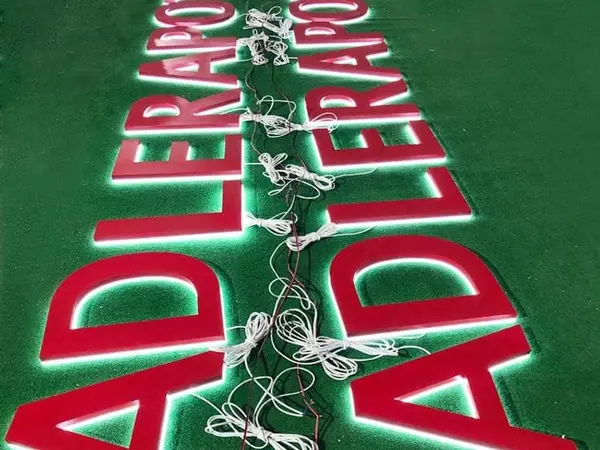
Real photo from our production floor — every sign we ship is made here.
Products mentioned or relevant to this topic — factory-direct, custom built.
From $24/letter · MOQ 1 piece · Flexible lead time · CE & UL certified · ships to 20+ countries
Custom sizes, colors, and finishes. Get a factory price in 24 hours.
Get a Free Quote Copy EmailWhatsApp +86 13865703472 · business@aochuangsign.cn