Look, I've seen it happen more times than I can count. A shop orders a 20-foot channel letter sign, gets it installed, and the last three letters look like they're running on AA batteries. Customer calls, screaming. Shop owner blames the factory. The factory blames the installer. Nobody wants to admit the real problem: nobody did the voltage drop math.
That's not a wiring problem. That's a math problem.
And it's the cheapest thing to fix before you order. I've been building signs at Aochuang Sign in Lu'an, Anhui since 2010, and I've watched this same story repeat on three continents. You can skip it.
Voltage drop is just the wire eating your power before it reaches the LEDs. Every foot of wire has resistance. The longer the wire and the higher the current, the more voltage disappears along the way. Your power supply puts out 12V. By the time it gets to the last module 50 feet away, you might have 9V. LEDs don't like 9V.
They get dim. They flicker. They die early.
Here's what nobody tells you: LED modules are designed to run at a specific voltage range. Push them too low and they barely glow. Push them too high and you cook them. There's no magic. It's just Ohm's Law, and it's been around since the 1800s.
For our channel letters, we use SMD 2835 modules as the standard. They pull around 0.25 to 0.35 amps each at 12V, depending on brightness. That current adds up fast when you have 20 letters in a run. The wire cares. Trust me.
You don't need calculus. You need a calculator and the guts to look at the numbers. Here's the basic formula: Voltage Drop = Current (amps) × Wire Resistance (ohms). Get the wire resistance from a chart. But for a quick rule of thumb: on a 12V system, anything over 15 feet of 18 AWG wire is asking for trouble.
Let's do a real example. Say you've got a run of 10 channel letters, each drawing 0.3 amps at 12V. Total current is 3 amps. You're using 18 gauge wire, which is about 0.0064 ohms per foot. Run length is 40 feet total (20 feet out, 20 feet back). Voltage drop = 3 amps × 0.0064 ohms/ft × 40 ft = 0.768 volts.
0.768 volts on a 12V system is 6.4% drop. That's borderline. Most LED modules get cranky below 10.5V. If you have 100 feet, you'd see 1.92V drop, 16% drop. Your last letter is running at 10V. Dim city.
So what's the fix? Thicker wire or higher voltage. That's it.
I've done this calculation on a napkin for a customer while his sign was half-installed. He saved himself a $2,000 rewire by adding 14 AWG instead of 18 AWG. The wire cost an extra $80. Math pays better than therapy.
I've seen this go wrong: a shop owner used 20-gauge speaker wire to power a 12-foot sign. It worked for a week. Then the connection points started melting. The LEDs weren't the problem; the wire was choking on current. Look, wire is cheap compared to a service call.
Here's a simple table for 12V systems, max current before you exceed 3% voltage drop (which is my personal limit for LEDs):
For 24V systems, double the distances. Same wire, same current, half the drop. That's why I always tell buyers: if your sign is longer than 12 feet, order it in 24V. It costs the same from our factory, but it saves you 50% on copper.
And don't even think about aluminum wire. Yes, it's cheaper. No, it doesn't belong in a sign. It corrodes, it creeps, and it fails. I've had installers try to save $10 on a run and cost the building owner a $3,000 fire repair. Stainless steel letters are durable, but your wire needs to be copper. No exceptions.
Look, 12V is fine for small signs. Three letters, five feet of wire, a little power supply. Done. But the moment you get past 10 feet of wire or 2 amps of current, 24V starts looking smarter.
Here's the physics no one argues with: if you double the voltage, you cut the current in half for the same power. And voltage drop depends on current. So halve the current, halve the drop. But it's even better: power loss in the wire goes down by 75%. That's less heat, less wasted energy, and a longer life for your power supply.
The ugly truth is, most sign shops order 12V because that's what they've always used. It's not wrong, but it's lazy. And when a 30-foot sign starts dimming at the far end, they blame the LED modules. Don't be that guy.
From our factory floor in Lu'an, we ship both 12V and 24V configurations. The price difference is a few dollars per letter. I've had customers in Dubai order 12V for a 40-foot rooftop sign because they didn't want to change their stock. Three months later they were on a plane back. I'm not flying to Dubai to tell you what I said on page one.
Every factory says their LEDs last 50,000 hours. Here's what nobody tells you: that L70 rating means the LEDs will still produce 70% of their brightness at 50,000 hours under perfect lab conditions. It doesn't mean your sign won't fail in 3 years. Cheap modules die in 12-18 months. I've pulled apart signs where half the modules were black and the other half were pulsing.
We use quality modules from Samsung, Osram, and Lan Jing. They cost more. They last 5+ years in real outdoor conditions. And we don't pretend otherwise. If you want the cheapest sign on Alibaba, that's fine. Just don't call me when it dies.
When we build our front-lit channel letters, we calculate the load per run before we solder a single connection. That's the difference between a sign that lasts and a sign that becomes a lawsuit.
And here's a second brutal honesty for you: CE and RoHS marks don't mean the LEDs are good. Any factory can get those in 2-8 weeks for 20,000-50,000 RMB. I've seen shops with zero quality control waving CE certificates. Ask to see the certificate with today's date and the actual test report. If they can't produce it, walk.
Here's what we do, and here's where we can't save you. Inside every letter we build, we use a wiring harness sized for the actual current. We don't use 22-gauge jumpers because they're cheap. We don't daisy-chain 20 modules on one run. We split circuits and balance loads so each leg sees the same voltage.
Our production process is 10 steps, from laser cutting with ±0.1mm tolerance to final export packaging. We run every sign through an
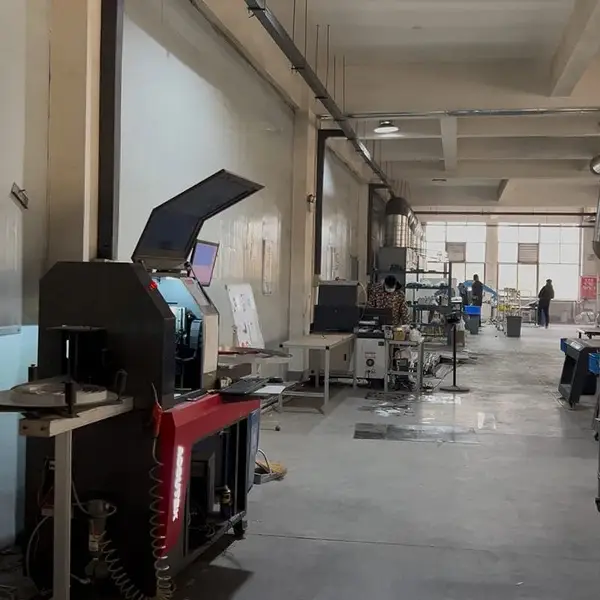
Real photo from our production floor — every sign we ship is made here.
Products mentioned or relevant to this topic — factory-direct, custom built.
From $24/letter · MOQ 1 piece · Flexible lead time · CE & UL certified · ships to 20+ countries
Custom sizes, colors, and finishes. Get a factory price in 24 hours.
Get a Free Quote Copy EmailWhatsApp +86 13865703472 · business@aochuangsign.cn
See pricing, specs, and get a free quote for the sign type you need. Built in our factory, shipped worldwide.