I've seen this go wrong: a contractor runs 12-volt modules down a 15-foot channel letter, uses 18-gauge wire, and wonders why the last letter flickers at 9 volts. The LEDs are rated for 12V. They're getting 8.5. That's not a faulty product. That's a voltage drop problem.
Here's what nobody tells you: the math isn't hard — it's just rarely done before installation. And by the time you realize it, you're on a ladder with a multimeter and a customer who's not paying for your overtime.
The ugly truth is that most sign shops and importers skip this calculation entirely. They wire it like a Christmas tree and hope for the best. Then they blame the factory when the last letter is dim. I've been on both sides of that argument for 16 years. Let's kill the guesswork.
Channel letters are long and narrow. The LEDs sit along the letter's stroke, often fed from one end. If you're running a 1-meter "M" or a 10-meter "W", the last module can be 20 feet from the power supply.
Every foot of wire has resistance. Every module draws current. The combination makes the voltage at the far end lower than at the power supply. LEDs are current-driven — lower voltage means lower light output, and in some cases, flicker or premature failure.
The difference between 12V and 9V at the last module is dramatic. You'll see it as a gradient — bright start, dull finish. On a front-lit channel letter, that looks bad. On a back-lit halo letter, where the light bounces off a wall, it looks twice as bad.
Here's the calculation every sign shop should run before wiring:
Vdrop = 2 × length × current × wire resistance per foot
That "2" is for the positive and negative wires. You're dropping voltage on both.
Let's make it concrete. You have a 12V system drawing 2 amps. The wire run is 30 feet from supply to the farthest LED. You're using 18 AWG wire, which has a resistance of about 0.0209 ohms per foot.
Vdrop = 2 × 30 × 2 × 0.0209 = 2.5 volts.
Your last module gets 9.5V. Below its rated voltage. At 80% brightness, if it lights at all.
Most channel letter jobs use 18 AWG or 20 AWG for module connections. That's fine for short runs. It's deadly for long ones.
Those numbers assume you're okay with a 5% drop. I'm not. I want the LEDs running close to full voltage.
If your run is longer, don't just step up the wire. Step up the system voltage. 24V LEDs are the fix for large channel letters. At 24V, the same load draws half the current, which quarters the voltage drop. That's not a marketing trick. That's Ohm's law.
At Aochuang Sign in Lu'an, Anhui, we've built thousands of channel letters for export. We use quality SMD 2835 modules — Samsung or OSAAM emitters when the customer specifies — rated L70 for 50,000 hours. But a good LED module won't save you from bad wiring.
That's why every one of our signs goes through an 8-12 hour aging test before packing. We run the LEDs, check the current, and measure the voltage at the last module. If the drop is over 5%, we fix the wiring — not the customer's problem, because this is a factory problem. We control the internal harness.
For large runs, we often recommend dual-lit channel letters because they can be wired with two separate circuits — one for front, one for halo — which halves the load per wire. That helps as much as a bigger wire.
I've seen imported signs wired in series, letter to letter, with one power supply at the start. That's not wiring — that's a chain of failure. The first letter gets the full supply, the second gets less, the third gets less still, and the sixth letter just gives up.
The correct way is parallel wiring — each letter or each section gets its own pair of wires back to a central distribution point. Even then, you need to account for the home run length.
A lot of customers ask why a cheap sign from another factory is cheaper. It's the LED modules, but it's also the wiring. A cheap harness uses 20 AWG and pre-wired with no thought to voltage. Then they blame you when it dims.
I can promise you that our stainless steel letters use the same LEDs and wiring practice as our aluminum ones. I can promise that we will give you a wiring diagram with every order over 1 meter — and that's a real wiring diagram, not a crayon sketch.
Here's what I can't promise: that your sign will look perfect if you hire someone who ignores wire gauge and runs 60 feet of 18 AWG from the power supply. That's not our responsibility — and no honest factory would take that responsibility.
When you order from us, we ask for the distance between the power supply and the farthest letter. That's not a sales trick. That's a question that tells us whether you need 12V or 24V, and what wire to spec. If a factory doesn't ask that question, they're not engineering your sign — they're just boxing up product.
We build rimless channel letters that are naturally easier to wire — no metal ribs to short the harness, and more room for a proper heat-shrunk splice. On those, we often wire the whole letter from one entry point, but we still verify the far end voltage on every single one.
For a 3-meter channel letter, typical load is 1.5 to 3 amps depending on LED density. If you feed it from one end with 14 AWG and 24V, you can get away with 15 feet of home run. At 12V, you're already in trouble. That's the difference between a sign that lasts 5 years and one that's a service call at 6 months.
Our acrylic light boxes are shorter runs — generally 1-2 meters — so voltage drop is rarely an issue there. But we still use 18 AWG minimum for the module harness and run the power connections at 24V by default.
Nobody talks about this, but the quality of the LED module determines how much voltage drop you can tolerate. A quality SMD 2835 module will still be reasonably bright at 10.5V. A cheap module — the kind that comes in bargain sign kits — will drop off drastically below 11V. I've tested modules that cut to 50% brightness at 9.5V. That's not a voltage drop problem; that's a junk component problem.
That's why we use Samsung and OSAAM. They cost more, but they hold their light output better under voltage fluctuation. If you buy a cheap import sign, you're fighting the LEDs and the voltage at the same time.
When you're ready to order, don't just send a photo and a height. Tell us:
We'll calculate the voltage drop at our side and tell you if the design needs 24V or a second power supply. That's free. That's what a 16-year shop should do for a customer who's ready to spend money.
But if you insist on wiring it yourself with whatever's in the truck — well, at least call us first and we'll tell you the wire size you need. It'll save you a second trip up the ladder.
Voltage drop isn't hard to calculate. It's just rarely done until it's too late.
The signs coming out of our factory are built to run — and we prove it with an aging test that checks the full voltage path. We can't control what happens after the sign leaves our dock. But if you give us the numbers, we'll give you a sign that doesn't dim at the far end.
That's not a promise. That's a calculation.

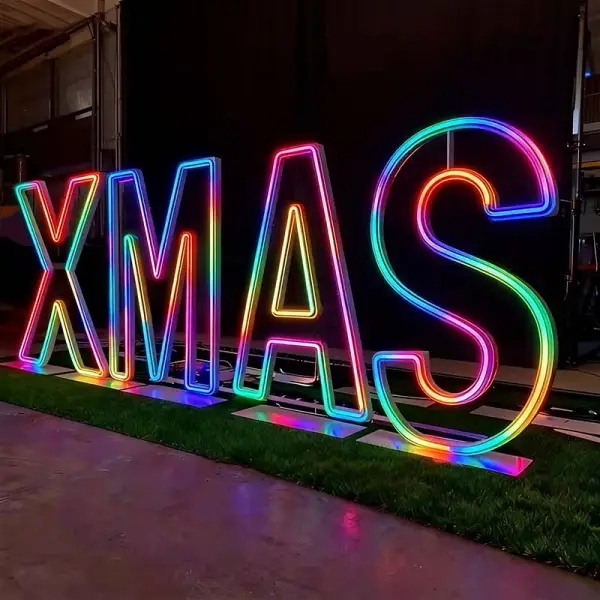
Real photo from our production floor — every sign we ship is made here.
Products mentioned or relevant to this topic — factory-direct, custom built.
From $24/letter · MOQ 1 piece · Flexible lead time · CE & UL certified · ships to 20+ countries
Custom sizes, colors, and finishes. Get a factory price in 24 hours.
Get a Free Quote Copy EmailWhatsApp +86 13865703472 · business@aochuangsign.cn
See pricing, specs, and get a free quote for the sign type you need. Built in our factory, shipped worldwide.