It's 11pm. My hands still smell like aluminum oxide and cutting fluid. A customer just sent me a link to a $3,200 monument sign and asked why his local quote is $18,000.
I've been on the floor at Aochuang Sign in Lu'an since 2010. We run 3,000 square meters, keep 50 people busy, and ship to every time zone. MOQ of one piece. Lead time about 5-15 days. None of that makes a monument sign cheap, and anyone who says otherwise hasn't crated one.
Here's what nobody tells you: that $3,200 price is a bare aluminum cabinet with no engineering, no foundation, no freight, no permit, no install, and probably no LED worth a damn. Those costs don't vanish because you saw a pretty render on Instagram.
A monument sign is a low-profile, ground-mounted structure that identifies a business, development, or institution. Unlike a pylon sign on a pole, it sits close to the ground, often on a masonry or concrete base, and puts your name or brand at eye level.
Why does it matter? Because it's the first physical thing a customer sees before they pull into your parking lot. It tells them this place is permanent, not a pop-up.
I've seen a cheap monument sign kill a brand's credibility before the front door opens. The sign leans, the acrylic face has yellowed, or the LED flickers because somebody spec'd junk modules. That's not a first impression; that's a liability.
For a standard 4 ft x 6 ft non-illuminated aluminum monument with an acrylic panel face, factory-direct product cost usually runs $1,500 to $3,000. For a 6 ft x 10 ft illuminated monument with routed acrylic and a stone or brick base, product cost lands $4,000 to $9,000 before it leaves our dock.
Once you're installed, engineering stamped drawings add $500 to $3,000 depending on wind and seismic zone. Permits run $200 to $1,500. Site prep and foundation work usually costs $800 to $3,500. Freight and crating for signs over 8 ft wide can tack on another 10% to 20%. Installation labor adds $1,500 to $5,000.
So that illuminated monument you saw online for $3,200? Installed, it lands between $9,000 and $22,000. And that's if nothing goes sideways.
No shortcuts.
Look, I'm not a general contractor and I don't pour footings. But I've watched enough jobs get priced to know where the money goes. And if you're importing from our facility, add the US Section 301 tariff of roughly 30% on the product cost. That's on top of everything else.
Size drives material and freight first. An 8-ft-wide crate gets handled 6 to 8 times in LCL sea freight between our dock and yours. Every touch is a chance for damage. That's not in the brochure, but it's real.
Most online pricing guides never mention freight or engineering. They're written by people who've never crated an oversized sign. Freight for a monument sign isn't a FedEx envelope. LCL sea freight runs $80 to $200 per cubic meter and takes about 65 days. Air freight is faster but $4 to $12 per kilogram, which gets stupid for a 400 lb cabinet.
Illumination changes everything. A non-illuminated monument sign is just a cabinet and face. An illuminated one adds LED modules, drivers, wiring, and UL/ETL requirements. More on that later, but don't kid yourself: light doubles the complexity and the price.
Your location matters too. If you're in a coastal area, you need marine-grade materials or you'll be replacing the sign in three years. 304 stainless steel gives you 10+ years outdoors. 316 stainless costs 20-30% more because it contains 2-3% molybdenum and lasts 15+ years in marine or industrial environments. For a strip mall in Ohio, 304 is fine. For Miami Beach, pay for 316 or you'll watch it pit.
Aluminum is the workhorse. It weighs one-third of steel, lasts 8-12 years outdoors, and is naturally rust-proof. Typical thickness runs 0.040 to 0.063 inches. You can anodize it, powder coat it, or brush it. Most monument sign cabinets start here because it's lighter and cheaper than steel.
Some clients want a cast aluminum or bronze base for a heavier, more permanent feel. That's a different animal. Cast metal gives you real heft, but it costs more and tells customers you spent money on purpose.
For the face, don't overcomplicate the acrylic. A 3mm acrylic face cuts 92% of light output. A 2mm face cuts 90%. Your customer won't notice that 2% difference, but they will notice the 40% cost bump if you spec thicker material for no reason.
Here's what nobody tells you: UV-resistant acrylic matters more than thickness. Domestic acrylic can start yellowing in 1-2 years. Mitsubishi or Degussa UV-resistant sheet lasts 5-8 years before yellowing. If you're building a sign that's supposed to last, import the good face material.
If you're putting halo-lit letters on top of a monument, don't let someone sell you cheap LED modules. Quickest way to spot bad modules: look at the solder joints. Dull gray means the joints will fail in 12-18 months. Shiny silver means proper lead-free solder. Quality modules from Samsung, Osram, or Blueview last 5+ years. Cheap ones die fast and take your reputation with them.
Engineering stamped drawings act as the first gatekeeper. Depending on wind zone and seismic activity, expect to pay $500 to $3,000 or more. Some municipalities won't even review your permit without them. Don't skip this step to save money. Wind and seismic loads can turn a monument sign into a projectile.
I've seen this go wrong: a shop ordered the sign first, then found out the city required stamped drawings and a footing designed for 115 mph winds. The sign sat in a warehouse for three months while they paid storage. Permits also vary wildly — $200 in one town, $1,500 in another.
If your monument sign is illuminated, you need to deal with electrical compliance. NEC Article 600 governs electric signs in the US. UL 48 certification costs $4,000 to $15,000 and takes 4 to 9 months with quarterly audits. ETL is a cheaper alternative, 10-30% less. CE marking runs 20,000 to 50,000 RMB and takes 2-8 weeks. Most factories will say they have CE. Ask to see the certificate with today's date. Watch them sweat.
IP65 sounds impressive. It means the sign is dust-tight and can handle water jets from any direction. It does NOT mean your sign survives a Florida hurricane. For coastal areas, IP66 or higher may be required. Don't confuse a lab rating with real-world storm survivability.
First, know your site. Get the address, the local wind zone, and the municipality's sign code before you message a fabricator. If you don't know whether you need 304 or 316 stainless, or whether the sign is illuminated, you're not ready for a real quote.
Look, I've watched sign shops pay $800 for a front-lit letter from a domestic fabricator. Same 304 stainless, same Samsung LEDs. We ship that letter for $120. Factory-direct savings on product routinely run 50-65% compared to US retail installed prices. Front-lit letters run $20-80 per letter factory-direct, while installed retail runs $200-700. Halo-lit letters run $35-120 per letter factory-direct, while installed retail runs $400-1,000.
That doesn't mean you skip the local contractor. You need them for engineering, foundation, permitting, and installation. But you can save real money by sourcing the fabricated sign from us and paying for those services separately.
We run a 10-step production process: laser cutting at ±0.1mm, TIG welding, grinding, polishing, CNC routing, LED assembly, neutral silicone sealing, an 8-12 hour aging test, 100% QC inspection, and export packaging. That's why our lead time is about 5-15 days and why our warranties run 2 years on LED and 1 year on power supplies.
Before you ask, here are the answers I'm tired of repeating.
Q: Can I get a monument sign for under $2,000?
No. Not installed. Maybe a bare non-illuminated cabinet from some factory if you're lucky, but after freight, engineering, foundation, permit, and install, you're not close to $2,000.
Q: Why is freight so high on an 8-ft sign?
Because crates are big, heavy, and handled 6 to 8 times in LCL sea freight. Oversized-load trucking on the receiving end adds another 10-20%. That's reality.
Q: Do I really need stamped drawings?
Yes. Wind and seismic loads can turn that sign into a liability. Building departments ask for them. Paying $500 to $3,000 for engineering is cheaper than a lawsuit, and I can't believe I still have to explain this.
Q: Why does 316 stainless cost more than 304?
Because it contains 2-3% molybdenum for marine-grade corrosion resistance. It lasts 15+ years vs 10+ for 304, and costs 20-30% more. Inland Ohio? 304 is fine. Miami Beach? Pay for 316.

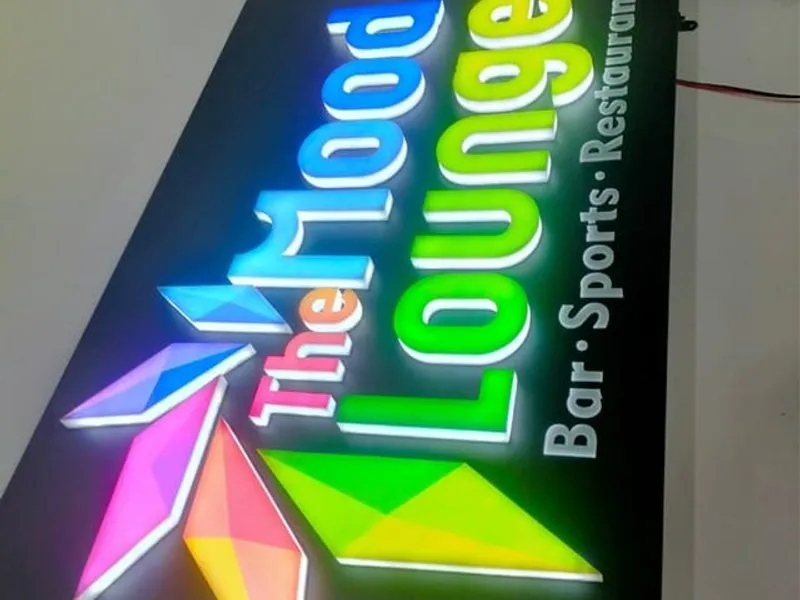
Real photo from our production floor — every sign we ship is made here.
Products mentioned or relevant to this topic — factory-direct, custom built.
From $24/letter · MOQ 1 piece · Flexible lead time · CE & UL certified · ships to 20+ countries
Custom sizes, colors, and finishes. Get a factory price in 24 hours.
Get a Free Quote Copy EmailWhatsApp +86 13865703472 · business@aochuangsign.cn