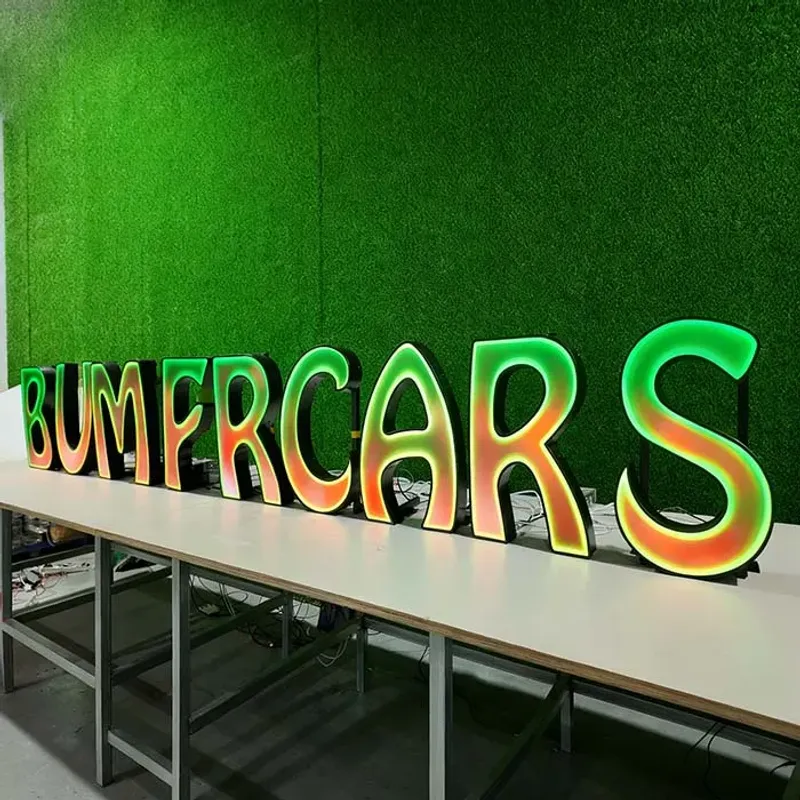
You’re Paying for “Architectural,” But Getting Decorative
Let me break this down: if your monument sign doesn’t hold up 10 years in the weather, it’s not architectural—it’s a temporary decoration with a bigger price tag. I’ve seen it a hundred times. A developer signs off on a $15,000 entry sign for a corporate office park. Six months later the acrylic is yellow, the LEDs flicker in the rain, and the stainless steel already has rust spots. That’s not architectural design. That’s cutting corners on spec.
Most buyers don’t realize that monument signs live outside 24/7. Rain, UV, wind grit, temperature swings from -20°F to 110°F. The materials spec has to be written for that reality, not for what looks good in a rendering. Here’s what actually matters when you’re designing a sign that’s supposed to say “this company has been here 30 years and isn’t going anywhere.”
Materials: The Difference Between 3 Years and 15
You want stainless steel? Talk to me about grade first. 304 stainless (18% chromium, 8% nickel) will last 10+ years in a typical suburban office park. Density 7.93 g/cm³, common thickness 1.0–3.0 mm. Brushed #4 finish hides fingerprints, mirror #8 shows every smudge but looks premium. For a corporate park in Ohio, that’s fine. But if your site is within 5 miles of saltwater—like Miami Beach or a coastal business park—304 is suicide. You need 316, which adds 2–3% molybdenum. It costs 20–30% more per letter. I’ve watched property managers replace 304 letters after 3 years because of pitting corrosion. Pay for 316 and it’s 15+ years, no excuses.
Aluminum? One-third the weight of steel. 8–12 year outdoor life. 0.040–0.063" (1.0–1.6 mm) is standard for backs and returns. It naturally rust-proof, but powder coating adds another 5–8 years. A full aluminum monument with anodized finish? Under $10–25 per letter from a factory. But here’s the brutal truth: aluminum bends easily. If your sign gets hit by a landscaping truck (and it will), aluminum dents. Stainless takes the hit better.
Acrylic—that’s where most projects go wrong. The spec says “UV-resistant acrylic.” In reality, you get two grades. Mitsubishi or Degussa cast acrylic: 90–92% light transmittance, UV-stable for 5–8 years before any yellowing. Domestic cast? 1–2 years. I’ve seen Chinese factories swap Mitsubishi for local acrylic and pocket the difference. You won’t notice until the sign looks jaundice. Always specify the brand in your PO. And thickness: 2mm for small letters, 3mm for medium. Over 2.5 meters tall, jump to 5mm or the face will sag in summer heat.
LED Lifespan: The 50,000-Hour Lie
Every LED module says “50,000 hours L70 lifespan.” That’s marketing. L70 means the light output drops to 70% of initial brightness at 50,000 hours. But that’s only valid under lab conditions: 25°C ambient, constant current, no voltage ripple. Your monument sign lives inside a sealed cavity that hits 65°C on a July afternoon in Atlanta. The real lifespan? Depends on the chip.
SMD 2835 are the industry workhorse: 100–150 lumens per watt. Good modules use Samsung or Osram chips—5+ years real outdoor lifespan. Cheap modules? 12–18 months. Quickest way to spot bad LED modules: look at the solder joints. Dull gray = won’t last 18 months. Shiny silver = proper lead-free solder. Ask your supplier for a close-up photo of the solder joints. If they can’t produce it, walk away.
Color temp matters for corporate parks. 4000K to 5000K neutral white is the sweet spot: looks professional, doesn’t feel industrial. 3000K warm is for hospitality. 6000K cool is for highway signs. For a office park entrance, 4000K reads as “clean and serious.” Don’t let anyone sell you 3000K because it “looks elegant.” It looks like a coffee shop.
Certifications: Don’t Get Fooled by a PDF
Here’s the math: CE marking costs 20,000–50,000 RMB and takes 2–8 weeks. Most factories will say they have it. Ask to see the certificate with today’s date. Watch them sweat. CE is self-declared in many cases—no mandatory third-party test. For US projects, you need UL 48 (electric signs) or ETL as a cheaper alternative (10–30% less cost, same safety standards). UL 48 costs $4,000–15,000 plus quarterly audits. That’s why many offshore factories skip it. If your sign needs to pass inspection in Chicago or New York, UL isn’t optional.
IP ratings get misused too. IP65 means dust-tight and protected against water jets from any direction. That’s the minimum for outdoor signs. IP66 is for powerful jets—think coastal winds driving rain sideways. IP68 means submersible (waste of money unless the sign sits in a flood zone). I’ve seen specs call for IP65 on a sign that faces a Gulf Coast hurricane zone. That’s not engineering, that’s wishful thinking. NEC Article 600 also requires proper wiring, disconnect switches, and bonding. Your sign can survive weather but burn down the parking lot if the electrical isn’t up to code.
Fabrication: Where the Spec Meets the Shop
Every sign goes through ten steps. Design confirmation (1 day). Laser cutting—tolerance ±0.1mm (1–2 days). TIG welding for returns and backs (1–2 days). Grinding and polishing to hide weld marks (1–2 days). CNC routing the acrylic face (1 day). LED assembly (1–2 days). Sealing with neutral silicone—not acidic stuff that corrodes the aluminum (1 day). Then an 8–12 hour aging test running the LEDs at full brightness to catch early failures. 100% QC inspection. Finally, export packaging: each letter wrapped in foam, packed in a carton, then strapped into plywood crate. Total time: 7–15 days.
Most buyers don’t realize that welding quality determines the final look. If the TIG weld isn’t ground smooth, you’ll see a shadow line through the painted face. If the silicone sealant is applied sloppily, water wicks into the cavity and kills the LEDs. I’ve watched sign shops pay $800 for a front-lit letter from a domestic fabricator. Same 304 stainless, same Samsung LEDs. We ship that letter for $120 from our factory in Lu’an, China—3,000m² facility, 50+ skilled workers, CE/ROHS/ISO 9001 certified. The savings come from vertical integration, not skimping on material. But you have to know what to ask for.
Shipping: The Underappreciated Failure Point
LCL sea freight sounds cheap: $80–200 per cubic meter, plus $1,200–3,000 for a full container. But your crate gets handled 6–8 times between our dock and yours. Every touch is a chance for damage. That’s not in the brochure. For a monument sign—often 5–10 feet wide—the crate is enormous. If the packaging loosens, letters bounce against each other. I’ve seen acrylic faces shattered because the foam shifted in transit.
Express shipping (7-10 days, $30–100 for small packages) works for sign kits under 20 kg. Air freight ($4–12/kg, about 10 days) is reliable but expensive. Sea freight takes about 65 days and requires the buyer to handle customs clearance. Plus US Section 301 tariff adds about 30% on Chinese-made signs. Factor that into your budget. The factory-direct savings of 50–65% on product still hold after tariffs, but you can’t ignore the math.
For a corporate office park, plan your ordering timeline 8–12 weeks ahead. Rushed orders never go well. And never—ever—skip the aging test at the factory. I’ve had clients insist we skip it to save 2 days. Three months later, half the LEDs were dead. The aging test is non-negotiable.
FAQ: Questions I Get Asked Every Week
What’s the difference between front-lit and halo-lit monument signs?
Front-lit: the LED shines through the acrylic face. You see bright letters, the returns are dark. Halo-lit: the light bounces off the wall behind the letter, creating a glow around the letter outline. Front-lit is cheaper ($20–80 per letter factory price). Halo-lit looks more premium ($35–120 per letter) but requires deeper returns and better sealing because the back is open. For a corporate park entrance, front-lit with a sleek stainless steel face reads modern. Halo-lit works for traditional architecture. Don’t mix them on the same sign—it looks like a typo.
Do I really need 316 stainless for a sign in a landlocked state?
No. If you’re more than 50 miles from the coast, 304 is fine. The chromium oxide layer self-heals in normal air. 316 only makes sense for aggressive environments: coastal, industrial (chemical plants), or near roads where de-icing salt sprays in winter. I’ve seen 304 last 15 years in Ohio. If your client insists on “marine grade” for a sign in Oklahoma, sell them the upgrade but know it’s overkill.
How do I verify a factory actually uses Mitsubishi acrylic?
Ask for the material certificate with the batch number. Then ask for a photo of the bare acrylic sheet edge shows a cast marking. Mitsubishi brands its sheets with a UV-stabilized layer that glows faintly under UV light. Or just specify in the contract: “Acrylic face must be 3mm cast acrylic, brand Mitsubishi or Degussa, with mill certificate provided.” If they push back, they’re using domestic cheap stock. Walk.
Can I install a monument sign myself to save installation costs?
Sure, if you’re comfortable drilling into a concrete footing with a hammer drill, running 1-inch conduit 50 feet from the nearest junction box, pulling 12-gauge THWN wire, and sealing the conduit entry against groundwater. The sign itself is heavy—stainless letters filled with LED modules weigh 20–50 lbs each. The base weighs 100+ lbs. If you mess up the leveling or the wiring, the sign flickers or tilts. A pro installer charges $500–1,500 depending on site conditions. Pay it. The only thing worse than a bad sign is a dangerous one.