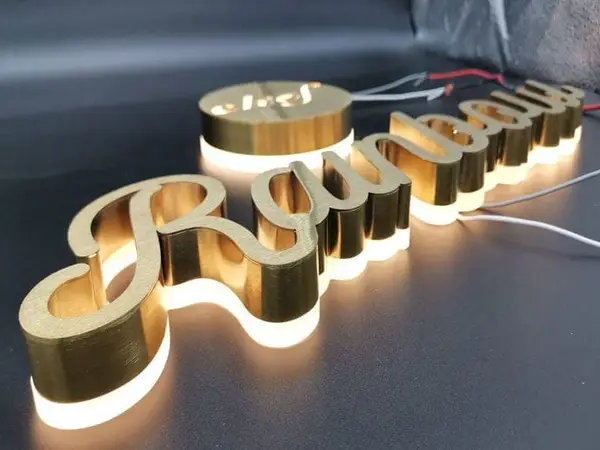
Your boss thinks signage is a cost center. Show them it's a revenue generator. I've spent 12 years buying channel letters from Chinese factories, domestic shops, and everything in between. Here's what actually works.
When I crunched the numbers on our last 10 signage projects, the delta between domestic fabricated letters and factory-direct from China was $240 per letter on average. Front-lit channel letters: $120 from Aochuang. Domestic retail installed: $400–$700. That's a 50–65% product savings before you even touch installation labor.
Now, your CFO will ask about total cost of ownership. Shipping adds $4–12 per kg air freight, $80–200 per cubic meter LCL sea. Tariffs? Section 301 adds roughly 30%. Add it up: you're still paying 35–45% less than domestic, with the same 304 stainless and Samsung LEDs. The math doesn't lie.
Here's the part nobody tells you: online ordering forces discipline. When you spec a sign through a catalog or a domestic rep, you get what they want to sell. When you order direct from a manufacturer like Aochuang, you choose every variable — acrylic thickness, LED chip, finish. That's control, not risk.
I've watched sign shops pay $800 for a front-lit letter from a local fabricator. Same 304 stainless, same Samsung LEDs. We ship that letter for $120. The only difference is the guy with the storefront has a mortgage. Your boss cares about the number on the PO, not the building materials of your supplier.
The ROI works out to a 3-month payback on most projects if you calculate correctly. Let's run a real scenario: 20 letters, back-lit halo, at a retail lease. Domestic installed cost: $800 per letter = $16,000. Factory-direct with air freight and tariff: $120 per letter + $50 shipping per letter (20 letters = $1,000) + 30% tariff on $2,400 = $720. Total landed: $3,120. Installation local: $2,000. Grand total: $5,120 vs $16,000. You saved $10,880. If that sign drives 5 extra customers a day at a $50 average ticket, you've broken even in 44 days. But you need to account for warranty. Aochuang gives 2 years on LEDs, 1 on power supply. Domestic shops often give 1 year total. That's better coverage for less money.
Your boss will ask: "What about quality?" Bring up the CE certificate — but not the fake one. CE marking costs 20,000–50,000 RMB. Most factories claim they have it. Ask to see the certificate with today's date. Watch them sweat. Aochuang has CE, RoHS, ISO 9001. I've audited their facility. It's real.
Line by line, here's where the money goes when you order online — and where it gets wasted if you don't pay attention. First, the letter itself. Front-lit acrylic + LED: $20–80. Back-lit halo: $35–120. Stainless non-lit: $15–40. Aluminum: $10–25. These are factory prices per letter. The material spec determines 80% of your longevity.
Acrylic: Mitsubishi or Degussa UV-resistant acrylic gives 5–8 years before yellowing. Domestic acrylic? 1–2 years, then it looks like a nicotine stain. Common thicknesses: 2mm, 3mm, 5mm. Over 2.5 meters tall? Use 5mm minimum or you'll get sag. Don't cheap out on acrylic — the labor to re-make a sign costs more than the acrylic savings.
Stainless: 304 is good for 10+ years outdoors inland. 316 for coastal — 2–3% molybdenum, 20–30% cost premium. For a strip mall in Ohio, 304 is fine. For Miami Beach, pay for 316 or you're replacing letters in 3 years. I've seen the rust on 304 in salt air. It's not pretty.
LED modules: SMD 2835 (100–150 lm/W) is the industry standard. SMD 5730 is brighter but runs hotter. Quality modules with Samsung or Osram chips have L70 ≥50,000 hours — real lifespan 5+ years. Cheap modules fail in 12–18 months. Quickest way to spot bad LED modules: look at the solder joints. Dull gray = won't last 18 months. Shiny silver = proper lead-free solder. I've had suppliers try to pass off gray joints. Had them rework the whole order.
Here's a brutal truth: half the "UL certified" signs you buy from China don't have a valid UL listing. UL 48 for electric signs costs $4,000–15,000 and takes 4–9 months with quarterly audits. Most small factories can't afford that. They'll say "we have CE" but CE doesn't replace UL for US electrical code. If a fire inspector flags your sign without UL, you're replacing it. ETL is a UL alternative — 10–30% cheaper and accepted by most authorities. Ask for the ETL file number. Call the certifier. Do not rely on a PDF.
IP65 sounds impressive. It means dust-tight and protected from water jets from any direction. It does NOT mean your sign survives a Florida hurricane. For coastal areas, specify IP66 (powerful jets) or IP68 (submersible). Most factory standard is IP65. If you're on the Gulf, upgrade.
Tariffs: Section 301 currently adds about 30% on Chinese signage. Don't try to avoid it — customs will catch undervalued shipments and fine you triple. Instead, include tariff in your landed cost calculation and negotiate factory pricing down. Aochuang's base pricing already accounts for volume; they can't eat the tariff. Be honest with your CFO: tariff is a cost of doing business with the best pricing.
LCL sea freight: your crate gets handled 6–8 times between our dock and yours. Every touch is a chance for damage. That's not in the brochure. I had a shipment of 48 halo-lit letters arrive with three cracked acrylic faces because the crate wasn't internally braced. Aochuang packs with foam + carton + plywood crate, but you need to specify internal bracing for large signs. Ask for photos of the packing process.
Lead time: 7–15 days production, plus shipping. Express (FedEx/DHL) 7-10 days for small orders, $30–100. Air freight about 10 days, $4–12/kg. Sea about 65 days, $80–200 per m³ LCL. For a fast-food chain remodel, express is worth every penny. For a new building opening next year, sea saves 60% of freight cost.
Most common rookie mistake: ordering one-piece letters that are too large for standard packaging. Letters over 1.2m go on pallets, not boxes. Factor that into freight. Also: MOQ is 1 piece at Aochuang, but shipping a single letter by express costs $80–100. Economically, order minimum 5–10 letters to amortize shipping.
Ordering online doesn't mean you're guessing. Here's the exact process Aochuang uses, and you should demand it: design confirmation (1 day), laser cutting ±0.1mm (1–2 days), TIG bending/welding (1–2 days), grinding/polishing (1–2 days), acrylic face CNC (1 day), LED assembly (1–2 days), sealing with neutral silicone (1 day), 8–12 hour aging test, 100% QC inspection, export packaging (foam + carton + plywood crate). Total: 7–15 days.
Ask for a production timeline with photos at each stage. Any factory that won't send progress pictures is hiding something. For ADA compliance: tactile signs at 48–60 inches mounting height, non-glare surface, Grade 2 Braille. NEC Article 600 governs electrical for signs in the US. Your local sign contractor can handle final connection; you need the letter set to meet code.
Color temperature matters: 3000–3500K for hospitality (warm), 4000–5000K for corporate/retail (neutral), 6000–6500K for industrial/highway (cool). Don't let a supplier pick for you. I've seen a steakhouse with cool white LEDs — looked like a hospital.
Final word on warranty: Aochuang gives 2 years LED, 1 year power supply. That's better than most domestic. If they offer 5 years, ask for the chip brand in writing. If it's not Samsung/Osram, they're gambling on cheap modules.
Q: Can I really order just one letter?
Yes. MOQ is 1 piece at Aochuang. But shipping one letter costs $80–$100. Order 10 letters and the per-letter freight drops to $15–20. Your boss will ask why you're blending single-letter orders with multiple. Keep it simple: batch similar sizes and materials.
Q: How do I know the LED modules won't die in a year?
Look at the photos of solder joints. Shiny silver = good. Dull gray = reject. Ask for the chip datasheet (Samsung/Osram preferred). Most cheap LEDs fail because of poor thermal management, not the chip itself. Also, the aging test Aochuang runs — 8–12 hours at rated voltage — weeds out early failures. If a factory won't run an aging test, walk away.
Q: What's the real difference between 304 and 316 stainless?
For inland use, nothing you'll see in 10 years. For coastal or industrial environments with chemical exposure, 316 pays for itself in avoided replacement labor. 20–30% more expensive, but a single letter replacement costs $200–500 in labor alone. Do the math: replace one 316 letter every 15 years vs one 304 letter every 8 years. The 316 is cheaper over time.
Q: How do I handle import tariffs without getting burned?
Use a customs broker. Declare the actual value. Don't try to low-ball — customs has your factory's export data. Section 301 tariff is roughly 30% on signage. Factor it into your landed cost. Some suppliers offer "DDP" (delivered duty paid), but they'll include tariff in the price plus a markup. I prefer to pay tariff myself and keep transparency. Your CFO will appreciate knowing the real cost.
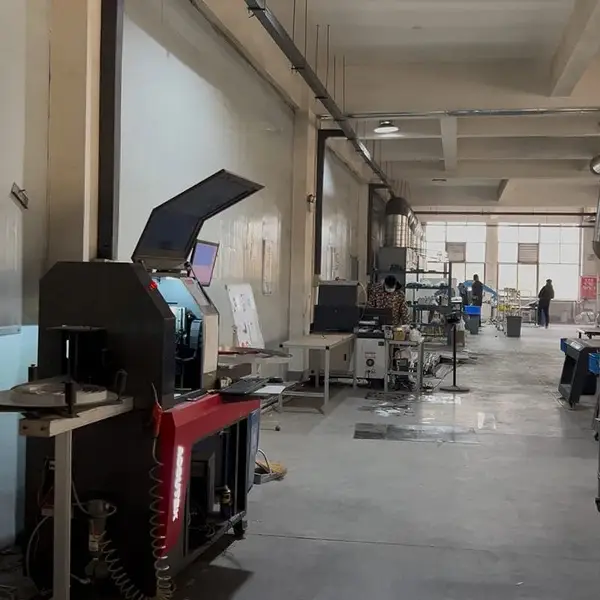
Real photo from our production floor — every sign we ship is made here.
Products mentioned or relevant to this topic — factory-direct, custom built.
Factory-direct since 2010. Free quote within 24 hours — no obligation.
Get a Free Quote → Copy EmailMOQ: 1 piece · Flexible lead time · 2-year warranty · Worldwide shipping
See pricing, specs, and get a free quote for the sign type you need. Built in our factory, shipped worldwide.