Same story, every time. Designer sends a file. “We need PMS 186 C.” Fine. Then the email: “And we need an exact match on the sign.”
16 years in this trade. I’ve melted acrylic, argued with powder coaters, watched grown men cry over a shade of blue. The gap between a Pantone swatch and a physical sign is a mile wide. And nobody in the brochure chain tells the customer that. So I’ll tell you what I tell my guys.
Look, Pantone is ink on paper. RAL is powder on metal. Different chemistries, different sheen, different base materials. There’s no official 1:1.
Pantone 186 C is a bright red. The closest RAL might be 3020 (Traffic Red) or 3000 (Flame Red). Close enough, right? Wrong. Under a sign shop’s fluorescent lights at 2 a.m., they’re different animals. Anyone promising a “perfect” conversion is lying through their teeth. I’ve seen entire batches of baked paint letters get kicked back because the RAL match looked 5% darker. 5% is invisible on a screen. On a 4-foot letter facing a client with a PMS swatch in hand? Lawsuit waiting to happen.
Rookie mistake: eyeballing the conversion off a phone screen. You can’t. The screen is backlit, the swatch isn’t, and your phone’s blue light filter just turned that warm gray into wet cement. I saw it go south once: a national chain wanted their brand green, PMS 7488. Nearest RAL? 6018. On the powder, it pulls yellower. They spent $12,000 redoing the letters. Not my money, but still.
Nobody tells you this: when a job order lands at our shop—3,000 square meters, 50 workers on the floor—the paint process is the last step. And the first one that gets blamed.
We take the metal. 304 stainless, 1.5mm thick, density 7.93g/cm³, the same stuff that’ll sit outside for a decade without rust. Or aluminum, a third the weight. We weld, grind, polish the returns. Then the paint booth. Powder coating uses RAL. You can’t mix Pantone ink. We pull a RAL fan deck, pick the closest chip, shoot a test panel. If the client’s smart, they send a physical swatch. We compare under controlled light: 4000K neutral, like most corporate lobbies. Even then, 5 times out of 10, the metallic flake in the powder shifts the color just enough to make a brand manager twitchy.
I’ve kept a log. Out of 100 painted sign orders, maybe 15 come back with some note about color. Not because we screwed up. Because the expectation was set wrong back at the design meeting. Metallic flake is the devil.
LED color temperature alone will wreck your match. 3000K warm white behind a red acrylic face gives you a deep brick red. 6500K cool white on the same acrylic turns it almost pink. Don’t believe me? I’ve run this test with SMD 2835 modules rated 130 lumens per watt. Exact same red acrylic, different LED strips. The client swore we switched his brand color.
That’s why when someone orders backlit halo letters with a painted return and an illuminated face, I ask: “Do you care how this looks at night? Because your PMS red won’t look like your PMS red when lit from inside.” I’ve seen this disaster: a high-end restaurant in Manhattan wanted a moody warm glow. Their logo was PMS 201, a rich burgundy. They used 4500K neutral LEDs because that’s what the spec sheet said. Result: mud-brown letters. They called me screaming. I wasn’t even the fabricator on that job—just the guy they called to fix it.
90% of color disputes start with a PDF. A designer picks a Pantone from a screen, emails a CMYK proof, expects the sign to look like that. It won’t. Ever.
Here’s the reality: if you’re spending more than $500 on a sign, you need a physical swatch. I’ve seen fabrics that match a Pantone book perfectly, then fail under a street lamp because the pigment’s spectral reflectance curve goes haywire in sodium light. Not witchcraft. Pure physics. But try explaining that to a marketing VP who’s never set foot on a factory floor.
I tell every client the same thing: send me a physical sample. A piece of the actual powder coat, a painted metal chip, a swatch you don’t mind me keeping for the records. Then I’ll spray a test panel under your actual lighting, not my booth, and mail it back. If it matches there, we’re done. Stop guessing.

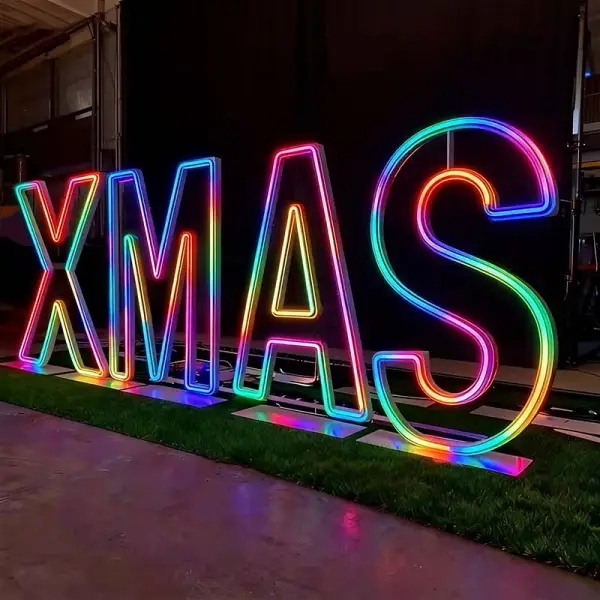
Real photo from our production floor — every sign we ship is made here.
Products mentioned or relevant to this topic — factory-direct, custom built.
From $24/letter · MOQ 1 piece · Flexible lead time · CE & UL certified · ships to 20+ countries
Custom sizes, colors, and finishes. Get a factory price in 24 hours.
Get a Free Quote Copy EmailWhatsApp +86 13865703472 · business@aochuangsign.cn
See pricing, specs, and get a free quote for the sign type you need. Built in our factory, shipped worldwide.