Look, if you think Pantone 186C and RAL 3020 are the same red, you're already losing money. I've watched sign shop owners order 500 letters based on a PDF screenshot. Then they call me screaming when the red looks orange under warm LEDs.
Color is a language with three dialects. Pantone is for printing and plastics. RAL is for paint and powder coat. Physical sign materials — acrylic, stainless, aluminum, LED light — speak their own language entirely. You can't translate word-for-word. You need a factory that understands the accent.
I've been on the floor of Aochuang Sign since 2010.
We've matched colors for banks in Dubai and burger joints in Ohio. Some jobs go perfectly. Others go sideways because nobody sent a physical sample.
Pantone is an ink mixing system. That's it. It was built for offset printing on paper. When you specify Pantone 294C for a light box face, you're asking a printer's language to describe a plastic that lets 90-92% of light through. Not a direct translation.
Here's what nobody tells you: Pantone C and U versions have different paper coatings. On a backlit acrylic face, neither looks the same as the chip in your hand. We can get close. But "close" is a tolerance, not a promise.
Cheap domestic acrylic will yellow in 1-2 years. Our UV-resistant Mitsubishi or Degussa acrylic holds 5-8 years. That matters more than the exact Pantone number. A perfect color that turns yellow in 18 months is useless.
And if you're doing front-lit channel letters, the acrylic face color and the LED inside have to work together. A 6500K cool LED will wash out a warm Pantone. I'll get to that.
RAL is a paint and powder coating standard. German engineering, very precise. RAL 9005 is jet black. RAL 9010 is pure white. We use RAL for stainless steel and aluminum finishes most of the time.
316 stainless costs 20-30% more than 304. If you're on Miami Beach, pay for it. If you're in a strip mall in Ohio, 304 is fine. That has nothing to do with color, but everything to do with how the finish holds up. A colored powder coat on cheap stainless will fail at the welds first.
The ugly truth is RAL to Pantone conversion charts are approximations. They're generated by software, not by a guy holding two physical chips under a D65 light booth. I keep three conversion charts in my office. They disagree on 10% of the colors.
If a factory tells you they can match any Pantone to RAL perfectly, they're lying. We can't do that. Nobody can.
Acrylic, stainless steel, aluminum, and LED all render color differently. That's the whole ballgame. You can take the same RAL 5013 cobalt blue and apply it to brushed aluminum or mirrored stainless. One looks satin, the other looks metallic. Same code. Different physical sign.
For stainless steel letters, we can do brushed #4, mirror #8, PVD, or powder coated. Brushed #4 eats light and makes colors look darker. Mirror #8 reflects everything and makes colors look brighter. Your Pantone chip doesn't account for that.
Aluminum is lightweight, one third the weight of steel. We can anodize it or powder coat it. Anodized aluminum is not the same color as powder coated. Anodizing is translucent, the base metal shows through. Powder coat is opaque. Same RAL code, different look.
I've seen this go wrong: a client specified RAL 3003 ruby red for back-lit halo letters. On the powder coat sample it looked perfect. Then we mounted warm white LEDs behind it. The red turned pink. We had to swap to 3000K warm white and a deeper red mix. Two extra days, extra cost. Because nobody asked about lighting.
Acrylic faces have light transmittance issues. 2mm and 3mm acrylic look brighter than 5mm. If your letters are over 2.5 meters tall, you need 5mm+ for structure. That thickness changes the color saturation. A 5mm deep blue looks darker than a 2mm deep blue.
You can't separate the LED from the face color. I don't care how perfect your Pantone chip is. If you put 6000-6500K cool white LEDs behind a warm cream acrylic, you get a sick greenish grey.
Not cream.
Here's what nobody tells you: cheap LED modules from some factories shift color after 12-18 months. They start at 6500K and drift to 8000K. Your sign looks great on install day, then six months later the client calls. We use Samsung, Osram, or Blueview modules. L70 at 50,000 hours. They don't drift like the $2 modules.
For dual-lit channel letters or halo-lit, the LED color temp is half the visible color. Specify 3000-3500K warm for hospitality. 4000-5000K neutral for corporate and retail. 6000-6500K cool for industrial and highway. That's in our data. It's not optional.
We test every sign with an 8-12 hour aging test before packaging. That catches color shift early. Most factories skip that. They'll tell you they did it. Ask for the test log with timestamps.
Don't email me a screenshot of a Pantone color from your phone. That's how you get a $4,000 mistake. Send a physical sample. A chip, a piece of metal, a swatch, anything. We'll match to the physical sample under D65 lighting and then send you a photo and a physical proof if you want it.
If you can't send physical, send the exact Pantone code and the RAL code if you have it. Tell us the material and the LED color temp. Tell us the environment: coastal, direct sun, indoor. That's the minimum.
Look, I get it. You're busy. You're comparison shopping three factories. The cheap factory in Vietnam or wherever will say "yes yes we match Pantone exactly." Then you get the letters and they're purple instead of blue. Then you call me to fix it. I've done that rescue job six times this year.
We can't match a Pantone color exactly on every material. No factory can. Acrylic has optical properties. Stainless has grain. Aluminum has anodizing chemistry. Powder coat has gloss level. If you need a 100% identical match across five materials, you need to adjust your expectation or pay for custom color development.
We can match within visual tolerance on powder coat, wet paint, and acrylic. We've matched brand colors for banks, hospitals, and franchises. We do it with physical samples, not conversion charts. That's the honest difference.
Our factory is 3,000 square meters in Lu'an, Anhui. 50+ workers. Exports worldwide. CE, RoHS, ISO 9001. MOQ is 1 piece, lead time about 5-15 days. We don't charge a setup fee for color matching if the order is over $500. Under that, there's a small sample fee. I'll tell you upfront.
The ugly truth is most sign shop owners don't understand color temperature. They order "white" LED. White means nothing. It's a range from 2700K to 8500K. That's like saying "I want a blue sign" and then getting mad it's not navy.
I've seen this go wrong: a contractor ordered acrylic light boxes for a restaurant menu display. Pantone 7508 warm tan face. Factory used 8000K LED modules because they were cheapest. The tan looked like dead skin. We rebuilt the whole thing with 3000K modules. Cost him triple.
Here's another: importing signs with a color mismatch. You save 50-65% buying factory direct. But if the color is off, you lose the entire order. A $1,200 sea freight shipment of stainless letters becomes scrap because the powder coat is RAL 7016 but the brand spec was Pantone 433C. They're both grey. They're not the same grey.
US retail installed price for a front-lit channel letter is $200-700. Our factory price is $20-80. A back-lit halo letter retails $400-1,000. Our price is $35-120. That savings means nothing if the color is wrong. Don't cheap out on the color confirmation step.
Here's our process, plain. First, we take your physical sample or codes. We mix a small batch. We spray or mold a test piece. We put it in the light booth. We photograph it next to your sample. We send you the photo, and if you want, we courier the physical test piece to your door. That costs about $30-100 express, depending on size. It's worth it.
Then we age test the sign for 8-12 hours with the specified LED. We check color shift. We do 100% QC inspection. We package in foam, carton, and

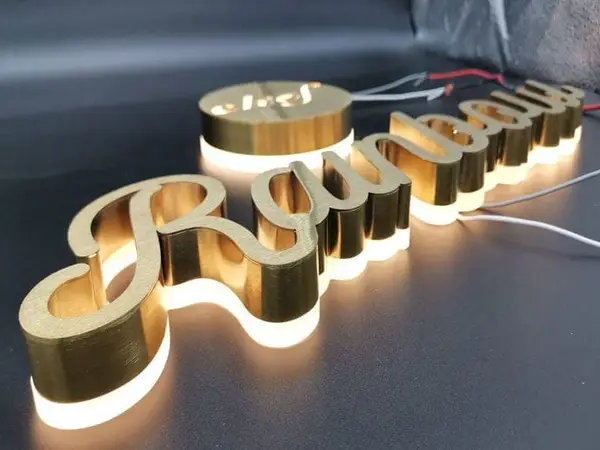
Real photo from our production floor — every sign we ship is made here.
From $24/letter · MOQ 1 piece · Flexible lead time · CE & UL certified · ships to 20+ countries
Custom sizes, colors, and finishes. Get a factory price in 24 hours.
Get a Free Quote Copy EmailWhatsApp +86 13865703472 · business@aochuangsign.cn
See pricing, specs, and get a free quote for the sign type you need. Built in our factory, shipped worldwide.