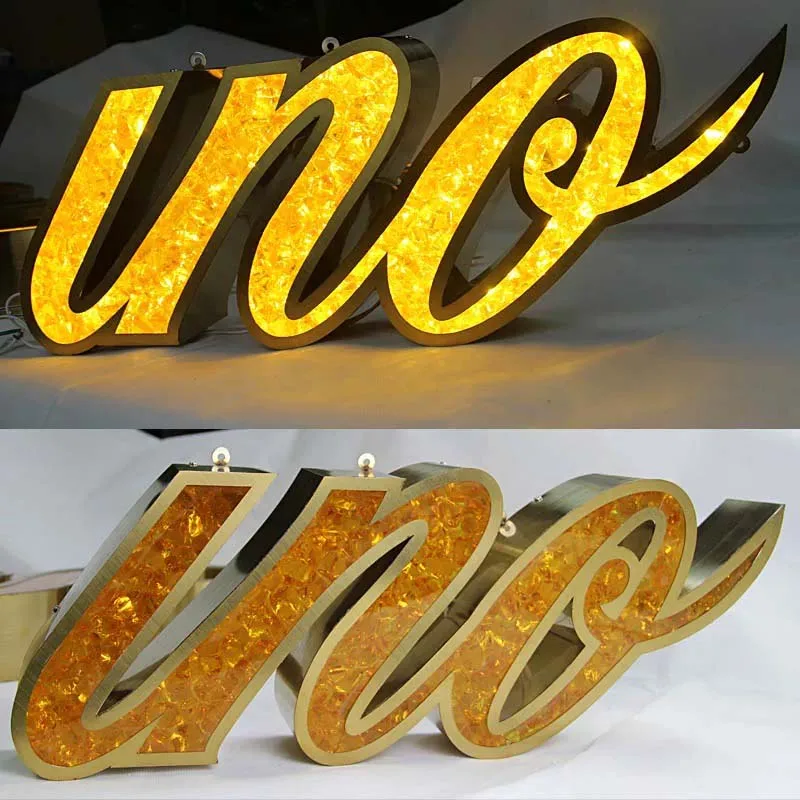
And I still get calls from sign shops who can’t tell the difference between push-through and reverse channel acrylic letters. They stare at the catalog photos, scratch their heads, and ask me which one looks better. The truth is – it depends on the job, the budget, and how much you trust your installer. Both types have been around longer than most of my TIG welders have been alive. But I’ve seen too many shops order the wrong kind, then blame the factory when the sign doesn’t pop like they imagined.
So let’s cut the crap. I’m gonna lay out exactly what you’re getting with each style – the look, the cost, the headaches – using the same numbers I run through every day on the factory floor. No marketing spin. Just the stuff you need to know before you write that PO. Trust me.
Push-through letters are the classic front-lit channel letter. The acrylic face sits flush with – or slightly pushes through – the metal return. Light from LED modules inside the letter shines through the acrylic, hitting your eyes directly. That’s your standard storefront sign. The one every strip mall has. Front-lit channel letters are our bread-and-butter for a reason: they work, they’re durable, and they’re cheap to make.
Reverse channel letters – also called back-lit or halo letters – mount the acrylic on the back of the metal letter. Light bounces off the wall behind the sign, creating a glowing halo around the letter shape. You don’t see the LED modules. You don’t see the acrylic face from the street. Just a crisp outline of light. That’s the premium look – think high-end hotels, law firms, or anyone who wants to look like they overpaid. Back-lit halo letters cost more for a reason.
The visual difference is night and day – literally. Push-through throws light straight at you. Reverse channel lights up the wall behind the letter. One is in-your-face readable. The other is subtle, architectural, and harder to read from a distance.
Here’s what nobody tells you: push-through letters are always brighter per watt of LED power. The light travels through the acrylic face with around 90-92% transmission (using good Mitsubishi or Degussa sheet, not the cheap domestic stuff that yellows in 18 months). You get a solid, even glow across the whole letter. No hotspots if the modules are spaced right – about 2 inches apart for SMD 2835s.
Reverse channel letters are dimmer by nature. The light has to escape from the back of the letter, bounce off the wall, and come back to your eye. You lose intensity. But what you gain is that halo effect – a soft, floating outline that looks classy as hell when the mounting surface is clean and the wall color is right. Dark brick or stone? Reverse channel kills. White vinyl siding? Not so much.
I've seen this go wrong: a shop orders reverse channel for a storefront with a busy brick pattern. The light scatters everywhere, the halo looks like a blurry mess, and the owner blames the sign maker. If you want to use halo letters, you need a uniform background, minimum 6 inches of flat wall around each letter. Otherwise, go push-through.
Let’s talk numbers, because I know that’s what you’re here for. Factory-direct from our floor in Lu’an, you’re looking at $20-$80 per letter for front-lit, $35-$120 for back-lit halo. That’s for 304 stainless steel returns, 3mm acrylic, and Samsung or Osram LEDs. Same letter size, same material spec.
The ugly truth is what happens when that letter lands in the US. You’ve got the 30% Section 301 tariff, shipping (express $30-100 small, air $4-12/kg, sea $80-200/m³ LCL), and then the installer’s markup. By the time you see a retail price, that $40 factory letter is $200-$700 installed. The halo version? $400-$1,000 per letter. The factory savings are 50-65% on the sign itself, but the final bill still hurts. It hurts.
Quick comparison: a 12-inch front-lit letter in 304 stainless with 3mm acrylic – factory price about $35. Add shipping, tariff, and some installer overhead – you’re at maybe $250 installed. Same letter as reverse channel? Factory $60, installed $450. For a 10-letter sign, that’s a $2,000 difference. You better be sure the halo look is worth it to your client.
Look, I don’t care if you order push-through or reverse channel – if you cheap out on the acrylic, you’re throwing money away. Domestic acrylic starts yellowing in 1-2 years. I’ve seen it. A 5-year-old sign with domestic sheet looks like it’s been chain-smoking inside a bus station. UV-resistant Mitsubishi or Degussa acrylic gives you 5-8 years before any noticeable shift. That’s a 40% cost premium, but it’s the difference between a sign that still looks good when the warranty expires and one that needs a new face after two summers.
For reverse channel letters, the acrylic thickness matters more. Most shops spec 3mm – that’s standard. But if your letter is over 2.5 meters tall – say, an 8-foot lobby logo – you need 5mm. Otherwise, the face will bow or

Real photo from our production floor — every sign we ship is made here.
Products mentioned or relevant to this topic — factory-direct, custom built.
Factory-direct since 2010. Free quote within 24 hours — no obligation.
Get a Free Quote → Copy EmailMOQ: 1 piece · Flexible lead time · 2-year warranty · Worldwide shipping
See pricing, specs, and get a free quote for the sign type you need. Built in our factory, shipped worldwide.