I’ve watched contractors argue for twenty minutes in a parking lot about which mount is “cleaner.” Meanwhile, the client’s gone inside to check their phone. It’s a waste of breath if you don’t know the facts. Raceway mount. Direct mount. Flush mount. They each solve different problems, and picking the wrong one can add thousands to the install, kill your UL listing, or leave you with a sign that fails in three years. I’m going to break it down like you’re on my factory floor in Lu’an, looking at a pile of laser-cut 304 stainless and a schematic that says “raceway: client approved.” No Wikipedia. No tender adjectives.
First, forget whatever some blog told you about “seamless aesthetic integration.” If you’re a sign shop owner or a contractor sourcing from China, you need to know three things: how the power gets to the LEDs, what the landlord will allow, and how many holes you’re drilling. That’s it. Over the next 2,000 words, I’ll give you the real numbers, the callbacks I’ve seen, and the lies you’ll hear from salesmen who’ve never stripped a TIG weld. I’ve burned my hands on hot acrylic and argued with suppliers about LED quality. I’m 16 years on the floor. Trust me—or don’t, but check my math.
A raceway is an aluminum or steel box, usually 4×4 inches or larger, that runs the length of the sign. The channel letters sit on this box. All the LED drivers, power supplies, and splices live inside it. You mount the raceway to the wall, fish one line of conduit into it, and you’re done. Front-lit channel letters on a raceway are the standard for 80% of strip malls in America. It’s not pretty, but it works.
Look, I’ve shipped raceways to Dubai, Sydney, and a steakhouse in Texas that needed UL-listed everything. The raceway is your friend when the building is made of brick, EIFS, or anything that hates a hundred drill holes. It lets you mount 12 letters with four anchor points instead of 48. The power runs inside the raceway, fully contained, so you’re not running flex conduit behind every letter. That matters when the fire marshal walks the job site. I’ve seen a shop get red-tagged because they direct-mounted letters and the wiring wasn’t in metallic conduit. The raceway can be pre-wired at our factory, tested under full load for 12 hours, and shipped as one assembly. That saves a day of labor on a scissor lift.
But here’s what nobody tells you: a raceway is a sail. A 12-foot raceway in a 90 mph wind gust will pull on the building like a truck. If your engineer didn’t spec the right anchors and the building façade is 20-year-old stucco, you’re looking at a failure. We had an installer in Oklahoma call us after a tornado watch—his raceway didn’t rip off, but the whole section of siding separated from the building. The sign held; the wall didn’t. That’s not a sign problem, but the client will blame the sign guy. Wind load calculations are not optional.
The other downside: raceways are visible. Some landlords hate the look. Architects call it “cluttered.” I call it a decision you should have made before the building was clad in marble. From a factory perspective, a raceway adds $15–$40 per letter to your cost, depending on width and paint. You’re paying for the extra aluminum, the welding, the powder coating. If you’re importing, the raceway also adds volume—shipping a 10-foot raceway LCL from China to Long Beach costs more than a box of letters by air. Factor that in.
Direct mount means each letter gets its own studs and its own power whip. You drill a hole for the studs, you drill a hole for the wire, and you push everything into the wall. No raceway. The letters sit flush or with a slight standoff, and the wiring runs inside the wall cavity, attic, or in surface-mounted conduit that’s hidden by the letters. Back-lit halo letters are almost always direct mount because the lighting effect requires a gap between the letter back and the wall. You can’t hide a raceway behind a floating letter; it ruins the glow.
I’ve seen this go wrong: a sign shop in Florida got a contract for 20-inch halo-lit letters across a new medical plaza. Gorgeous spec. They direct-mounted everything through the stucco. Two years later, the tenant moved out, the letters came down, and the property manager found 96 holes—half of them leaking water into the building’s sheathing. It cost $7,800 to patch, waterproof, and repaint. The sign installer had followed the client’s directive to “avoid a raceway” because it looked cleaner. Nobody asked who would pay for the holes later. The ugly truth is that direct mount looks fantastic in a rendering, but the liability lives long after the sign is removed.
Now, from the manufacturing side, direct mount letters are actually cheaper to produce. We don’t build the raceway. You get a set of individual letters, each with a sealed LED module, a power lead, and stainless studs welded to the back. For a 14-inch letter, you’d typically see three M6 studs. We CNC precise holes in the back plate, weld the studs, and the installer uses a paper pattern to mark the wall. The electrical connection is a watertight pigtail that pulls through the wall and connects to a remote power supply inside. That power supply needs to be accessible, so you’re putting an access panel somewhere indoors. The cost savings at the factory are maybe 15–20% over a raceway assembly, but the labor on site triples. You need to drill straight, caulk every penetration, and pray the wall cavity isn’t full of fire blocks. And if it’s a poured concrete wall, you’re core-drilling a hole for every single letter—good luck.
Here’s a fact with a number: we produced 3,800 direct-mount letters last year across 47 projects. Over half of them went to jobs where the general contractor required a structural engineer to sign off on the fastening method because each letter is its own point load. That’s paperwork you don’t need with a raceway that mounts to two steel columns. Direct mount also demands that every LED module is individually sealed to IP65 or IP66, because there’s no raceway to act as a secondary drip shield. We use neutral silicone rated for 25 years and test every letter in a water bath. Cheap shops skip this, and you get water in the letter face within 18 months. I’ve fired a supplier for that.
Flush mount is when a non-illuminated metal or acrylic letter is attached directly to the wall surface with standoffs or VHB tape. No light. No power. Stainless steel letters for a corporate lobby are flush mount 90% of the time. They’re either stud-mounted with standoffs that leave a ½-inch gap, or they’re taped on if they’re small and indoors. Flush mount is the cheapest, simplest installation—until it isn’t.
The brutal honesty: VHB tape is amazing. 3M VHB 5952 will hold a 10-pound letter to glass for a decade. But if the surface is powder-coated aluminum in Phoenix sun, that tape bakes and fails. I’ve had letters fall from a second-story soffit because the painter left silicone contamination on the panel. You can’t see it. You clean with isopropyl, but if that panel was wiped with a wax-infused rag, the tape never bonds. We ship stainless letters with pre-applied studs and a drilling template, and I always recommend mechanical fastening over tape for anything above head height. If a customer insists on tape, I make them sign a waiver. I don’t care about the extra sale; I care about the 4 a.m. call from a hospital where the “M” fell and smashed a windshield.
Flush mount letters can also warp if the wall is uneven. A rigid 24-inch fabricated “A” in 1.5mm stainless will not conform to a wavy brick surface. You’ll have gaps that collect spider webs and look terrible. That’s when installers try to fill with clear silicone and ruin the finish. The fix is to use threaded standoffs leveled with lock nuts, but then it’s not truly flush—it’s a ¼-inch standoff mount. Customers argue about the definition. I tell them: if you can see daylight behind the letter, it’s not flush. Period.
Raceway mount is the cheapest to install, full stop. You’re looking at 4–8 anchor points, one electrical connection, and maybe a half-day with a two-man crew. Direct mount is the most expensive on site: each letter needs a hole, a grommet, sealant, and somebody on the inside to connect wires. Flush mount falls in between for non-lit signs, because you still have to drill for each stud, but there’s no wiring. Here’s a rough table based on factory pricing from China and typical US install labor—I’m using our numbers from Aochuang Sign and field quotes from contractors I trust:
Those numbers don’t include the structural engineering for direct mount, which can add $1,500–$3,000 to the permit process. They also assume you’re not paying 30% Section 301 tariff for US import—which you will, on the product cost. Still, even with tariff, importing letters in a raceway from a factory like ours in Anhui saves 50% or more compared to local US wholesale. I’ve had clients land a complete 10-foot storefront sign for $3,200 all-in, where the local shop quoted $8,900. The difference is the raceway comes fully wired and UL-listed, so the installer plugs it in like an appliance.
Look, if you’re in the United States, NEC Article 600 applies to electric signs. A raceway is a sign body. It must be certified as an assembly. At Aochuang, we can provide UL 48 listed channel letters with a listed raceway—we go through a certified shop and pass quarterly inspections. That listing costs us a fortune, and I won’t pretend it’s free. But I will tell you this: if you buy letters from a factory that says “UL components” but no assembly listing, and you build the raceway yourself in your shop, the inspector can and will reject the whole sign. I’ve seen a $15,000 pylon sign rejected because the field-built raceway used unlisted wire nuts. The sign shop had to rip it apart on site, in February, in Minnesota.
Direct mount letters are even trickier. Each letter is a separate sign, so each needs to be listed as a complete luminaire or a sign section. Our direct-mount channel letters carry an ETL listing that covers the letter as a unit, but the installation—the wiring from the letter through the wall to the power supply—is field work that falls under the local electric code. If you’re not running that wire inside rigid or flexible metal conduit where exposed, you’re in violation. Many small sign shops skip this because “we’ve always done it that way.” Until the fire marshal retires and the new one red-tags half the town. I’ve lost a sale to a competitor who promised “no conduit needed” on a direct mount job. The customer called me back six months later to fix the violation. I didn’t say “I told you so”—I just sent the quote.
Flush mount non-lit signs don’t need electrical listing, obviously. But if you’re using them outdoors, the anchoring still has to meet wind load requirements in the IBC. And if the letters are installed above 48 inches and have braille for ADA compliance, that’s a whole separate set of rules. Don’t weld braille onto stainless letters after the fact. It looks like a tumor.
For a quick-service restaurant on a concrete tilt-up building with no interior access above the ceiling, use raceway mount. You mount the raceway during framing, pull one circuit, and the electrician is done before the drywall goes up. I once shipped a 22-foot raceway with 16 front-lit letters to a Wendy’s in Kansas; the whole sign was powered up 45 minutes after it hit the ground. That’s not elegant—it’s efficient.
For a high-end retail shop where the landlord forbids raceways, and the wall is interior drywall with a dropped ceiling, direct mount is your only option. You’ll be fishing wires and mounting drivers above the ceiling tiles. Make sure your purchase order includes 12 inches of extra lead wire per letter. Nothing worse than a pigtail that’s two inches short inside a 10-inch-thick wall. I’ve seen grown men cry into their tool belt.
The ugly truth is that many architects specify direct mount for buildings that have zero provision for it. They want the clean look of floating letters, but they design a solid precast concrete façade with no electrical chase. Then the GC screams at the sign contractor to “figure it out.” That’s when you call me, and I ask for the structural drawings. Half the time, we end up building a minimal 2-inch-deep raceway painted to match the wall, and the architect accepts it because it’s that or no sign. It’s not defeat—it’s physics.
Flush mount is for indoor lobbies, corporate directories, or small outdoor signs where lighting isn’t necessary. I’d also use it for aluminum letters on an exterior monument wall if the client doesn’t want halo lighting. Use stainless studs, not aluminum, because aluminum galls in stainless inserts and you’ll shear the stud before it’s tight. Also, if you’re near the ocean, specify 316 stainless for the letter and the studs. 304 will pit within two years in salt spray. I’ve replaced a 304 sign at a seafood pier—the “C” looked like it had acne. Cost the owner $2,800 for a preventable mistake.
Lie #1: “Direct mount is always watertight because we caulk the holes.” No. Caulk degrades. The sun eats silicone. The building settles. And the guy on the ladder is rushing because the lift rental ends at 4 p.m. I’ve seen a letter pull away from the wall by just 2mm because the stucco crumbled, and water traced the wire right into the building. A raceway mount outsources the waterproofing to the raceway, which has a drip edge and internal drains. I’m not saying raceways don’t leak—they can if you forget to seal the conduit entry—but it’s one point of failure, not 15.
Lie #2: “Flush mount with tape is maintenance-free.” Maintenance-free means you never have to touch it. Tape bonds are chemical and mechanical. When they fail, they fail suddenly. A stud-mounted letter will loosen and rattle before it falls—giving you a warning. A tape-mounted letter just disappears overnight. I’d take a dozen phone calls about rattling letters over one call about a missing “E” any day. For signs above 8 feet, pay for the studs.
I’m not going to pretend Aochuang can install your sign in Topeka. We’re in Anhui, China. We make the letters. We assemble the raceways. We UL-list the assemblies. We pre-wire, test for 12 hours, and pack them in foam and plywood crates that can survive a forklift driver with a grudge. What we cannot do is tell you how deep to drill your anchors for 120 mph wind zone without a local PE. I’ll give you the letter weight, the EPA (effective projected area), and the hole spacing. You do the math. Any factory that claims they can guarantee a flush mount install from 7,000 miles away is lying to you.
When you order from us, you’ll tell me the mount type, and I’ll send you a production drawing showing stud positions, raceway cross-sections, and wiring schematic. If you’re not sure, I’ll tell you the same thing I tell my son: go look at the wall. If the wall is concrete and the electrician is grumpy, pick raceway. If the wall is glass and the budget is unlimited, pick direct mount with halo letters. If the letters are metal and the lobby has a glass railing, pick flush mount with studs and a prayer.
You’re the installer. I’m the guy who welds the letters. But I’ve been around long enough to know when a mounting method is going to fail before the letters even leave the crate. Read the drawings. Trust your gut. And don’t let a client’s Pinterest board dictate your fasteners.

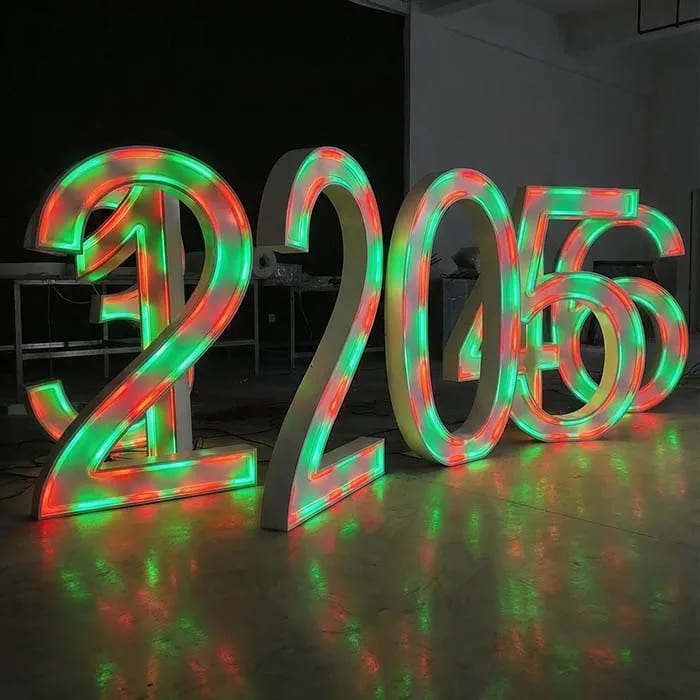
Real photo from our production floor — every sign we ship is made here.
From $24/letter · MOQ 1 piece · Flexible lead time · CE & UL certified · ships to 20+ countries
Custom sizes, colors, and finishes. Get a factory price in 24 hours.
Get a Free Quote Copy EmailWhatsApp +86 13865703472 · business@aochuangsign.cn
See pricing, specs, and get a free quote for the sign type you need. Built in our factory, shipped worldwide.