I've been on sign shop floors since 1998. 16 years of watching contractors argue about the same damn thing: how the sign actually attaches to the building.
The mount isn't a detail you sort out later. It changes your cost, your labor, your waterproofing, your NEC compliance, and what the sign looks like from the road. Get it wrong and you've got a $5,000 sign leaking water into a brick wall. Get it right and nobody notices the mount — which is the point.
Here's what nobody tells you: the cheapest mount on paper is rarely the cheapest after install.
Let me strip the jargon out of this. There are three ways to hang a sign on a building.
Raceway mount — A metal box, usually aluminum, 4 to 8 inches deep, bolts to the wall. Letters mount to the face of that box. All wiring runs inside the box. You get one or two big penetrations for power instead of twenty small ones. Ugly from the side, beautiful from the front, easy to service.
Direct mount — Letters mount straight to the wall surface. Each letter or group has its own small penetration for wiring. The power supply hides in the wall, above the ceiling, or in a remote enclosure. Cleanest look from every angle. Also the most on-site labor.
Flush mount — Letters sit flat against the surface with no visible gap. Usually non-lit or front-lit with a thin profile. No backlight halo. Used when you want the sign to disappear into the facade. Some people call direct mount "flush mount" and that drives me crazy.
I've seen this go wrong: three different customers in one month used "flush mount" to mean three different things. One wanted stud-mounted stainless letters. One wanted direct-mounted channel letters with no raceway. One wanted a recessed sign in a wall. All three said "flush." Specify your mount in writing, with a drawing.
This is what I recommend for 70% of storefront jobs. Not because it's the prettiest, but because it's the most predictable.
For front-lit channel letters on a strip mall, raceway is the default for a reason. One box, one conduit, one point of failure. You can pre-wire the entire sign at the factory, test it for 12 hours, then ship it. On site, the installer hangs the raceway, lands the main feed, and goes home. Total install time: half a day. Direct mount on the same job? Two to three days.
Raceway also solves the brick and CMU problem. Try drilling 40 clean penetrations through 100-year-old brick without blowing out the mortar. Now try drilling two. That's the raceway argument in one sentence.
Here's what it costs from our floor. A front-lit channel letter set ships from $20 to $80 per letter. The raceway adds maybe $40 to $150 total, depending on size. Compare that to US retail installed at $200 to $700 per letter. You're saving 50 to 65 percent buying factory-direct, and the raceway barely moves the number.
The ugly truth is some sign shops push raceway mounts because it makes their install crew's life easier, not because it's better for your building. A raceway hides the wiring, sure. It also hides sloppy work. If your wall is flat and you've got access behind it, direct mount looks better. Don't let someone sell you a metal box because they don't want to fish wire through a wall.
For architectural jobs, back-lit halo letters direct mounted to a stone or metal facade, there's no substitute. The letters float off the wall, the light spills behind them, and there's no box ruining the silhouette. This is what architects spec for hotels, corporate lobbies, and medical buildings.
But here's what nobody tells you: direct mount is a labor sinkhole on site. Each letter needs a penetration. Each penetration needs a sleeve, a connector, and silicone sealant. On a 12-letter sign, that's 12 holes, 12 grommets, 12 potential leaks. You need a lift, a drill, and a guy who actually knows how to seal around exterior penetrations. That guy costs $85 an hour in most US markets, and he's booked three weeks out.
The materials aren't the problem. Our halo letters run $35 to $120 per letter from the factory. The problem is the install bill. US retail for installed halo letters hits $400 to $1,000 per letter. That gap isn't product cost. That's labor, equipment rental, and the risk premium contractors charge for working at height on expensive walls.
Another thing: direct mount demands a real plan for the power supply. You can't just tuck it behind a letter. It goes in the wall cavity, in a plenum space, or in a remote weatherproof box with conduit run to the sign. If you're doing direct mount on a poured concrete wall with no cavity, you're running surface conduit, and at that point, why didn't you just spec a raceway?
Look, I sell direct mount signs every week. I'm not talking you out of it. I'm telling you to budget for the install before you order the sign. A $2,000 factory order for direct-mounted halo letters becomes a $7,000 installed project, minimum, once you factor US labor. Know that number going in.
This is the mount for stainless steel letters and aluminum letters. Non-lit, flat against the wall, held by studs or tape for interior jobs. You see this on law office doors, bank branches, and donor walls. The sign's not trying to shout. It's trying to belong.
Flush mount is the cheapest to produce and the cheapest to install. Our stainless non-lit letters run $15 to $40 per letter. Aluminum runs $10 to $25. Install is a matter of drilling pilot holes, inserting studs, and tightening nuts. No electrical. No waterproofing. A competent handyman can do 30 letters in a day.
But don't confuse flush mount with direct mount. Flush mount means no backlight, no halo, no dimensional gap. If you want lit letters that sit flat, you're back to front-lit channel letters with a raceway or a thin direct mount. If you want the halo glow, that's direct mount. Flush is for non-lit only.
The sign is half the cost. Shipping, tariff, and install are the other half, and everyone forgets them until it's invoice time.
Factory prices, let me be blunt. Front-lit channel letters: $20 to $80 per letter. Back-lit halo: $35 to $120 per letter. Stainless non-lit: $15 to $40. 3D fabricated: $40 to $120. Aluminum: $10 to $25. Light boxes: $80 to $250 per square meter. Neon flex: $30 to $200 per sign. MOQ is one piece. Lead time is 7 to 15 days. That's from our floor in Lu'an, Anhui — 3,000 square meters, 50 plus workers, exports worldwide.
Then you ship. Express for small stuff: 7 to 15 days, $30 to $100. Air freight: 10 to 20 days, $4 to $12 per kilo. Sea freight LCL: 50 to 70 days, $80 to $200 per cubic meter. Full container: $1,200 to $3,000. And if you're bringing this into the US, add roughly 30 percent tariff under Section 301. That tariff applies to the declared value. Don't let your supplier fudge the invoice. Customs isn't stupid, and the fine is yours.
The ugly truth is a $3,000 factory order for a lit sign becomes $4,500 to $5,500 landed in the US after freight and tariff. Still half of what a domestic shop charges. But it's not the $3,000 your spreadsheet said.
Here's a lie I hear constantly: "IP65 means it's waterproof." No. IP65 means dust-tight and protected from water jets from any direction. It does not mean your sign survives a Florida hurricane or a New England ice storm. For outdoor, IP65 is the floor. For coastal or high-exposure sites, push to IP66. IP68 is submersible, which is overkill for most signs but there if you need it.
Electrical compliance is a different animal in the US. NEC Article 600 governs signs. If your local inspector wants UL 48 listed product, that's a $4,000 to $15,000 certification, four to nine months, with quarterly audits. ETL is the cheaper alternative at 10 to 30 percent less. CE marking runs 20,000 to 50,000 RMB and takes two to eight weeks. Most factories say they have all three. Ask to see the certificate with today's date on it. Seriously. I've watched guys nod and hand over a PDF from 2019.
Warranty matters less than you think. Our LEDs carry two years, power supplies one year. Quality modules — Samsung, Osram, Blueview — run five plus years real lifespan. Cheap modules die in 12 to 18 months. A $15 savings on a power supply becomes a $400 service call on a 20-foot ladder. That's not a trade you want to make.
Ask yourself four questions.
That's the whole decision. Any sign shop making it more complicated than that is billing you for the confusion.
I'm going to be straight with you because that's how we keep customers for a decade. We manufacture signs in Lu'an, Anhui. We can pre-assemble your raceway, test the entire sign for 8 to 12 hours, and ship it crate-ready with foam, carton, and plywood. We can pre-drill stud patterns for direct mount and send a mounting template. We can include UL-listed power supplies and wiring diagrams. We cannot send an installer to your site. We cannot pull your permits. We cannot inspect your wall. That's on you or your contractor.
Our 10-step process is not a secret: design confirmation in one day, laser cutting at ±0.1mm in one to two days, TIG welding, grinding, CNC acrylic face, LED assembly, neutral silicone sealing, 8 to 12 hour aging test, 100 percent QC inspection, export packaging. Total: 7 to 15 days. You get a sign that's been lit on the bench for half a day before it ever leaves the shop. That catches dead modules before they hit your wall.
I've seen this go wrong: a customer ordered $12,000 in halo letters for a medical plaza, direct mount on a stone facade. Nobody specified the mount in the contract. The factory shipped with a raceway because that's the default. Customer refused the shipment. $3,000 in rework and four weeks of delay. All because one word was missing from the PO.
Specify your mount. Specify your IP rating. Specify your LED brand if you care. Put it in writing. A good factory will ask, but don't wait for them to ask.
Send photos of the wall. Not just dimensions. Photos. I want to see the brick, the stone, the stucco, the power access, the existing conduit. That tells me what mount you actually need better than any spec sheet.
Then confirm these three things: mounting method with a drawing, IP rating minimum IP65 for outdoor, and shipping terms. That's it. We'll handle the rest.
The mount isn't a footnote. It's the first thing the installer sees and the last thing the customer forgets.
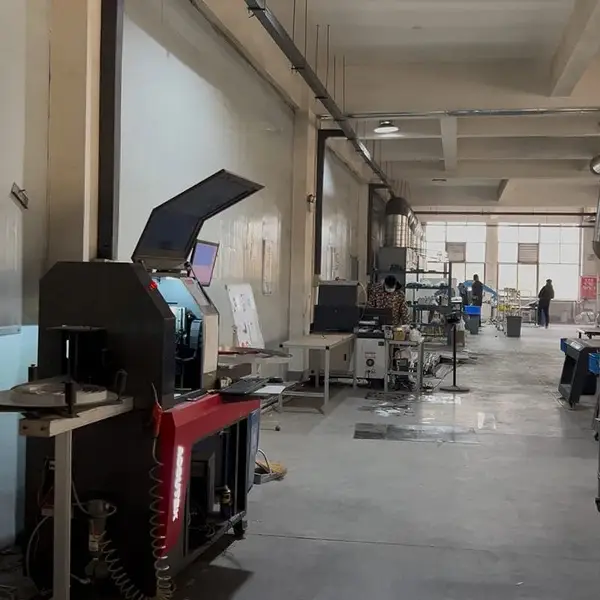
Real photo from our production floor — every sign we ship is made here.
From $24/letter · MOQ 1 piece · Flexible lead time · CE & UL certified · ships to 20+ countries
Custom sizes, colors, and finishes. Get a factory price in 24 hours.
Get a Free Quote Copy EmailWhatsApp +86 13865703472 · business@aochuangsign.cn
See pricing, specs, and get a free quote for the sign type you need. Built in our factory, shipped worldwide.