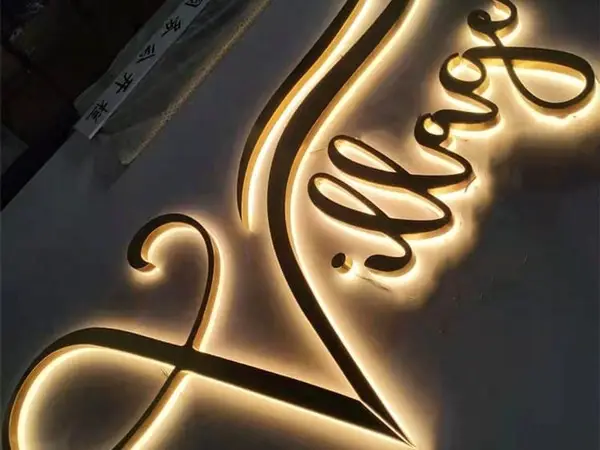
Here's what nobody tells you: The first quote you get from a Chinese sign factory isn't the real price. It's the "we hope you don't ask too many questions" price. I've been running a sign shop in Lu'an for over a decade, and I've watched buyers get burned by brokers who mark up 40% and pass off cheap LED modules as Samsung. So let's talk about how this actually works.
You're not buying a sign. You're buying a supply chain that hasn't screwed up yet.
The sign industry loves to hide behind jargon. "Project management," "quality control," "global sourcing." It's all fluff. What matters is whether the stainless steel is actually 304, whether the LED chips are actually Samsung or Osram, and whether the factory will own their mistakes when a shipment arrives with cracks in the acrylic. I've seen this go wrong a hundred times.
The math isn't complicated. A front-lit channel letter runs $20-80 per letter from a factory like mine. In the US, you're looking at $200-700 per letter installed. That's a 50-65% savings on the product itself. For a shop owner, that margin pays for your truck, your insurance, and your rent.
The ugly truth is that many US sign shops don't fabricate anymore. They're installers and project managers. They buy from China because they can't compete with the labor costs of welding stainless by hand in a union shop. And that's fine. We all need to eat.
But you need to know what you're getting into. A $15 aluminum letter from a Chinese factory is not the same as a $40 stainless steel letter. And a $40 stainless letter from a factory with a 3,000㎡ facility and 50+ workers is not the same as one from a guy working out of his garage with a broken TIG welder.
Let's break down the main product categories so you're not asking the wrong questions. When a buyer emails me "I need signs," I have to drag the specifics out of them. Don't be that buyer.
Channel Letters:
Metal Letters:
I'm going to tell you what the glossy brochure won't. The factory that sells you a "stainless steel" sign without specifying the grade is screwing you.
Stainless Steel 304 vs 316: 304 stainless has 18% chromium and 8% nickel. It'll last 10+ years outdoors. 316 adds 2-3% molybdenum, which makes it marine grade. It costs 20-30% more, and it's worth every penny if that sign is going anywhere near ocean salt. For a strip mall in Ohio, 304 is fine. For Miami Beach, pay for 316. I've seen this go wrong: a contractor bought a ton of "stainless" signs from a Chinese factory without specifying the grade, and they started showing rust pinpricks after 18 months. It was cheap stuff, not real 304.
Acrylic Face: Here's a trick many buyers don't know. The brand of acrylic matters. Mitsubishi or Degussa acrylic has 90-92% light transmittance and won't yellow for 5-8 years. Domestic Chinese acrylic will start yellowing in 1-2 years. The factory should tell you which one they're using without you asking. If they don't, run.
The thickness matters too. 2mm and 3mm are common, but if your letter face is over 2.5 meters, you need 5mm. Otherwise, the face will warp or crack in wind load.
LED Modules: This is where the industry's dirty secrets live.
SMD 2835 modules are the industry standard, 100-150 lm/W. Quality modules from Samsung, Osram, or Blueview will last a real 5+ years. Cheap modules from no-name Chinese brands? 12-18 months, and then your client's sign is going dark and you're paying for a service call.
SMD 5730 is higher brightness. Good for signs in direct sunlight, but they run hotter. SMD 5050 is for RGB—if that's your game.
The L70 rating is your friend. That's the hours until the LED hits 70% brightness. Look for ≥50,000 hours. And remember that "L70 rating" doesn't mean the sign dies at 50,000 hours. It means it gets dimmer.
Here's the entire process, from "I need a sign" to a crate on your dock. We'll use my factory's process as the standard because it's the one I know. Expect your chosen factory to have a similar flow.
Total time: about 5-15 days depending on volume and complexity.
The lead time is the lead time. Don't ask for a 3-day turnaround on 500 letters. It's not going to happen, and if someone says they can do it, they're going to skip steps 4, 8, and 10.
Let's be clear about certifications. They're not all created equal, and most buyers don't know what they're asking for.
UL 48 is the standard for electric signs in the US. Getting a UL 48 certification costs $4,000-15,000 and takes 4-9 months, plus quarterly factory audits. ETL is a UL alternative that runs 10-30% cheaper. If a factory claims to have UL, ask to see the certificate with today's date. They're not permanent.
CE is the European standard. It costs 20,000-50,000 RMB (about $3,000-7,000 USD) and takes 2-8 weeks. The problem is that CE is self-declared. You can stick a CE sticker on a brick if you want. So ask for the test report.
I've dealt with factories in Guangdong that claimed CE but didn't have an in-house EMC lab. Their signs were essentially unshielded light bulbs emitting radio noise. Don't be that buyer. Ask to see the test report. Not the certificate. The report with the test data.
IP65 is the minimum for outdoor. It means dust-tight and protected against water jets from any direction. It does NOT mean your sign survives a Florida hurricane. For coastal or extreme weather conditions, you want IP66 (powerful jets) or IP68 (submersible). Hmm.
But here's what's more important than the IP rating: the seam sealing quality. A sign can be IP68-rated and still leak if the welder did a poor job on the corners. Quality control is about the people, not the label.
Alright, let's talk money. Factory prices for channel letters generally look like this per letter:
For context, the US retail installed price for a front-lit letter is $200-700. For halo-lit, $400-1,000. When you can buy the same quality product factory-direct for $120, the math is straightforward.
Shipping is where you'll lose the margin.
Then there's the US Section 301 tariff on Chinese goods. It's hovering around 30%. You need to factor this into your total landed cost. We as the manufacturer have to note that we are not immune to this. When you get those documents from customs, don't be surprised. We recommend our clients use a customs broker who can sometimes find the right HS code and partially mitigate this. But it's part of the game.
I've been importing since 2010. I've made every mistake it's possible to make, and I've seen the same mistakes from my clients. Here are the big ones to avoid.
Mistake #1: Not providing vector artwork. You send a JPEG of your logo and expect it to scale to 3 meters. It'll be pixelated garbage. Send an AI, EPS, or CDR file. Better yet, send it via WeChat so we can review it together.
Mistake #2: Asking for samples only. The sample is always gorgeous. The factory knows you're going to hold it and measure it. The risk is the production batch. That's why I tell every new client: Ask for a low-volume first order. 20 letters. If the quality is consistent, order 500. Asking for "a sample" is fine for testing materials, but it won't protect you from production quality.
Mistake #3: Not specifying your environment. Where is the sign going? A desert in Arizona? A beach in Miami? A factory in Detroit? That changes the acrylic specification, the LED color temperature, and the stainless steel grade. Indoor or outdoor? I've seen a designer specify a 2mm acrylic face for an outdoor sign in a windy area. It cracked after two weeks.
Mistake #4: Ignoring color temperature. LED color temperature isn't just an aesthetic choice. For hospitality, you want 3000-3500K warm. For corporate/retail, 4000-5000K neutral. For industrial/highway, 6000-6500K cool. Specify this in Kelvin, not "white." I can't tell you how many times a client says "white" and means daylight when I interpreted it as warm.
Mistake #5: Not checking the power supply. The LEDs are only as good as the power supply. A cheap $5 LED driver will kill a $500 LED setup. Insist on quality brands. We use Mean Well and similar.
You should demand these five things before placing an order:
When you email a factory, make it easy for them to give you a useful quote. Include:
Show that you've done some homework. A buyer who says "I need a sign" gets a canned quote. A buyer who says "I need 50 front-lit channel letters, 30cm return depth, 5mm acrylic, Samsung 2835 LEDs, with 6000K color temp, plus 10 backlit halo letters with 2mm return" gets a specific, accurate quote. And that buyer gets prioritized.
The label "factory to buyer" matters. No middlemen.
I've been in this trade since 2010. Our factory, Aochuang Sign, is located in Lu'an, Anhui, China. We've got a 3,000㎡ production facility, 50+ skilled workers, and we export worldwide. We have CE, RoHS, and ISO 9001 certifications. Our MOQ is 1 piece. It's not our goal to promise you things we can't deliver. It's our goal to be the kind of supplier you still trust after five years.
Look, we're direct. We don't have a sales team that tells you what you want to hear. We have engineers and shop floor guys who've built signs for 16 years. The best way to find out if we're the right fit is to send us your drawings, ask for pricing, and see what we say when you ask "why is it that price?"
We can often point to the materials. That builds trust.
A sign is one of the first things a customer sees at your client's business. The margin is good, but the relationship is better. When you get it right with a good factory, you'll both be making money for years..

Real photo from our production floor — every sign we ship is made here.
From $24/letter · MOQ 1 piece · Flexible lead time · CE & UL certified · ships to 20+ countries
Custom sizes, colors, and finishes. Get a factory price in 24 hours.
Get a Free Quote Copy EmailWhatsApp +86 13865703472 · business@aochuangsign.cn
See pricing, specs, and get a free quote for the sign type you need. Built in our factory, shipped worldwide.