Eleven pm. I just got off a call with a contractor in Texas who paid $740 per letter for 24 front-lit channel letters. Same 304 stainless, same Samsung LED modules, same acrylic face we ship factory-direct for $120 a letter. By the time he knew the difference, the project had already blown its budget. I've had this conversation more times than I can count.
I've been building signs since 2010. I've burned my hands on hot acrylic, argued with LED suppliers about solder joints, rebuilt signs after coastal storms tore cheap aluminum apart. I work at Aochuang Sign in Lu'an, Anhui, China. We run 3,000 square meters of production space, fifty-plus workers, export orders worldwide. I'm not a content marketer. I'm the guy who knows which acrylic yellows in two years and which one doesn't.
Nobody tells you this: most sign buyers don't lose money on the sign itself. They lose it on the replacement. Cheap LED modules last 12-18 months. Quality ones from Samsung, Osram, or Blueview run five-plus years of real lifespan. That's not a warranty claim. That's what happens on the wall.
A real sign manufacturer isn't a middleman with a laser cutter. We handle design confirmation, laser cutting, bending, TIG welding, grinding, polishing, CNC routing, LED assembly, sealing, aging tests, QC, and export packaging. Ten steps. Our lead time runs about 5-15 days—not because we rush, but because the process is tight.
Laser cutting hits ±0.1mm tolerance. Bending and welding take one to two days. Then we grind and polish. Then we CNC-route the acrylic face. LED assembly follows. We seal with neutral silicone. Every sign then runs an 8-12 hour aging test. Then 100% QC inspection. Then foam, carton, plywood crate. If a factory can't describe that process in detail, walk away.
Ugly truth: many "sign manufacturers" are just trading companies with a website. They don't own the floor. They can't tell you which SMD chip is in the module or whether the stainless is 304 or 316. When you ask for a certificate with today's date, they sweat. That's the test.
Materials aren't interchangeable. Acrylic LED letters live or die by the acrylic face. UV-resistant acrylic from Mitsubishi or Degussa lasts 5-8 years outdoors. Domestic stuff yellows in 1-2 years. Light transmittance sits at 90-92%. A 3mm face cuts 92% light output. A 2mm face cuts 90%. Your customer won't notice the 2%, but they'll notice the 40% cost bump if you buy thicker than you need.
For anything over 2.5 meters wide, use 5mm or thicker acrylic. Don't argue. Sagging is a real thing in sun and wind.
Stainless steel is a different animal. 304 stainless steel letters will run 10-plus years outdoors. The alloy has 18% chromium and 8% nickel. Density sits at 7.93g/cm³. Common thickness runs 1.0-3.0mm. For a strip mall in Ohio, 304 works fine.
But 316 stainless has 2-3% molybdenum. It's marine grade. It survives 15-plus years in coastal or industrial air. It costs 20-30% more. For Miami Beach, pay for 316 or you're replacing letters in three years. I've seen this go wrong: a signage company spec'd 304 for a beachfront restaurant in Florida. Three years later, pitting corrosion showed up. The client blamed the sign maker. The real problem was the spec.
Aluminum weighs one-third of steel and lasts 8-12 years outdoors. You'll typically see 1.0-1.6mm thickness. It's naturally rust-proof. Anodized, powder coated, brushed. Fine for interior or moderate exterior. But in high wind or impact zones, steel holds better.
CE marking costs 20,000-50,000 RMB and takes 2-8 weeks. Most factories claim they have it. Ask to see the certificate with today's date. Watch them sweat. We hold CE, RoHS, and ISO 9001. Ask for proof.
UL 48 is a different beast. It costs $4,000-15,000 and takes 4-9 months, with quarterly audits. ETL is the cheaper alternative, 10-30% less. US electrical code falls under NEC Article 600. If someone promises UL in two weeks, they're lying.
IP ratings tell you about dust and water resistance. IP65 means dust-tight and water jets from any direction. It does NOT mean your sign survives a Florida hurricane. IP66 handles powerful jets. IP68 handles submersible conditions. Minimum outdoor rating should be IP65. Coastal or extreme weather, go IP66 or higher.
Look, certifications matter. But they don't replace a real aging test. We run every sign 8-12 hours powered before it leaves the floor. That catches solder joint failures, bad modules, loose connections. No certificate catches those.
Factory prices per letter usually run: $20-80 for front-lit channel letters, $35-120 for back-lit halo, $15-40 for stainless non-lit, $40-120 for 3D fabricated, $10-25 for aluminum. Light boxes run $80-250 per square meter. Neon flex runs $30-200 per sign. Ordering front-lit channel letters for a storefront? That's your range.
US retail installed prices run $200-700 per letter for front-lit, $400-1,000 for halo. Factory-direct savings run 50-65% on product. But you still need to handle shipping and installation. Don't ignore that.
Shipping depends on how fast you need it. Express takes about 5-15 days and costs $30-100 for small parcels. Air freight takes about 10 days at $4-12 per kg. Sea freight takes about 65 days. LCL runs $80-200 per cubic meter. FCL runs $1,200-3,000. US Section 301 tariff adds about 30%. Factor that in.
Here's the part nobody tells you: LCL sea freight means your crate gets handled six to eight times between our dock and yours. Every touch invites damage. That's not in the brochure. If your sign has delicate faces or exposed edges, pay for better crating or choose air freight.
Our MOQ is one piece. Most factories demand ten or twenty. Ours doesn't. Lead time runs about 5-15 days. Warranty: two years on LED, one year on power supply. Real numbers. Not sales fluff.
Quickest way to spot bad LED modules: look at the solder joints. Dull gray means lead-free solder was done wrong. Those modules won't last 18 months. Shiny silver means proper lead-free solder. That's the difference between a sign that fails in a year and one that lasts five.
SMD 2835 chips are the industry standard. They run 100-150 lumens per watt. SMD 5050 handles RGB. SMD 5730 gives 40-60 lumens per chip—the highest brightness. L70 is rated at 50,000 hours minimum. Quality modules last 5+ years real lifespan. Cheap ones die in 12-18 months. Ugly truth: some factories buy reject modules from other lines and pass them off as new. We don't.
After LED assembly, we seal with neutral silicone. Aging test. QC. Export packaging: foam, carton, plywood crate. If the crate doesn't protect the corners, the sign arrives damaged. I've seen it happen.
For back-lit halo letters, you mount the LED behind the letter so light spills onto the wall. It's a premium architectural look. US retail installed runs $400-1,000 per letter. Factory price is $35-120. Same materials, same process. The difference? The distribution chain.
Can you match a Pantone color exactly? For powder coat or baked paint, yes. For acrylic, no. Acrylic comes in standard color grades and translucency levels. If your brand color is hyper-specific, use a printed vinyl face or a painted metal return. Don't expect a 5mm acrylic sheet to nail Pantone 294 C perfectly.
Why is sea freight so slow? Because your crate sits in a container on a dock, then a ship, then another dock, then customs, then a truck. Fifty to seventy days is normal. Need it next month? Use air freight or express. Stop asking why your ocean shipment hasn't arrived in two weeks.
Do you install signs in the US? No. We manufacture. We can coordinate shipping and send detailed installation drawings. But you'll need a local licensed sign contractor for the install and permitting. Anyone who says they'll handle your US install from overseas is lying.
Is 316 stainless really worth 20-30% more? If you're within a mile of salt water or heavy industrial air, yes. Inland? 304 is fine. Don't overpay for 316 in Ohio. Don't underpay for 304 in Miami. It's not complicated.

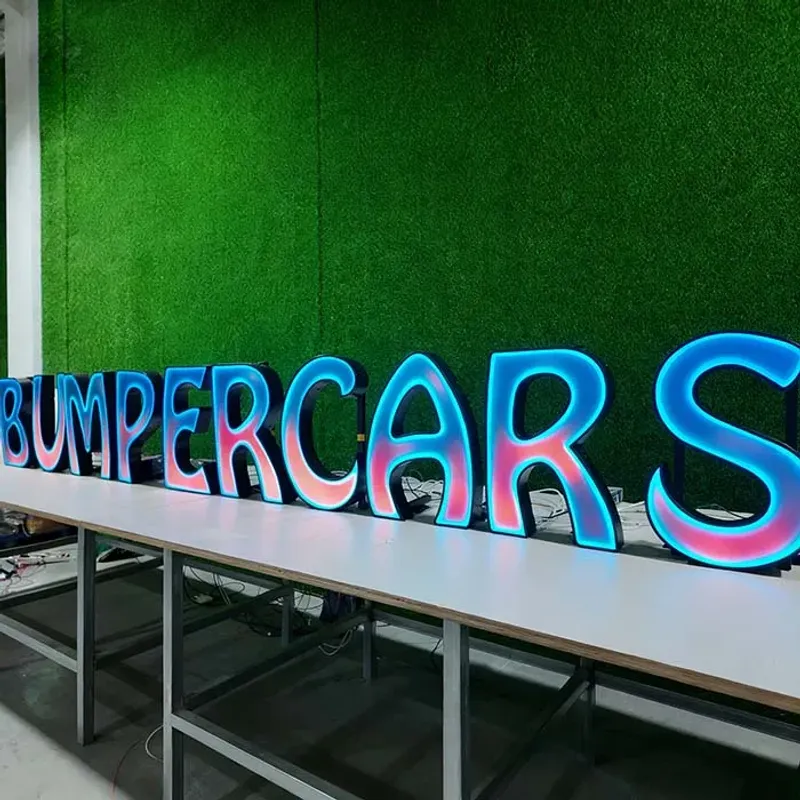
Real photo from our production floor — every sign we ship is made here.
Products mentioned or relevant to this topic — factory-direct, custom built.
From $24/letter · MOQ 1 piece · Flexible lead time · CE & UL certified · ships to 20+ countries
Custom sizes, colors, and finishes. Get a factory price in 24 hours.
Get a Free Quote Copy EmailWhatsApp +86 13865703472 · business@aochuangsign.cn