I've watched sign shop owners pick the wrong LED module because a glossy brochure promised 200 lumens per watt. That number came from a laboratory cold plate, not a sun-baked storefront in Phoenix. Here's what nobody tells you: compare LED types by the light that actually ends up inside your channel letter, not the chip-on-paper rating.
After 16 years on the factory floor, I've handled reels of all three SMD types—2835, 5050, 5730—and seen the fails. Some failures were spectacular: an entire bank chain's red channel letters glowing pink after 14 months because a purchasing agent fell for the "same specs, half the price" lie. The ugly truth is that a module's real lifespan isn't in the datasheet. It's in the phosphor quality, the heat dissipation, and whether the factory used genuine Samsung dice or mystery chips from a back-alley supplier.
Aochuang Sign builds over 50,000 letters a year. We don't gamble on cheap LEDs. But we also don't upsell you on features you don't need. This guide will lay out exactly what SMD 2835, 5050, and 5730 modules do—and don't do—so you can spec your next front-lit channel letters or back-lit halo letters without getting burned.
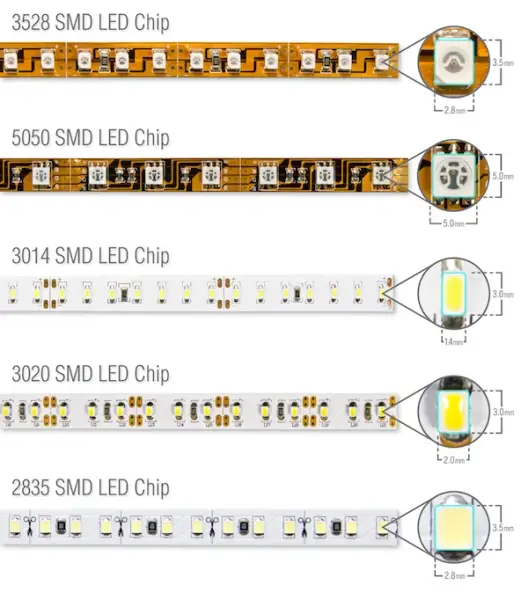
Let's pin down what these SMD codes actually mean. "SMD" is Surface Mounted Device. The number is the package dimensions in tenths of a millimeter. A 2835 measures 2.8mm × 3.5mm. A 5050 measures 5.0mm × 5.0mm. A 5730 measures 5.7mm × 3.0mm. Size matters for light output, heat management, and how tightly you can pack modules in a narrow stroke.
I've seen this go wrong: a contractor used fat 5050 modules inside 1-inch stroke letters. The light looked like a string of Christmas bulbs, not a smooth glow. You can't fix that with a diffuser. You either use smaller 2835s or switch to rimless channel letters with an edge-lit design. The module footprint dictates the sign's aesthetic as much as any paint color does.
Efficiency: 100-150 lumens per watt. That's the genuine range, not the inflated marketing number. Our factory tests show 120-130 lm/W for decent Samsung-based 2835 modules at the drive current we actually use—not the 0.5 mA they ran in the lab. These chips are small, cheap, and you can pack a lot of them per meter. If you need even illumination across a 3-foot letter face, 2835s are your go-to.
Look, 80% of front-lit channel letters on American strip malls use 2835 modules. They'll give you solid white light at 6000-6500K, the cold blue-white that screams "open for business." With quality modules—think Samsung or Lan Jing—real outdoor lifespan hits 5+ years before hitting L70, the point where light output drops to 70% of original. Cheap 2835s? Those die in 12-18 months. I've dug failed strips out of sign returns. The phosphor turns brown. The adhesive backing turns to chalk. That's what 3 cents a module buys you.
SMD 2835s dominate warm white too. For a restaurant's food menu signs or a hotel's indoor lobby letters, we run 3000-3500K warm. The soft glow makes stainless steel faces look like they cost twice as much. Just remember: a 2835 isn't your brightest choice per single chip. For a huge 6-foot letter with only 2-inch sides, you might need something with more punch.
The 5050 module is physically larger, with three LED dice inside one package. On paper, that means higher output. In reality, it's the RGB workhorse. You can put a red, green, and blue die in the same chip and mix colors. For a nightclub's neon flex signs or animated channel letters that chase rainbow patterns, 5050 RGB is the right tool.
Here's what nobody tells you: most channel letters don't need RGB. They need solid, uniform white. If you're buying white 5050 modules for a standard storefront, you're paying extra for dice you'll never individually control. White 5050s exist, but their lumen-per-watt falls between 80-110, noticeably lower than 2835. The larger footprint makes them harder to hide. I've seen a dealer sell a contractor 5050 because "it's more versatile." The sign ended up with visible hotspots and 30% higher module cost. Rookie mistake.
Now, if you genuinely need a sign that turns from white to red at night, 5050 RGB with a smart controller is your answer. Just budget for waterproof connections. The cables are thicker, the controllers add $40-120 per sign, and the color-changing will never be as brilliant as dedicated single-color modules. But for a bowling alley or a bar, it's the only way to get that effect.
These 5.7mm long chips push 40-60 lumens per chip. That's brute force. In channel letters, 5730 modules deliver the highest brightness for applications where the sign has to punch through direct sunlight on a south-facing wall. I'm talking bank headquarters, auto dealership pylons, highway-facing and monopole signs where dim equals invisible. For dual-lit channel letters that glow white on the face and blast light out the back, 5730 modules earn their keep.
The ugly truth is that 5730s run hot. Pack them too tight inside a sealed letter, and you'll cook the solder joints. Our production team spaces them at least 20% wider than 2835s. We also upgrade to aluminum-backed PCBs that wick heat toward the letter's metal returns. Without proper thermal management, those 60,000-hour L70 ratings evaporate to 20,000. I've torn apart failed 5730 signs where the module's own heat yellowed the acrylic face. That's a costly replacement.
Are they efficient? Less than you'd think. Because the chip is bigger and driven harder, you get about 90-110 lm/W in real conditions. The 40-60 lumens per chip is absolute output, not per watt. A string of 5730s can drink 14 watts per foot versus 9 watts for 2835 at the same visible brightness. Factor that into the power supply cost. A bigger transformer, heavier wiring, and slightly more heat in the building's electrical bill. Worth it when you need the lumens, wasteful when you don't.
Let's cut the crap. Here's when to pick which module, no exceptions.
Sellers love throwing around "L70 ≥50,000 hours." That number means nothing without test conditions. At Aochuang, we do 8-12 hour aging tests at 45°C ambient, not 25°C. Here's a trick: ask the supplier for the TM-21 report that projects L70 based on LM-80 test data. If they stare at you blankly, walk away. The actual L70 of a decent Samsung 2835 driven at 150mA is around 54,000 hours. A no-name chip at the same current might hit 30,000. Pay the extra 40% for the brand module. You'll avoid service calls five years down the line.
Look, IP65 rating means the module can handle water jets from any direction. It does not mean it's submersible. For channel letters that will face sideways rain, make sure the module's connector boots are silicone, not rubber. Rubber hardens over time. Silicone doesn't. Every module we ship goes through a 100% QC check with a 30-second water spray test before packing. Still, IP68-rated modules (submersible) are overkill for channel letters unless the sign will sit in a fountain. Don't pay 15-25% more for something you don't need.
A roll of cheap 2835s might save you $6 per letter. Over 50 letters, that's $300. One boom lift rental to replace a failed sign costs $400 minimum. I've replaced entire channel letter sets because the owner thought saving $200 on modules was smart. The labor alone to dismantle a facade sign runs $600 per visit. Our factory guarantees 2 years on LED modules, 1 year on power supplies. We can do that because we use genuine Samsung, Osram, or Lan Jing—not recycled or "equivalent" dice.
Stainless steel letters compound the issue. A stainless steel letters sign with mirror finish costs $40-120 each from our factory. Glue in cheap modules that flicker after a storm and you've turned a premium monument into a maintenance headache. The same logic applies to aluminum letters: lightweight, rust-proof, but a failed LED behind an opaque face means you can't just swap a lamp. You dismantle the whole letter.
Can I mix 2835 and 5730 in the same letter? Don't. Nine times out of ten you'll get uneven color temperature and brightness bands that ruin the face. If you need to boost brightness at the bottom of a tall letter, use more modules, not different chip types.
Do 5050s make better white than 2835s? No. The three-die structure of a white 5050 is actually less efficient because the phosphor conversion layer is larger. Stick with a properly specced 2835.
Which module handles the Florida sun best? SMD 5730 handles high ambient heat better because the larger chip spreads thermal load—if you use an aluminum PCB. But the real trick is the power supply: keep the driver in a vented compartment, not sealed inside the letter. Heat rises and cooks the capacitors.
We don't force you into bulk module orders. Our MOQ is one piece for channel letters. But when you specify Samsung 5730 modules for a single 12-inch letter, we'll charge a small premium because we have to break a reel. That's honest. Most factories won't tell you that upfront; you'll just see a mysteriously inflated quote. At Aochuang, the module cost is what it is: $4-12 per meter for 2835s, $8-16 for 5730s, depending on IP rating and chip brand. I'd rather lose a sale than ship junk that fails and tarnishes your reputation.
Shipping matters too. Express takes 7-10 days and costs $30-100 for a small box of signs. But if you're importing 200 front-lit letters on a pallet, sea freight at $80-200/m³ LCL gets the modules here slowly but affordably. We pack each letter in foam, then carton, then plywood crate. The modules sit inside their sealed letters, fully tested, ready to wire. You don't have to guess if the LEDs survived the ocean crossing.
After 16 years, I have a drawer full of failed modules from every brand imaginable. The ones that last are boringly consistent: Samsung 2835 (120-130 lm/W real), driven at conservative currents, on 2mm aluminum PCB, sealed with neutral silicone. That's the heart of a million-dollar sign program. The disappointing ones are always the "bargain" 5730s that were actually over-driven 2835s in a bigger package. The fantasy ones are 5050s sold as "high brightness white" when they were just leftover RGB stock re-binned as single color.
Here's my last piece of no-BS advice: for 95% of channel letter projects, a quality 2835 module in the right color temperature will outperform any supposedly "higher spec" alternative. Buy the right tool, not the shiny one. And if your supplier can't tell you the bin number and the LM-80 certification agency, find a supplier who can. Or just call us. We'll shoot straight.
Products mentioned or relevant to this topic — factory-direct, custom built.
Factory-direct since 2010. Free quote within 24 hours — no obligation.
Get a Free Quote →MOQ: 1 piece · 7-15 days · 2-year warranty · Worldwide shipping
See pricing, specs, and get a free quote for the sign type you need. Built in our factory, shipped worldwide.