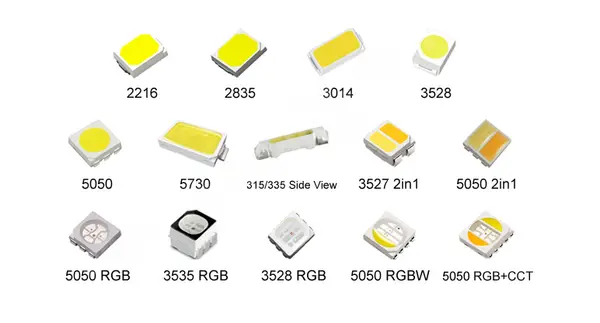
I've opened up channel letters after a year of Florida sun and seen 2835 modules turned into dim, flickering nightmares. Here's the ugly truth: most shopping comparisons are written by people who've never snipped a wire. I have. I've got the burn scars from a hot-wire bender and a memory full of modules that didn't live up to the promise. If you're trying to figure out which SMD LED package belongs in your front-lit channel letters, you're in the right place—but hold on to your coffee. This is going to be blunt.
Look, I'll bottom-line it right now. For 90% of storefront signs, a quality 2835 module at 4000K will make your customer happy and keep you out of warranty hell. The 5050 is king of RGB and nothing else. The 5730 is a beast when you need maximum punch in a tiny stroke—but it'll cost you. Forget anything you've read on a blog that mentions "lumen density" like it's a wine note. Let's talk brass tacks.
SMD 2835, 5050, and 5730—the numbers give you the package footprint in tenths of a millimeter. A 2835 is 2.8mm x 3.5mm. A 5050 is 5.0mm x 5.0mm. The 5730 is 5.7mm x 3.0mm. That seems like trivia, but it's the foundation of every decision you'll make.
I've seen this go wrong: a fabricator ordered 5050 modules for standard 2-inch stroke channel letters because some YouTube video said "5050 is brighter." The letters looked great on the bench, but after 18 months, half the modules had cooked themselves. Why? The 5050 package generates more heat per module. In a narrow stroke without enough aluminum coil for heat-sinking, you're building an oven. The 2835's smaller footprint lets you distribute light evenly with more modules, running each at lower current. That's the secret to real-world longevity, not some lab number.
The 5730 is the oddball. It's about the same width as a 5050 but slimmer. That makes it ideal for ultra-narrow returns or halo-lit letters where you're wedging modules into a tight reveal and need every lumen. But it's a hot chip, no question. Mount it on a quality aluminum PCB—if your supplier uses FR4 fiberglass, walk away.
Here's what nobody tells you: luminous efficacy isn't lumen output. The 2835 in the right bin delivers 100-150 lumens per watt. That's the industry standard for a reason. A single 2835 LED die uses about 0.2-0.5 watts and pushes out enough light that your acrylic face diffuses it cleanly. The 5730 runs 0.5 watts per chip and can spit out 40-60 lumens per chip—the highest single-chip brightness in our lineup. The 5050, in its common RGB form, has three tiny dies inside that each do 6-8 lumens for red, green, and blue. You're not using a 5050 white for brightness; you're using it for color tricks.
I've tested modules from factories that claim "200 lumens per watt from 2835." They were driving the chip at 100mA on a PCB with no thermal management. The light was blistering at first, then dead within 600 hours. The ugly truth is that factory lumens are often measured at 25°C junction temperature—your sign's insides can hit 70°C. Derate everything by 20-30%. Don't chase spec-sheet lumens; chase known-good module brands like Samsung, Osram, or Lan Jing list L70 at 50,000 hours. That's the number that says "after 50,000 hours, you still have 70% light." Cheap modules hit L70 in 12-18 months. I've replaced them. It's not fun.
Look, if you're lighting a 4-foot channel letter with a 3mm acrylic face, a 2835 module every 4-5 inches gives a smooth wash. The 92% light transmittance of acrylic doesn't care whether the LED behind it is a 2835 or a 5730, but the difference shows in hot spots. With a 5730, you'll need fewer modules—but if you space them too wide, you'll create a scalloped light pattern that makes your sign look like a 1990s dot-matrix printer. I see this rookie mistake constantly: overconfidence in brightness, under-respect for even distribution.
For white light, you're choosing 3000-3500K warm for a restaurant, 4000-5000K neutral for a corporate lobby, or 6000-6500K cool for a roadside pylon. The 2835 and 5730 come in
Products mentioned or relevant to this topic — factory-direct, custom built.
Factory-direct since 2010. Free quote within 24 hours — no obligation.
Get a Free Quote →MOQ: 1 piece · 7-15 days · 2-year warranty · Worldwide shipping
See pricing, specs, and get a free quote for the sign type you need. Built in our factory, shipped worldwide.