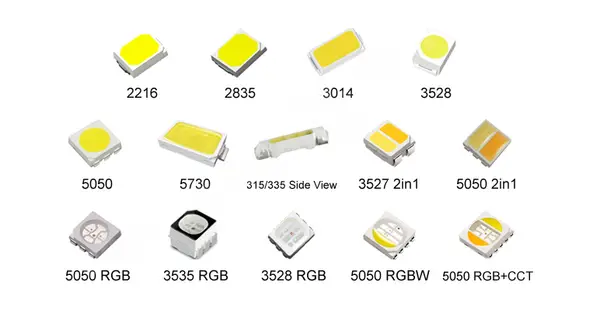
Look, I've spent 16 years on the factory floor. I don't care about datasheet jargon. I care about what burns out and what doesn't. Here are the three SMD packages you'll actually see in channel letters.
SMD 2835 is 2.8mm by 3.5mm. It's the industry standard. These are the workhorse diodes that put out 100-150 lumens per watt. If you order a white front-lit channel letter and don't specify, you're getting 2835. They're cheap, they spread light evenly, and they run cool enough to not cook the acrylic.
SMD 5050 is 5.0mm by 5.0mm. It packs three diodes in one package, so it can do RGB color mixing. That's the main reason to use it. For single-color white, it's not more efficient than 2835. It just makes more heat.
SMD 5730 is 5.7mm by 3.0mm. It's the brightness king per chip, pushing 40-60 lumens per chip. Use it when you need fewer diodes punching through deep returns or thick acrylic. But spacing matters, or you'll get hot spots that look like dotted lines instead of a clean face.
Here's what nobody tells you: raw lumens don't mean a damn if the spacing's wrong. I've seen signs with 5730 modules packed too close, and they looked like a runway, not a sign.
2835 modules are small. You can mount them every 2-3 inches and get smooth, even illumination behind 3mm or 5mm acrylic. That's why we default to them on front-lit channel letters. For a 24-inch letter, the 100-150 lm/W rating means less power draw and less heat for the same visible brightness.
5050 RGB modules need a controller and extra wiring. If your client wants a bar sign that fades from red to blue, fine, that's the tool. But if they ask for white and something cheaper, don't let a salesman talk you into 5050 because it sounds premium.
5730 modules throw more light per chip. I spec them on deep channel letters where the face sits 5 inches or more from the back. They're also good for light boxes with thick acrylic or heavy ink coverage. But you'll use fewer modules, and that can be a blessing or a hot-spot curse. Spacing is on you.
Color temperature matters more than diode size. I've had clients pick 5050 RGB but then choose 6500K white for a hotel lobby. That's a mismatch. For hospitality, you want 3000-3500K warm white. For corporate and retail, 4000-5000K neutral. For a truck stop off I-80 or industrial signage, 6000-6500K cool. If someone sells you 5050 RGB for a hotel front desk, they don't know signs.
The ugly truth is that "L70 ≥ 50,000 hours" is a lab number. It means the diodes still emit 70% brightness after 50,000 hours under controlled temperature and current. It doesn't mean your sign in Phoenix, Arizona will run for 5.7 years without problems.
What actually kills LED modules in channel letters? Heat and cheap drivers. I've pulled modules out of signs where the diode was fine but the power supply had swollen capacitors. Warranty on the LED was 2 years. Warranty on the power supply was 1 year. Guess which one died first.
Quality modules with Samsung, Osram, or Lan Jing diodes last 5+ years in real outdoor conditions. Cheap no-name modules? 12-18 months. I've seen it happen. Not once. Dozens of times.
We offer both. We don't hide it. If your client needs to cut cost, I'll sell you domestic modules and tell you the truth: you'll be back in 18 months. If it's a repeat client or a high-end install, don't do that.
I've seen this go wrong: a contractor in Texas ordered 50 white channel letters with 5050 modules because a supplier said "bigger chip, brighter sign." He saved nothing. He got heat, uneven light, and a $6,000 redo.
Here's what nobody tells you: white 5050 modules are often less efficient than 2835. The extra size doesn't add lumens per watt. It adds thermal mass that traps heat. For white single-color, 2835 wins on cost, light quality, and lifespan. Period.
5730 isn't a magic bullet either. If your letter stroke is under 4 inches, 5730 is overkill. You'll run fewer modules, but the light won't spread evenly unless you add diffusers or increase the can depth. That costs money. Just use 2835.
Look, I'll give you factory numbers. Front-lit channel letters from us run $20-80 per letter. Back-lit halo letters run $35-120. That's before shipping and import tariffs. The LED module type doesn't swing that price as much as you'd think
Products mentioned or relevant to this topic — factory-direct, custom built.
Factory-direct since 2010. Free quote within 24 hours — no obligation.
Get a Free Quote →MOQ: 1 piece · 7-15 days · 2-year warranty · Worldwide shipping
See pricing, specs, and get a free quote for the sign type you need. Built in our factory, shipped worldwide.