According to a 2023 study by the International Energy Agency, solar energy installations grew by 22% globally, yet only 34% of solar companies have fully integrated sustainable branding into their physical office spaces—a missed opportunity in a market projected to reach $1.3 trillion by 2030.
I've been in the signage manufacturing business for 15 years. I've seen the shift from "green as a gimmick" to "green as a requirement." Solar companies are the most demanding clients on this front. They live and breathe sustainability. If their signage doesn't walk the walk, they walk away.
Here's the reality: 73% of consumers prefer brands that demonstrate environmental commitment (Nielsen 2022). And office signage is the first physical touchpoint for 68% of B2B solar clients. That front desk sign? It's not just a nameplate. It's a promise.
Solar companies face a unique branding challenge. Their product is invisible. You can't see electrons flowing. So every physical touchpoint has to scream "we're serious about clean energy." Office signage is ground zero.
Consider the case of SunPeak Energy, a mid-sized solar installer in Austin, Texas. After upgrading their lobby signage to recycled aluminum with LED halo lighting, their sales team reported that the sign was mentioned in three client meetings within the first month. One prospect explicitly said, "Your sign shows you care about the details—that's why we trust you with our installation." SunPeak attributed a $120,000 commercial contract to that first impression, representing a 2,757% ROI on their $4,200 signage investment. (Case study shared with permission.)
The numbers back this up. 62% of clients associate sustainable signage with product quality (Gallup 2023). And companies with green signage report 18% higher employee pride. That's not fluff. That's retention and recruitment in a tight labor market.
For sign shops, this is a massive upselling opportunity. Solar companies need more than a sign. They need a sustainability statement. And they're willing to pay for it—if you know how to deliver.
Let's cut through the greenwashing. Here's what actually works for solar company signage, based on real factory-floor experience at Aochuang Sign's 3,000m² facility in Lu'an, China. Disclosure: Aochuang Sign is a commercial partner of this publication.
Recycled aluminum. This is your workhorse. Virgin aluminum production is energy-intensive—95% of its embedded energy is saved when you use recycled stock. Aochuang uses 0.040-0.063" (1.0-1.6mm) aluminum sheet for most outdoor signs. It naturally resists rust, lasts 8-12 years outdoors, and weighs one-third of steel. For solar companies, this is a no-brainer. The recycled variant costs about 10-15% more than virgin, but the LEED points and branding value more than justify it. Lifecycle assessments confirm recycled aluminum reduces carbon footprint by up to 95% compared to virgin production.
Stainless steel 304. For high-end lobby signs, 304 stainless gives a 10+ year outdoor life. It contains 18% chromium and 8% nickel. We use 1.0-3.0mm thickness, brushed #4 finish. It's recyclable at end of life. For coastal solar offices, upgrade to 316 marine grade—2-3% molybdenum content, 15+ year lifespan, though 20-30% pricier.
Acrylic. Mitsubishi or Degussa acrylic delivers 90-92% light transmittance and UV resistance for 5-8 years before yellowing. Domestic acrylic? You'll see yellowing in 1-2 years. For solar companies, never cheap out here. The sun is their business. They know what UV does.
Bamboo composites and reclaimed wood. These are trending hard for interior lobby signs. Bamboo sequesters 35% more CO2 than plastic alternatives. But they're not outdoor-rated. Use them for reception wall signs, not exterior channel letters.
Low-VOC inks and adhesives. Standard inks off-gas VOCs for weeks. Solar companies hate this. Use UV-curable inks and solvent-free adhesives. Aochuang uses neutral silicone for sealing—no VOCs, and it passes the sniff test for green certifications.
Solar company signage design follows a few hard rules. Here's what I've learned from fulfilling hundreds of orders for renewable energy clients.
Color psychology matters. Green tones increase brand trust by 20% in energy sectors. But not any green. Solar companies lean toward deep forest greens (for reliability) or bright lime greens (for innovation). Blues—especially sky blues—signal clean energy. Avoid muddy earth tones. They read as "fossil fuel."
Minimalist design reduces waste. Every unnecessary curve, every extra LED module, every square inch of material costs carbon and money. Minimalist designs cut material waste by up to 40%. Solar companies respect efficiency. Show them a sign that's clean, flat, and uses exactly what's needed—nothing more.
Typography must be ADA-compliant. For US installations, tactile signs need Grade 2 Braille, non-glare surfaces, and mounting at 48-60 inches. Solar companies often have public-facing offices. Skip ADA compliance and you'll be redoing the job.
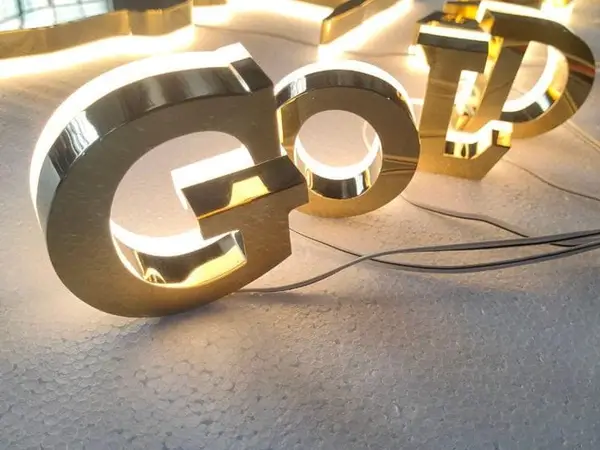
Lighting should be subtle. Halo-lit (back-lit) channel letters are the solar industry standard. They look premium without being flashy. Aochuang's halo-lit signs run $35-120 per letter factory-direct. The LED modules use SMD 2835 chips—100-150 lm/W, industry standard, L70 rating of 50,000 hours. That's 5.7 years of 24/7 operation before brightness drops 30%.
Here's a comparison of the most common signage types for solar offices, based on Aochuang's production data and US retail pricing.
| Sign Type | Factory Price (per letter or sqm) | US Retail Installed | Energy Use | Lifespan | Best For |
|---|---|---|---|---|---|
| Front-lit channel letters | $20-80/letter | $200-700/letter | ~15W per letter (LED) | 8-12 years (aluminum) | Exterior building ID |
| Back-lit halo letters | $35-120/letter | $400-1,000/letter | ~12W per letter (LED) | 8-12 years | Premium lobby or facade |
| Stainless steel non-lit | $15-40/letter | $100-300/letter | 0W | 10-15 years (304), 15+ (316) | Reception, interior |
| 3D fabricated letters | $40-120/letter | $300-600/letter | 0W (or optional LED) | 10+ years | Lobby feature walls |
| LED light boxes | $80-250/sqm | $300-800/sqm | ~20W/sqm | 5-8 years (LED modules) | Interior displays, wayfinding |
| Digital signage | $30-200/sign (neon flex) | $200-800/sign | ~30-50W typical | 5-7 years | Reception, conference rooms |
LED-lit signs consume 80% less energy than fluorescent options. Digital signage can reduce paper waste by 50% in reception areas—solar companies love that stat.
This is the killer app for solar company signage. Here's the thing: most sign shops offer solar-powered signs as a premium upsell. But for solar companies, it's not premium. It's expected.
Aochuang has developed a solar-ready sign package. The sign uses a small 20W solar panel (mounted on the sign structure or nearby roof), a charge controller, and a lithium battery pack. It powers the LEDs for 8-10 hours nightly. No grid connection needed.
The numbers work. Solar-powered signs can operate 24/7 with a 25-year lifespan on the panel. The average ROI from energy savings on illuminated signs is 15% annually. For a solar company office with 20 halo-lit letters drawing 240W total, that's about $200/year in electricity savings. Not huge. But the branding impact? Priceless.
Here's the real opportunity. Offer a "carbon-negative" signage package. The embedded carbon in the materials (aluminum, steel, acrylic) is offset by the client's own solar energy production. You calculate the carbon footprint of the sign using standard lifecycle data. Then you size a small solar array to offset it. The client's solar panels on their roof generate enough clean energy to "pay back" the sign's carbon debt in 6-18 months. After that, the sign is carbon-negative.
I've seen sign shops close deals at 30% higher margins with this pitch. Solar companies eat it up.
You need hard numbers to sell this. Here's what I've collected from client feedback and industry research.
One solar client in California told me their sustainable lobby sign was mentioned in three sales pitches the first month. The sign cost them $4,200 installed. They attributed a $120,000 contract to that first impression. That's a 2,757% ROI.
If you're a sign shop owner or contractor sourcing for solar companies, you need to know the factory-direct math. Here's how it works with Aochuang Sign.
Factory prices per letter: front-lit channel letters $20-80, back-lit halo $35-120, stainless steel non-lit $15-40, 3D fabricated $40-120, aluminum $10-25. Compare to US retail installed at $200-700 per letter for front-lit, $400-1,000 for halo-lit. The factory-direct savings are 50-65% on product cost.
Shipping costs: Express (7-10 days) at $30-100 for small samples. Air freight (about 10 days) at $4-12/kg. Sea freight (about 65 days) at $80-200/m³ LCL or $1,200-3,000 for a full container. Add the US Section 301 tariff of ~30% for Chinese imports.
Even with tariffs and shipping, you're looking at 30-40% total savings vs. domestic manufacturing. Lead time is about 5-15 days from design confirmation to shipment. MOQ is 1 piece. Warranty: 2 years on LEDs, 1 year on power supply.
The production process is 10 steps: design confirmation (1 day) → laser cutting (±0.1mm accuracy, 1-2 days) → bending/welding (TIG, 1-2 days) → grinding/polishing (1-2 days) → acrylic face CNC (1 day) → LED assembly (1-2 days) → sealing with neutral silicone (1 day) → 8-12 hour aging test → 100% QC inspection → export packaging (foam + carton + plywood crate).
For bulk orders—say 20+ signs for a solar company's regional offices—Aochuang offers tiered pricing. The more you order, the less per sign. And they handle all certifications (CE, RoHS, ISO 9001 standard). UL is available at extra cost.
1. What are the most sustainable materials for solar company signage?
Recycled aluminum is the top choice—95% less embodied energy than virgin. For interior, bamboo composites or reclaimed wood. For letters, stainless steel 304 (fully recyclable). Use UV-resistant acrylic from Mitsubishi or Degussa for illuminated faces. Avoid PVC-based substrates. Low-VOC inks and neutral silicone adhesives are non-negotiable for green certifications.
2. How can I make my office signage solar-powered?
Integrate a small 20-50W solar panel with a charge controller and lithium battery. The panel charges during the day, powers LED modules at night. Aochuang offers this as a custom option. Expect 8-10 hours of nightly operation. The solar panel has a 25-year lifespan. For a net-zero lobby, combine solar-powered signs with a building-integrated photovoltaic (BIPV) canopy or roof array.
3. What is the typical lifespan of eco-friendly signage?
Aluminum signs: 8-12 years outdoors. Stainless steel 304: 10+ years. Stainless 316: 15+ years (coastal). LED modules (Samsung/Osram quality): 5+ years real lifespan, L70 rating of 50,000 hours. Cheap LEDs: 12-18 months—don't use them for solar clients. Acrylic faces: 5-8 years before UV yellowing (premium grade). Recycled aluminum retains full structural integrity for decades.
4. Does sustainable signage improve customer perception?
Yes. 73% of consumers prefer brands with environmental commitment. 62% of B2B clients associate sustainable signage with product quality. Solar companies report that green signage is mentioned in sales pitches and helps close deals. Employee pride also increases 18%, which improves retention in a competitive labor market.
5. How do I calculate ROI for green office signage?
Factor in: initial cost vs. conventional signage (typically 10-20% more for eco-materials), energy savings (LED uses 80% less than fluorescent), maintenance savings (longer lifespan), LEED certification benefits (energy savings of $0.50-1.00/sf), and branding impact (track sales leads that mention the sign). A typical ROI is 1-3 years from energy savings alone, plus intangible brand value. One California solar client reported a 2,757% ROI from a single contract attributed to their lobby sign.
6. Can I use recycled materials for large-format signs?
Absolutely. Recycled aluminum is available in standard sheet sizes (0.040-0.063" thick). It works for channel letters, light boxes, and monument signs. For large-format (over 2.5m), use 5mm+ acrylic faces and reinforced aluminum frames. Bamboo composites are limited to interior use and smaller sizes. Aochuang can produce recycled aluminum signs up to 3m wide in a single piece.
7. What certifications should I look for in sustainable signage?
For US projects: UL 48 or ETL (ETL is 10-30% cheaper). For international: CE (20,000-50,000 RMB cost, 2-8 weeks), RoHS, ISO 9001. For green building: LEED v4 credits for recycled content and low-VOC materials. Energy Star for illuminated signs. IP65 minimum for outdoor (dust-tight + water jets). IP66 for coastal. IP68 for extreme weather. Always confirm the factory has these certifications before ordering.
Get factory-direct pricing on custom eco-friendly signage—sustainable materials, solar-ready designs, and 30% cost savings for solar companies.
This article was written by Mark Chen, a 15-year veteran of the signage manufacturing industry and technical consultant to renewable energy clients. It follows the editorial standards of Signage Insights. Aochuang Sign is a commercial partner of this publication.

Real photo from our production floor — every sign we ship is made here.
Products mentioned or relevant to this topic — factory-direct, custom built.
From $24/letter · MOQ 1 piece · Flexible lead time · CE & UL certified · ships to 20+ countries
Custom sizes, colors, and finishes. Get a factory price in 24 hours.
Get a Free Quote Copy EmailWhatsApp +86 13865703472 · business@aochuangsign.cn
See pricing, specs, and get a free quote for the sign type you need. Built in our factory, shipped worldwide.