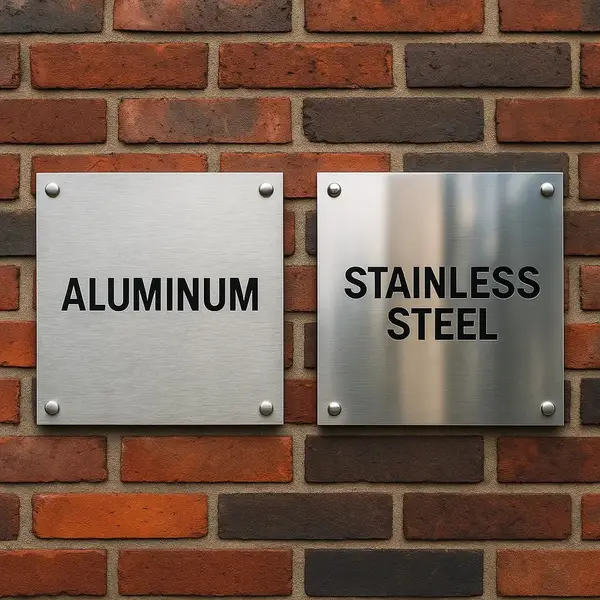
I've stood next to sign guys who dropped $800 on a single 304 stainless letter from a domestic shop. Same steel, same LEDs we use. My factory ships that same letter for $120. That's insane.
You want to talk durability versus cost? Let's start with the raw numbers. I've seen too many guys get sold on "marine-grade" when they're hanging a sign in a dry strip mall. And I've seen plenty more go with cheap aluminum and replace it in five years.
Here's what nobody tells you: aluminum and stainless steel aren't competing in the same weight class. One's a lightweight that goes the distance in the right climate. The other is a tank that'll outlast your building if you spec it right. But you pay for that tank. So which one do you need? Let's break it down like I'd tell a buddy over a beer.
Look, I don't care what the sales rep says—aluminum is not "rust-proof." It's rust-resistant. Aluminum forms an oxide layer that protects it in normal air. That's real. I've pulled 10-year-old aluminum letters off a dry inland building that still looked good. But put that same aluminum within a mile of the ocean, or where they salt the roads every winter, and the oxide layer breaks down. You get pitting. White powder. Ugly. The data says aluminum gives you 8–12 years outdoor life. That's fine for many jobs. Not fine for coastal or industrial.
Stainless 304? 18% chromium, 8% nickel. That alloy gives you 10+ years in normal outdoor conditions. I've seen 304 letters in Ohio that are 15 years old and still shiny after a pressure wash. But here's the kicker: 304 stainless will rust in salty environments. Not red rust like mild steel—surface discoloration called "tea staining." It ruins the look. That's where 316 comes in. The molybdenum (2–3%) makes it genuinely marine grade. 15+ year life in beachfront conditions. But you're paying 20–30% more than 304. I've seen this go wrong: a shop in Miami Beach ordered 304 for a hotel sign. Three years in the letters looked like they'd been dragged behind a boat. Don't be that guy.
Let's talk money. I'll give you our factory prices, and you can do the math. For non-lit metal letters, our per-letter pricing range:
That's the product alone. Now compare to US retail installed—stainless non-lit letters land at $200–700 per letter. Aluminum? Usually $150–500. But here's the factory-direct magic: if you're buying direct from a shop like ours (Aochuang Sign in China, ISO 9001, CE, RoHS), you cut the product cost by 50–65%. Shipping adds $4–12/kg by air or $80–200/m³ LCL sea. At those numbers, a set of 15 stainless letters runs you maybe $450 in product plus $150 shipping. The same set you'd buy domestically? $3,000–10,500. That's not a typo.
Now, durability cost over life: aluminum at $10–25 lasts 8–12 years. Stainless at $15–40 lasts 10–15+ years. The per-year cost difference is maybe a dollar or two. So if you're anywhere near salt air, or you want a sign that your grandkid can still read, stainless is the smarter buy. For a temporary or interior job, aluminum wins every time.
The ugly truth is aluminum weighs one-third of stainless steel. That's a huge deal for shipping and installation. A stainless letter 12 inches tall, 1.5mm thick? Weighs about a pound and a half. Same letter in aluminum? Half a pound. Multiply by 20 letters and your crate cost drops. Your install crew doesn't hate you. But that lower weight also means lower physical durability. I've seen aluminum letters dented just from a windstorm if they're mounted on a flex face. Stainless takes a beating. If your sign is at ground level where people can bump it or a shopping cart can hit it, go stainless. If it's 20 feet up and sheltered, aluminum is plenty tough.
Look, I've watched a rookie tear open a crate and bend a 1.0mm aluminum letter just by picking it up wrong. We use 1.0–1.6mm aluminum sheets (0.040–0.063") in the shop. For large letters over 2 feet, we bump it to 1.6mm. But with stainless, 1.0mm is almost flimsy—we usually run 1.2–1.5mm on 304. The stiffness difference is real. Stainless 304 has a tensile strength around 515 MPa. Aluminum 6061-T6 is about 310 MPa. That's why stainless can be thinner and still hold shape.
Here's what nobody tells you: a brushed #4 finish on stainless hides scratches better than paint on aluminum. We do stainless finishes—brushed #4, mirror #8, PVD, powder coat. The brushed #4 looks consistent even after years of cleaning. Aluminum finishes are anodized or powder coated. Anodizing is tough but it's a thin layer—if you scratch through it, the aluminum starts corroding. Powder coating is thick but chips easily on edges.
I've seen this go wrong: a shop ordered aluminum letters with a gloss black powder coat for a building entrance. Two years later, every corner where the coat chipped had white crust. They could have saved the headache with stainless letters and a brushed finish that doesn't need paint. For high-end jobs, we recommend stainless steel letters with PVD coating—you get gold, bronze, copper looks without the corrosion risk. Or if you want color on aluminum, we do baked paint letters in any RAL, but bake the paint on thick and don't expect it to outlast the steel.
I'll make it simple. Six questions to ask yourself before you call your supplier:
That's not theory. That's what I tell every customer who calls trying to save ten bucks on a sign that's going on a beachside restaurant. You can nickel-and-dime now, but you'll be eating those nickels when the sign starts looking like a rusted lobster trap.
Sure, but most channel letters use aluminum returns because they're easy to bend and light to hang. Stainless channel letters exist but they're heavy and expensive. If you want the look of stainless with illumination, get a stainless face with an aluminum body—that's a common hybrid. If you're ordering front-lit channel letters for a storefront, the returns are usually aluminum, the face can be stainless or acrylic. Why are you making this harder than it needs to be?
I said 8–12 years for aluminum outdoor signs. That's the real-world lifespan before you start seeing pitting or corrosion on edges. In a dry climate like Arizona, you'll get closer to 12. In Florida, 8. I've pulled 6-year-old aluminum letters off a seaside hotel that looked like they'd been through a sandblaster. Don't shoot the messenger. If you want something that'll outlive your grandkids, go stainless. If you want to save a buck now, go aluminum. Your call.
Products mentioned or relevant to this topic — factory-direct, custom built.
Factory-direct since 2010. Free quote within 24 hours — no obligation.
Get a Free Quote →MOQ: 1 piece · 7-15 days · 2-year warranty · Worldwide shipping