Materials • Fabrication • Finishes • Illumination • Pricing • Installation
Metal signage is the premium tier of business identification. Unlike plastic or vinyl signs that signal "budget," metal signs communicate permanence, quality, and attention to detail. A stainless steel sign on a building says: "We've been here, we'll stay here, and we care about how we look."
Metal signage encompasses any sign where the primary visible material is metal — stainless steel, aluminum, brass, copper, or bronze. These can be flat-cut letters, three-dimensional fabricated letters, cast plaques, etched panels, or illuminated signs with metal faces. The common thread is that the metal itself is the design feature, not just a structural component hidden behind plastic.
The global metal signage segment has grown steadily, driven by demand from corporate offices, luxury retail, hospitality, and healthcare — all industries where brand perception directly impacts revenue. A well-made metal sign lasts 10-15+ years outdoors with minimal maintenance, making it one of the best ROI investments in commercial branding.
Factory insight: Metal signage carries the highest profit margins in the industry — 40-60% for specialty pieces like brass relief and copper signs, compared to 15-25% for standard illuminated channel letters. This is because the perceived value is driven by material and craftsmanship, not just functionality. A hand-polished stainless steel letter feels like jewelry for your building.
The metal you choose defines how your sign looks on day one — and how it looks a decade later. Here's every major metal used in commercial signage, with real performance data.
The industry standard for premium signage. Density: 7.93g/cm³. Contains 18% chromium and 8% nickel — the chromium forms a self-healing oxide layer that prevents rust. This is the metal you see on corporate headquarters, luxury retail facades, and high-end hotel lobbies.
The same chromium-nickel base as 304, but with 2-3% molybdenum added. The molybdenum dramatically improves resistance to chlorides — meaning saltwater, road salt, and industrial chemicals won't pit the surface.
The lightweight workhorse of the signage industry. Density: 2.7g/cm³ — roughly 1/3 the weight of steel. Naturally forms a protective oxide layer that prevents further corrosion. Cannot rust (no iron content).
The heritage metals. Brass (copper + zinc) has a warm golden tone; copper has a distinctive reddish-orange that develops a green patina (verdigris) over decades. These are statement materials used for plaques, dedication signs, and architectural features.
| Material | Outdoor Life | Weight | Relative Cost | Best For |
|---|---|---|---|---|
| SS 304 | 10+ years | Heavy | $$$ | Premium exteriors, corporate lobbies |
| SS 316 | 15+ years | Heavy | $$$$ | Coastal, marine, industrial |
| Aluminum | 8-12 years | Light | $$ | Large signs, high-rise, interiors |
| Brass | 20+ years | Heavy | $$$$$ | Plaques, heritage, luxury |
| Copper | 20+ years | Heavy | $$$$$ | Architectural features, patina art |
Individual letters laser-cut or water-jet-cut from flat metal sheet. Mounted with standoff spacers that create a shadow gap between the letter and the wall — this shadow is part of the design. The simplest and most cost-effective metal signage option.
Typical thickness: 3mm–10mm. Thicker = more dimensional presence, higher cost. Factory price: $15–$50 per letter depending on size and material.
Three-dimensional letters with metal faces, metal returns (sides), and a hollow interior. Can be illuminated (LEDs inside) or non-illuminated. These have physical depth — typically 30mm–120mm — and cast real shadows. This is what you see on premium storefronts and corporate buildings.
Factory price: $30–$120 per letter. More complex than flat-cut due to welding, forming, and finishing of the 3D shape.
Multi-layered metal artwork where different elements are fabricated at different depths to create a sculptural, bas-relief effect. Often combines multiple metals (stainless steel background + brass lettering + copper accents) and finishes. These are custom artistic pieces — each is essentially a commissioned artwork.
Factory price: $200–$2,000+ per piece depending on size and complexity. Lead time: about 65 days.
Molten metal (typically aluminum, brass, or bronze) poured into a mold, then finished and polished. Cast plaques have a weight, texture, and permanence that fabricated signs can't match. The casting process captures fine detail — down to the texture of a signature or a photographic relief.
Chemical etching or mechanical engraving removes material to create text, patterns, or images on a metal surface. The recessed areas can be paint-filled for contrast. Common for directional signage, room identification, and information panels.
How a metal sign is made determines its precision, cost, and the level of detail possible. Here are the main production methods:
| Method | Precision | Best For | Cost Level | Min Detail Size |
|---|---|---|---|---|
| Laser Cutting (Fiber) | ±0.1mm | Letter cutting, intricate patterns | $$ | ~1mm |
| Water Jet Cutting | ±0.2mm | Thick plates (10mm+), heat-sensitive | $$$ | ~2mm |
| CNC Routing/Milling | ±0.05mm | 3D contouring, beveled edges | $$$ | ~0.5mm |
| TIG Welding | Manual skill | Joining returns to faces, 3D letters | $$ | N/A (seam) |
| Casting (Sand/Investment) | ±0.5mm | Plaques, complex 3D shapes | $$$$ | ~3mm |
| Chemical Etching | ±0.05mm | Fine text, patterns, ADA signs | $$ | ~0.1mm |
The most common method for cutting metal letter shapes. A high-power fiber laser beam melts through the metal along a programmed path. Advantages: extremely precise (±0.1mm), fast, smooth cut edges that need minimal cleanup, and no tooling cost — the cutting path is just a digital file. Works on stainless steel, aluminum, brass, and copper up to ~20mm thickness.
A high-pressure stream of water mixed with abrasive garnet particles cuts through metal. Unlike laser cutting, there is no heat-affected zone — the metal's properties don't change near the cut edge. This matters for thick plates (10mm+) and for materials where heat would cause warping or discoloration. Also the only method that can cut reflective metals (mirror-finish stainless, polished copper) without back-reflection damaging the cutting head.
Tungsten Inert Gas welding joins the metal face to the metal returns (side walls) on 3D fabricated letters. This is skilled manual work — a good welder produces seams that disappear after grinding and polishing; a bad welder leaves visible joints, burn marks, or warped panels. The weld must be continuous (not spot-welded) for structural integrity and waterproofing.
The same piece of stainless steel can look completely different depending on how it's finished. Finish selection is arguably the most important aesthetic decision you'll make.
The most popular finish for stainless steel signage. A linear grain is created by sanding the surface with abrasive belts or wheels. The fine parallel lines hide fingerprints and minor scratches better than any other finish. Under lighting, it has a soft, directional sheen — not mirror-like, but not matte either.
Best for: Corporate logos, exterior letters, anywhere people will touch the sign.
The metal is polished to a reflective, mirror-like surface. Dramatic and eye-catching — but shows every fingerprint, water spot, and micro-scratch. Requires regular cleaning to maintain the look. Often used for decorative accents rather than entire signs.
Best for: Interior feature walls, luxury retail, decorative accents. Avoid for high-touch exterior applications.
A dry polyester or epoxy powder is electrostatically sprayed onto the metal, then baked at 180-200°C to form a hard, uniform skin. Available in any RAL color. More durable than wet paint — resists chipping, scratching, and fading. Can produce matte, satin, or gloss textures.
Best for: Brand-color matching, aluminum signs, exterior durability. 7-10+ year outdoor life on properly prepared metal.
A thin-film coating applied in a vacuum chamber. Produces durable metallic colors — gold, rose gold, champagne, black, bronze — on stainless steel. Unlike electroplating, PVD doesn't use toxic chemicals and produces a harder, more wear-resistant surface. The gold color on "gold stainless steel" is almost always PVD.
Best for: Luxury branding, gold/rose gold/black metal finishes, high-traffic interior signs. 10+ year color stability indoors.
An electrochemical process that thickens aluminum's natural oxide layer. The porous oxide can absorb dyes before sealing, producing colored aluminum that won't chip or peel (because the color IS the metal, not a coating on top). Clear anodizing preserves the natural aluminum look; colored anodizing produces everything from gold to black.
Best for: Aluminum signs, architectural panels, any aluminum that stays outdoors.
| Finish | Material | Outdoor Durability | Fingerprint Resistance | Cost Impact |
|---|---|---|---|---|
| Brushed (#4) | Stainless steel | Excellent | Excellent | Baseline |
| Mirror (#8) | Stainless steel | Good (needs cleaning) | Poor | +15-25% |
| Powder Coated | Steel, aluminum | Excellent | Good | +10-20% |
| PVD Coated | Stainless steel | Very Good | Good | +30-50% |
| Anodized | Aluminum | Excellent | Good | +10-15% |
Metal signs can be illuminated or non-illuminated — and the illumination method dramatically changes the effect:
Solid metal letters with no internal lighting. Relies entirely on ambient light and the inherent qualities of the metal — its color, texture, and the shadows it casts. The purest expression of metal signage. Requires good natural or architectural lighting on the mounting surface.
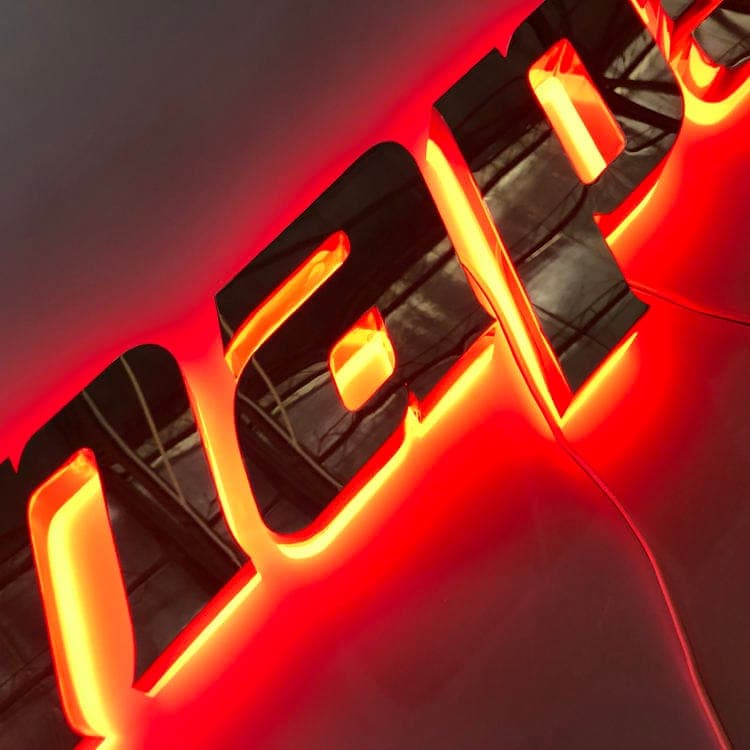
The most popular illumination method for metal signs. The letter face is opaque metal; LEDs inside the letter project light backward onto the wall, creating a soft halo glow around each letter. During the day, it reads as solid metal; at night, the halo effect is dramatic and sophisticated. This is the signature look of premium corporate signage.
Requires: Hollow 3D letters with standoff mounting (light needs space to escape), LEDs mounted on the back panel facing the wall.
The face is translucent acrylic (or another light-diffusing material), but the sides (returns) are metal. Gives the brightness of front illumination with the premium appearance of metal edges. Common for retail where visibility is the priority but brand image matters.
LEDs mounted along the inner edges of a metal letter cast light sideways, illuminating only the outline. Creates a dramatic silhouette effect. Less common but highly distinctive.
Different industries use metal signage differently. Here's what works for each:
| Industry | Preferred Type | Preferred Material | Typical Budget |
|---|---|---|---|
| Corporate HQ / Office | Back-lit halo letters, lobby logos | SS 304 brushed | $3,000–$15,000 |
| Law Firms | Solid metal letters, brass plaques | Brass, SS 304 | $2,000–$8,000 |
| Luxury Retail | Halo-lit, PVD gold/rose gold | SS 304 PVD-coated | $5,000–$20,000 |
| Hotels & Hospitality | Metal relief art, cast plaques | Bronze, brass, copper | $5,000–$30,000+ |
| Healthcare | Etched directional signs, room IDs | SS 304, aluminum | $1,000–$5,000 |
| Restaurants & Bars | Metal-faced channel letters, neon accent | Aluminum, SS 304 | $1,500–$6,000 |
| Government / Municipal | Cast bronze plaques, aluminum panels | Bronze, aluminum | $2,000–$10,000 |
| Religious / Memorial | Cast plaques, etched panels | Bronze, brass | $500–$5,000 |
Metal signage pricing is driven by four factors: material, size, complexity, and finish. Here's what to expect:
| Product | Material | Price Range | Unit |
|---|---|---|---|
| Flat-cut letters | SS 304, 5mm | $15–$40 | Per letter |
| Flat-cut letters | Aluminum, 5mm | $10–$25 | Per letter |
| 3D fabricated letters (non-lit) | SS 304, 30-80mm deep | $40–$120 | Per letter |
| 3D halo-lit letters | SS 304 + LEDs | $50–$150 | Per letter |
| Cast bronze plaque | Bronze, 12"×18" | $200–$800 | Per plaque |
| Metal relief wall art | Mixed metals | $500–$3,000+ | Per piece |
| Etched SS panel | SS 304, 24"×36" | $150–$500 | Per panel |
Budget tip: For a 6-letter sign, the bulk of your cost isn't the metal — it's the labor to cut, weld, grind, and polish each letter. A 12" letter in brushed 304 costs about the same to fabricate as an 18" letter — the extra material cost is small. So when you're on a budget, go bigger but simpler: large flat-cut letters cost less than small 3D fabricated letters, and they have more visual impact. Size impresses; complexity costs.
Metal signs are the most durable category of signage — but "metal" isn't a guarantee. Here's what actually happens outdoors:
| Material + Environment | Appearance Holds | Structural Integrity |
|---|---|---|
| SS 304, inland, brushed | 10-15 years | 20+ years |
| SS 304, coastal, brushed | 3-5 years (tea staining) | 10+ years |
| SS 316, coastal, brushed | 10-15 years | 20+ years |
| Aluminum, powder coated, inland | 7-12 years | 15+ years |
| Brass, lacquered, inland | 5-8 years (lacquer fails first) | 30+ years |
| Brass, unlacquered, any | Develops patina in 1-3 years | 30+ years |
Font choice affects both aesthetics and manufacturability:
The gap between the letter and the wall is a design feature. Standard standoff distance is 15-25mm (about 3/4" to 1"). This creates a shadow that gives the letter presence and dimensionality. For halo-lit signs, the standoff must be large enough for light to escape evenly around the entire letter — typically 25-40mm.
Stainless steel threaded studs are welded to the back of each letter. The installer drills corresponding holes in the wall, pushes the studs through, and secures with nuts and washers from inside or with anchors in masonry. The holes are sealed with neutral-cure silicone. This is the cleanest method — no visible hardware from the front.
Decorative standoff barrels (typically stainless steel or aluminum, 15-25mm long) screw into the back of the letter and into the wall. The standoffs are visible — they become part of the design. This is standard for interior lobby signs and flat-cut letters.
For illuminated metal signs, all letters pre-mount to an aluminum raceway or backer panel at the factory. The entire assembly mounts to the building as one unit. Fewer wall penetrations, easier wiring, simpler permitting — but a less "floating" appearance.
Metal signs are low-maintenance, not zero-maintenance:
When you receive a metal sign, here's what separates craftsmanship from corner-cutting:
| Aspect | Quality Work | Poor Work |
|---|---|---|
| Cut edges | Smooth, burr-free, consistent | Rough, sharp burrs, wavy cuts |
| Weld seams (3D letters) | Continuous bead, ground smooth, invisible after finishing | Spot welds, visible seams, burn marks |
| Brushed grain | Straight, consistent, unidirectional | Wavy, inconsistent direction, swirl marks |
| Corners | Crisp, sharp, consistent radius on all letters | Rounded inconsistently, some sharp some blunt |
| Stud placement | Pattern printed from digital file, evenly spaced | Eyeballed, uneven, some studs too close to edges |
| Powder coat | Even thickness, no drips, no thin spots, full coverage | Orange peel texture, drips at edges, thin/bald spots |
| Packaging | Each letter in foam sleeve, plywood crate, waterproof wrap | Bubble wrap in a cardboard box |
Stainless steel 304: 10-15 years before visible aging in normal environments. Stainless steel 316: 15+ years, even coastal. Aluminum (powder coated): 7-12 years. Brass/bronze (lacquered): 5-8 years before lacquer needs redoing; the metal itself lasts decades. These are "looks good" numbers — structurally, metal signs last essentially forever if properly mounted.
Stainless steel 304 for most situations — best balance of cost, appearance, and durability. Switch to SS 316 if the sign is within 5 miles of saltwater or exposed to de-icing salt. Powder-coated aluminum is excellent for large, lightweight signs. Avoid bare carbon steel outdoors — it will rust within months.
Cast: Metal poured into a mold. Solid throughout, heavier, captures fine surface texture. Best for plaques and decorative pieces. More expensive, longer lead time, but unmatched permanence. Fabricated: Sheet metal cut, bent, and welded into shape. Hollow interior (can fit LEDs). Best for letters and 3D signs. More affordable, faster, more versatile for illuminated applications.
Yes — back-lit (halo-lit) is the standard for illuminated metal signs. The metal face is opaque; LEDs inside project light backward, creating a halo around each letter. Front-lit is also possible by using a translucent face (acrylic) with metal returns (sides). Edge-lit and combination-lit round out the options.
A 6-letter brushed stainless steel sign (18" letters, non-illuminated, flat-cut): $150–$300 factory price. The same in 3D fabricated back-lit: $450–$900 factory price. Add shipping, tariffs, and local installation for total project cost. See Section 8 for detailed pricing tables.
Most commonly with stainless steel threaded studs welded to the back of each letter. The studs go through pre-drilled holes in the wall and are secured with nuts/washers. For interior signs, standoff barrels are popular — they're visible and become a design element. We provide a full-size paper template showing exact stud positions for every letter.
Minimal. Annual cleaning with mild soap and water. Check mounting fasteners for tightness. Inspect sealant around penetrations. For illuminated signs, check LED function. That's about it — one of the reasons metal signage has the lowest total cost of ownership despite higher upfront cost.
Yes. Whether it's a specific brushed grain direction, a custom PVD color (gold, rose gold, champagne, black), or an exact powder coat RAL number — we can match it. Send a physical sample or precise specifications (grit number for brushed finish, RAL/Pantone for color, PVD color code). We'll produce a finish sample for your approval before production.
Send us your design or tell us what you have in mind. We'll respond with material recommendations, finish samples, and a detailed quote within 24 hours.
Get a Free Quote → Copy EmailExplore specific topics from this guide in depth — each article is a comprehensive 1,500–2,500 word resource written by our factory experts.
MOQ: 1 piece • Lead time: 7-15 days • SS 304/316, Aluminum, Brass • Worldwide shipping
Dive deeper with these in-depth articles from our factory floor.