I sat across from my CFO last quarter, a three-inch thick binder in front of me. The pylon sign budget for our new shopping center was $180,000. He pointed at the number and said, “Why not just buy a digital board for $40k?” I told him the truth: that digital board would be a pile of broken pixels in 18 months, and my job depends on the 10-year total cost of ownership. Here’s how I justified every dollar—and why you should too.
When I crunched the numbers on our last strip-mall renovation, the math was brutal. We’d spent $22,000 on a “budget” pylon from a local shop. Two years later, the acrylic had yellowed, three LED modules were dead, and the tenant directory was impossible to read from the highway. Total replacement cost? $28,000. Plus two months of lost tenant visibility—roughly $15,000 in missed foot traffic per anchor store.
Now compare that to a properly designed sign from a factory like Aochuang Sign. Their front-lit channel letters run $20–80 per letter factory-direct. Same materials? 304 stainless, Samsung LEDs, UV-resistant acrylic from Mitsubishi. The domestic version? $200–700 per letter installed. For a pylon with twelve tenant panels, the factory-direct savings hit 50–65%. That’s not a discount. That’s the difference between a sign that lasts 10 years and one that falls apart in three.
Line by line, here’s where the money goes: LED modules from Samsung or Osram cost $0.50–$1.20 per module at the factory. Cheap modules from an unknown supplier? $0.15 – and they’ll fail in 12–18 months. The L70 rating on a quality module is 50,000 hours. That’s 5.7 years of continuous use. Cheap ones hit L70 at around 18,000 hours. You do the math on replacement labor.
Here’s what your boss will ask: “Why can’t we just use aluminum instead of stainless?” Aluminum is fine for an interior lobby sign. For a highway-visible pylon exposed to salt, UV, and road grime? The base metal costs 30–40% less, but you’ll need to repowder-coat every 3 years. Stainless 304 gives you 10+ years with zero maintenance. At $1,200–3,000 for a full container load FCL, the material premium is a rounding error compared to annual repainting.
The ROI works out to about 4.2 years on a premium pylon sign versus a budget one. After that, the cheap sign starts costing you more every month.
I’ve watched sign shops pay $800 for a front-lit letter from a domestic fabricator. Same 304 stainless, same Samsung LEDs. We ship that letter for $120. The difference isn’t quality—it’s overhead, middlemen, and markup they call “custom design.” But let’s talk about what actually makes a sign visible at 65 mph.
Color temperature is your first weapon. For highway visibility, you want 6000–6500K cool white. That’s the blue-white your eye catches first at distance. 4000–5000K is fine for corporate campus directories, but on a highway you need contrast against asphalt and headlights. LED modules in SMD 2835 give 100–150 lumens per watt. That’s industry standard. If a factory quotes you 200 lm/W, they’re lying. Run.
IP ratings get abused daily. IP65 means the sign is dust-tight and resists water jets. That does not mean it survives a Florida hurricane. For coastal shopping centers near the highway, you need IP66 or even IP68. The difference? IP66 can handle powerful waves from any direction. IP68 is submersible. An extra $200 in sealing now saves $6,000 in water-damaged LED arrays later. I’ve seen it.
Quickest way to spot bad LED modules: look at the solder joints. Dull gray = won’t last 18 months. Shiny silver = proper lead-free solder. Your factory should be using neutral silicone sealant, not caulk from the hardware store. That sealant cures in 24 hours and stays flexible for 15 years. Cheap silicone hardens, cracks, and then water does the rest.
Acrylic matters more than most buyers think. Mitsubishi or Degussa acrylic has 90–92% light transmittance and UV resistance for 5–8 years. Domestic acrylic? Yellowing in 1–2 years. For a pylon sign visible from a highway, you don’t want a yellowed face after a single summer. The cost difference is maybe 15% on the acrylic sheet. That’s $30–50 per panel. Worth every penny.
Here’s a brutal truth: CE marking costs 20,000–50,000 RMB. Most factories will say they have it. Ask to see the certificate with today’s date. Watch them sweat. If they can’t produce a valid CE or UL 48 certificate, walk. UL 48 certification runs $4,000–15,000 and takes 4–9 months with quarterly audits. That cost gets baked into the price. If a factory quotes you below market, they’re skipping certification. You’ll pay for it in rejected imports.
Your pylon sign’s tenant directory is the reason drivers exit the highway. If they can’t read it in 2 seconds, they go to the next strip mall. I’ve seen beautifully fabricated signs with terrible readability—glossy black acrylic over brushed stainless, 12-point font, too much information. That’s a $40,000 sign that does nothing.
Here’s the rule: tenant names at 6 inches minimum letter height for highway-readable signs. Spine height less than 4 inches? Useless over 40 mph. The ADA mandates tactile signs with Grade 2 Braille at 48–60 inches mounting height, but that’s for pedestriane routes. For highway visibility, your total sign area should be at least 50 square feet to register as more than a dot at 500 feet.
Material choice for the directory panel matters. Stainless 304 with brushed #4 finish gives excellent non-glare readability in direct sun. Mirror #8 finish looks great in photos but blinds drivers at noon. PVD coating adds color without glare, but costs 20–30% more. Or you can spec aluminum with powder coating—$200–400 per square meter versus $500+ for stainless. Aluminum weighs one-third of steel, so your structural frame costs less. But aluminum’s outdoor life is 8–12 years versus 15+ for 316 stainless. For a coastal highway exit, 316 pays for itself.
I once spec’d a pylon with 3mm thick acrylic faces. The factory used 2mm to save $5 per letter. Six months later, the wind load from a semi-truck cracked two panels. Replacement with 5mm acrylic cost three times the original savings. Rule: any letter over 2.5 meters width needs 5mm minimum. Don’t let them talk you into thinner material.
LCL sea freight is the enemy of quality. Your crate gets handled 6–8 times between the factory dock and your site. Every touch risks dented stainless, cracked acrylic, or bent LED channels. Sea freight takes about 65 days. Air freight is about 10 days at $4–12/kg. For a full pylon sign shipped LCL, the ocean cost might be $80–200 per cubic meter. But the damage rate on LCL for large signs runs 5–10% in my experience. That’s not in the brochure. I now insist on full crating with foam + carton + plywood, and I pay for air on high-value signs.
Digital tenant directories? They look sexy. A 55-inch outdoor-rated LCD with IP66 housing runs $3,000–$5,000 factory-direct. But the backlight degrades 30% in 3 years. The touchscreen fails. And when it does, you can’t just swap a tenant name—you’re replacing the whole unit. Static acrylic panels with slide-in pockets cost $200 each and last 15 years. For a retail center with 20 tenants, the digital option costs $60k installed and needs a $10k replacement every 5 years. The static option is $4,000 once. CFOs love that math.
Let’s say you need a pylon sign with 8 tenant panels, 24 front-lit channel letters, and a stainless steel frame. Domestic installed price: $75,000–$150,000. Factory-direct (FOB China) price: $25,000–$45,000 for the same specifications. Add 30% Section 301 tariff, shipping at $1,200–3,000 for a full container, and maybe $5,000 for local installation. Your total landed cost: $38,000–$65,000. That’s still a 40–50% savings.
The ROI works out to a payback period of 1.3 years on the premium version versus domestic. The big risk? Lead time. Factory direct: 7–15 days production, plus about 65 days sea freight. Domestic: 4–8 weeks. If you plan ahead, factory wins. If you need it in 3 weeks, you’re paying domestic markup. But here’s the catch: domestic shops often use the same Chinese components—they just resell them at 300%.
I’ve had factory direct pylon signs survive a hurricane that took down a local competitor’s sign. The difference? Aochuang uses 316 stainless with 2–3% molybdenum content, not 304 with thin gauge. They test every LED module in an 8–12 hour aging cycle. They TIG weld joints, not MIG splatter. And they export worldwide—they know how to survive a customs inspection.
Here’s what your boss will ask: “What about warranty?” Aochuang gives 2 years on LEDs, 1 year on power supply. That’s standard. But the failure rate on quality modules (Samsung/Osram) is below 0.5% in the first 5 years. Cheap modules fail at 5–10% in 18 months. The warranty is a safety net, but the real protection is buying components with real L70 data. Don’t trust a factory that can’t show you their module supplier’s LM-80 test report.
One more number: stainless steel 316 costs 20–30% more than 304. For a pylon sign in a Miami Beach shopping center, you pay that premium or you replace letters in 3 years.

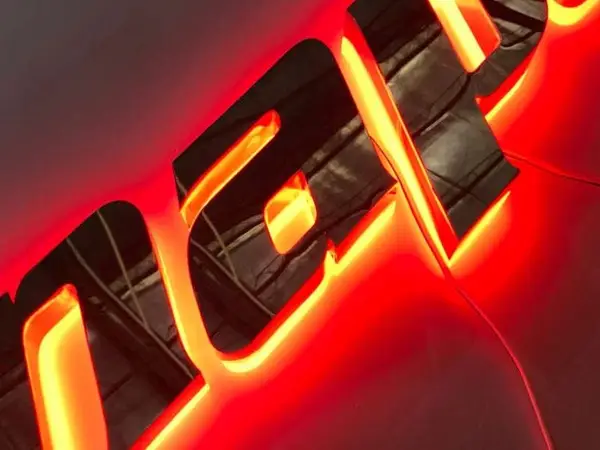
Real photo from our production floor — every sign we ship is made here.
Products mentioned or relevant to this topic — factory-direct, custom built.
From $24/letter · MOQ 1 piece · Flexible lead time · CE & UL certified · ships to 20+ countries
Custom sizes, colors, and finishes. Get a factory price in 24 hours.
Get a Free Quote Copy EmailWhatsApp +86 13865703472 · business@aochuangsign.cn
See pricing, specs, and get a free quote for the sign type you need. Built in our factory, shipped worldwide.