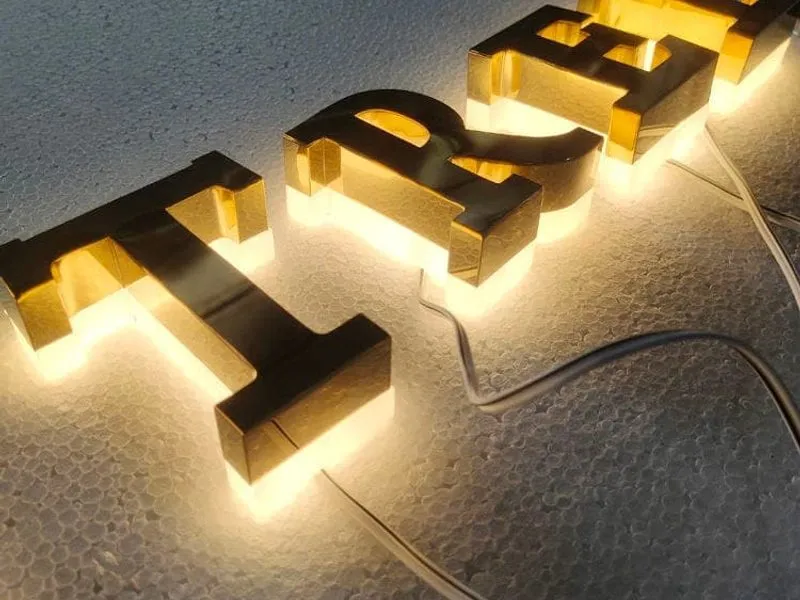
You’ve been burned before. We all have. A client’s halo-lit channel letters arrive with LEDs that are half as bright as the sample. The acrylic is thinner than spec. The stainless steel has rust spots after one season. And the factory? They blame the shipping company.
Here’s the hard truth: Most quality problems with Chinese sign orders aren’t accidents. They’re decisions. The factory chooses cheaper materials. They rush assembly. They skip the 8-hour aging test. And they bet you won’t catch it until the crates are open.
I’ve spent 15 years on the factory floor in Lu’an, Anhui, watching this play out. I’ve seen 50-worker shops pump out perfect orders and I’ve seen $50,000 shipments get rejected at the dock. The difference isn’t luck. It’s a system.
Here’s the system that works.
Most buyers rely on a pre-shipment inspection. They hire SGS or Bureau Veritas to check the finished goods right before the container sails. That’s fine for commodity products. For custom signs? It’s a trap.
The problem is simple: once the acrylic is cut, the LED modules are soldered, and the metal is welded, fixing a mistake means starting over. A pre-shipment inspector can tell you the letters are the wrong color. But by then, you’ve already paid for the materials and the labor. The factory has two options: rework at your cost, or ship the defect and hope you don’t notice until after payment.
The real leverage is during-production inspection. Here’s why it matters. At Aochuang Sign, our 10-step production process takes about 5-15 days. The critical steps—laser cutting (tolerance ±0.1mm), bending/welding (TIG welding, 1-2 days), and LED assembly (SMD 2835 modules at 100-150 lm/W)—all happen in the first 5-7 days. If you catch a problem on day 3, the factory can fix it. On day 12, it’s too late.
I tell every buyer the same thing: require daily photo updates at each production stage. Not just a video call—photos of the material cutting, the wiring, the sealing. Use a simple traffic-light system: green for on-spec, yellow for minor deviation (documented and approved), red for anything that requires rework. This shifts the power from the supplier to you without needing a third-party inspector on site.
You can’t inspect what you don’t measure. Here’s the specific checklist I use when I’m auditing a factory for a custom sign order. Print this and hand it to your supplier before they start production.
Acrylic is where factories cut corners. The spec says 5mm Mitsubishi or Degussa UV-resistant acrylic (90-92% light transmittance, 5-8 years outdoor life). But the factory might swap it for domestic acrylic that yellows in 1-2 years. I’ve seen this happen on $80,000 orders.
Here’s what to check:
Stainless steel is a minefield. Grade 304 (18% Cr, 8% Ni) is standard for outdoor signs—10+ year life. Grade 316 (2-3% Molybdenum) is for coastal or industrial environments, but it costs 20-30% more. Factories will quote 304 and deliver 201 or 430 if you don’t check.
Quick test: A magnet sticks to 201 and 430. It barely sticks to 304. It won’t stick to 316.
Aluminum is simpler. At 1.0-1.6mm thickness for most signs, it’s naturally rust-proof and weighs one-third of steel. But check the finish: anodized or powder coated is standard for 8-12 year outdoor life. Brushed aluminum without coating will pit in 2-3 years near the ocean.
LED quality is the biggest variable. Here’s the data:
| LED Type | Lumens per Watt | Real Lifespan (Quality Brand) | Real Lifespan (Cheap Brand) |
|---|---|---|---|
| SMD 2835 | 100-150 lm/W | 5+ years (Samsung/Osram/Lan Jing) | 12-18 months |
| SMD 5050 | Variable | RGB capable, 3-5 years | 6-12 months |
| SMD 5730 | 40-60 lm/chip | Highest brightness, 3-5 years | 6-12 months |
The L70 rating (time until brightness drops to 70% of original) should be ≥50,000 hours for any outdoor sign. Ask for the LM-80 test report. If they can’t provide it, the LEDs are likely generic Chinese chips with no reliability data.
Color temperature matters too. For hospitality signs, 3000-3500K warm white. For corporate retail, 4000-5000K neutral. For industrial or highway, 6000-6500K cool. If the factory sends a mix of color temps in the same sign, you’ll see it instantly at night.
Most buyers approve one sample and assume the production run matches. That’s a mistake. I require three samples:
For each sample, document the following:
If the factory won’t agree to three samples, find another factory. It’s a red flag that they’re hiding something.
Color matching is the most common dispute I see. The buyer approves a Pantone swatch on a computer screen. The factory prints the sign. They look different. Who’s wrong?
Both of you. Computer screens are not calibrated. Pantone swatches fade. The solution is a physical color standard and a remote inspection process.
Here’s what works:
One more thing: LED color temperature affects how painted or printed colors appear. A 3000K warm LED will make cool blues look muddy. A 6000K cool LED will wash out warm reds. Test the sign with the actual LEDs you’re using.
Your contract is your only leverage after payment. Here are the clauses I insist on:
State a maximum acceptable defect rate. For custom signs, I use 2% by unit count. Any sign with a defect (wrong color, dead LEDs, cracked acrylic, bubbles in vinyl) is rejected. The factory must replace it at their cost within 7 days. Shipping is on them.
If the pre-shipment inspection finds defects, the factory has 5 business days to rework and re-inspect. If they miss this deadline, you get a 2% discount per day of delay, capped at 15%.
Standard lead time is about 5-15 days. If the factory misses the agreed delivery date, they pay 1% of the order value per week of delay, up to 10%. This covers your storage and client penalties.
Any material substitution requires your written approval. If the factory uses a different acrylic, LED brand, or metal gauge without approval, you have the right to reject the entire order at their cost.
Specify binding arbitration in a neutral location (Singapore or Hong Kong are common). Avoid Chinese courts unless you have a local lawyer. The cost of arbitration is split 50/50, with the losing party reimbursing the winner.
SGS, Bureau Veritas, and TÜV Rheinland all offer inspection services in China. For a sign order worth $5,000-$20,000, a pre-shipment inspection costs $400-$800. A during-production inspection costs $600-$1,200. It’s cheap insurance.
But here’s the catch: generic inspectors don’t know signs. They’ll check the box count and the packaging. They won’t know that the acrylic should be 5mm, not 4.5mm, or that the LED modules should be 100 lm/W, not 80.
So you need to write the inspection checklist. Send the inspector the following:
Tell the inspector to photograph every measurement. If the factory knows the inspector has a detailed checklist, they’re far less likely to cut corners.
Here are the defects I see most often, and the specific prevention steps:
| Defect | Root Cause | Prevention |
|---|---|---|
| Bubbles in vinyl | Dust on acrylic before application; low-quality vinyl | Require cleanroom conditions for vinyl application. Use 3M or Avery vinyl only. |
| Uneven lighting | LEDs spaced too far apart; wrong LED angle for letter depth | Specify LED spacing (typically 1-2 inches for 3mm acrylic). Test with a light meter. |
| Rust on stainless steel | Grade 201 or 430 substituted for 304; welding contamination | Magnet test at inspection. Require passivation after welding. |
| Acrylic yellowing | Domestic acrylic instead of Mitsubishi/Degussa | Check UV certificate. Caliper thickness. Hold sample to sunlight. |
| Water ingress | Poor sealing; acid-cure silicone instead of neutral | Require IP65 minimum (dust-tight + water jets). For coastal, IP66 or IP68. Test with a hose. |
| Color mismatch | No physical color standard; different lighting conditions | Require physical Pantone swatch. Test under actual LED illumination. |
Your sign might be perfect at the factory. But if it’s packed wrong, it arrives broken. And then you’re arguing with the shipping company, not the factory.
Here’s the packaging standard I use:
Shipping costs vary widely. Express (7-10 days) is $30-100 for small orders. Air freight (about 10 days) is $4-12/kg. Sea freight (about 65 days) is $80-200/m³ for LCL, or $1,200-3,000 for a full container. For most custom sign orders, sea freight is the only economic option for large quantities.
One more thing: the US Section 301 tariff adds roughly 30% to the cost of Chinese-made signs. Factor this into your pricing. Some factories offer FOB (free on board) pricing that excludes tariffs. Others offer DDP (delivered duty paid) that includes everything. Know which you’re getting.
Quality control for custom sign orders from China isn’t about trust. It’s about systems. A pre-production sample. Daily photo updates during production. A third-party inspection with a sign-specific checklist. Contract clauses that penalize defects and delays. And a packaging standard that survives 50 days at sea.
The factories that deliver quality—like ours at Aochuang Sign, with our 3,000m² facility, 50+ workers, and CE/RoHS/ISO 9001 certifications—welcome this scrutiny. The factories that cut corners will resist it. That resistance tells you everything you need to know.
One last factory-floor truth: The best quality control is a long-term relationship. When a factory knows you’ll be back next month, they’re far less likely to cheat you on this order. So find a good factory. Set up the system. And then order again.
I recommend a 2% defect rate by unit count. Any sign with a functional defect (dead LEDs, cracked acrylic, wrong color, bubbles in vinyl) should be rejected. Cosmetic defects (minor scratches on the back, slight color variation within 1 Delta E) are negotiable—but you decide the threshold. Put it in the contract.
Three methods: (1) Require a pre-production sample made with the exact materials. (2) Ask for material certificates—mill certificates for steel, UV test reports for acrylic, LM-80 reports for LEDs. (3) Hire a third-party inspector (SGS, Bureau Veritas) to visit during production and measure each material with a caliper, thickness gauge, and light meter. The cost is $400-$1,200, which is cheap compared to a rejected shipment.
Yes, but with limitations. A video call is useful for verifying that production is happening and for spotting obvious defects (wrong color, poor welding). But cameras distort colors and measurements. Use video for process confirmation, not final acceptance. Always require a physical sample or detailed photos with a ruler in the frame for measurements.
Minimum items: (1) Acrylic thickness and UV rating (caliper measurement). (2) LED type, brightness (lm/W), color temperature, and spacing. (3) Metal gauge and finish (brushed, mirror, or PVD). (4) Sealing quality (neutral silicone, IP65 minimum). (5) Wiring and cable length (match your spec). (6) Mounting bracket dimensions and hole placement. (7) Packaging (foam + carton + plywood crate). (8) Aging test (8-12 hours at full power to catch early LED failures).
First, document everything with photos and video of the unboxing. Second, check the contract—if you have a defect rate clause and rework timeline, the factory is obligated to fix it. Third, if the factory refuses, file a claim with your shipping insurance (you did buy insurance, right?). Fourth, for serious disputes, invoke the arbitration clause in your contract. Singapore or Hong Kong arbitration costs $3,000-$10,000, but it’s faster than court. Fifth, and most important, don’t pay the final 30-50% of the order until you’ve inspected the goods. That payment hold is your strongest leverage.

Real photo from our production floor — every sign we ship is made here.
Products mentioned or relevant to this topic — factory-direct, custom built.
From $24/letter · MOQ 1 piece · Flexible lead time · CE & UL certified · ships to 20+ countries
Custom sizes, colors, and finishes. Get a factory price in 24 hours.
Get a Free Quote Copy EmailWhatsApp +86 13865703472 · business@aochuangsign.cn
See pricing, specs, and get a free quote for the sign type you need. Built in our factory, shipped worldwide.