Let's cut through the noise. Every custom sign order from China carries a hidden cost that has nothing to do with the price per letter. It's the cost of getting it wrong. Wrong aluminum gauge. Wrong LED color temp. Wrong sealant that cracks in your local winter.
I've seen it all in 15 years. A $5,000 order of channel letters arrives with 2mm acrylic instead of the 5mm you specified for a 3-meter-tall sign. The stainless steel has rust spots before it's even installed. The LED modules are dead within 18 months — not the 5 years you paid for.
Here's the hard truth: you cannot inspect quality into a finished sign. Once the acrylic is cut and the LEDs are soldered, defects are locked in. The only way to win is to audit the process before production starts.
This guide is built on real factory-floor experience from Aochuang Sign, a 3,000m² facility in Lu'an, Anhui, that has been exporting worldwide since 2010. The numbers, the specs, the pitfalls — they're all here. No fluff.
Disclosure: I work with Aochuang Sign as a quality consultant, but the advice here applies to any factory. For unbiased perspective, I also reference standards from UL, ISO, and independent agencies like QIMA and SGS. Alternatives like Shenzhen-based Sunrise Sign or Guangzhou's SignCraft offer similar capabilities; always compare three quotes.
Never skip the sample. Never. A pre-production sample is not a courtesy. It's your only chance to catch material substitutions, color mismatches, and dimensional errors before they multiply across 50 letters.
Set clear pass/fail criteria before you approve anything. Use a written checklist. Here's what must be verified:
The sample approval process should take 1-2 days. Aochuang, for example, completes design confirmation in one day and sends a sample within about 5-15 days total lead time. If a supplier can't produce a sample that fast, they're either overloaded or disorganized.
This is where most buyers drop the ball. They inspect the final product but never see the raw materials or the production process. That's a mistake. Because once a batch of aluminum is cut to size or LEDs are reeled off the spool, defects are baked in.
Insist on a video walkthrough before you place an order. Here's what to look for:
A factory like Aochuang with ISO 9001 certification will have documented procedures for material handling. If they can't show you a clean storage area, walk away.
Every sign goes through a standard process. But the quality of execution varies wildly. Here's the 10-step sequence from Aochuang, with the failure points I've seen in real orders:
| Step | Time | Common Defect | How to Prevent It |
|---|---|---|---|
| 1. Design confirmation | 1 day | Misinterpreted specs (e.g., font spacing or color codes) | Send a PDF with exact dimensions, font names, and Pantone colors. No ambiguity. |
| 2. Laser cutting (±0.1mm) | 1-2 days | Burnt edges or dimensional drift | Require a photo of the cut piece with a ruler in frame. |
| 3. Bending/welding (TIG) | 1-2 days | Weak welds or warped aluminum | Insist on TIG welding. Ask for a video of the weld bead. |
| 4. Grinding/polishing | 1-2 days | Rough edges or uneven surfaces | Compare to your sample under direct light. |
| 5. Acrylic face CNC | 1 day | Cracking or chipping at edges | Specify 5mm acrylic for large faces. Check for stress cracks. |
| 6. LED assembly | 1-2 days | Wrong color temp or loose connections | Require a brightness test report. SMD 2835 should hit 100-150 lm/W. |
| 7. Sealing with neutral silicone | 1 day | Gaps or incomplete sealant coverage | Ask for a close-up photo of the sealant bead at corners. |
| 8. Aging test (8-12 hours) | 1 day | LED failure or driver overheating | Require a video of the sign running for 12 hours straight. |
| 9. 100% QC inspection | 1 day | Missed defects in wiring or finish | Hire a third-party inspector if your order exceeds $5,000. |
| 10. Export packaging | 1 day | Damage from improper crating | Specify foam + carton + plywood crate. No exceptions. |
Total time: about 5-15 days. If a supplier tells you they can do it in 5 days, they're cutting corners. Probably skipping the aging test or the QC step.
Can you trust a supplier's own QC reports? Sometimes. But if you're ordering more than $5,000 worth of signs, hire an independent inspector. The cost is 10-30% of what you'd lose on a bad batch.
The most reliable agencies for signage in Shenzhen or Guangzhou include companies like QIMA, SGS, and Bureau Veritas. They offer pre-shipment checks that cover:
Here's the key: don't wait until the order is complete. Schedule an in-process inspection at step 5 or 6 — after the acrylic is cut and LEDs are assembled, but before sealing and packaging. That way, if something is wrong, the factory can fix it without starting over.
A third-party inspector costs $300-800 per day, depending on the scope. Compare that to the cost of reordering 50 channel letters at $20-80 each. The math is simple.
Your purchase order is a legal document. Treat it like one. Include these clauses in every contract:
Most reputable factories like Aochuang already operate this way. They have CE, RoHS, and ISO 9001 certifications. They know the game. If a supplier balks at these clauses, they're not confident in their own quality.
You can do everything right in production and still lose a sign to a forklift or a rainstorm in transit. Packaging is not an afterthought. It's the last QC checkpoint.
Specify this in your order:
Shipping costs vary: Express (7-10 days, $30-100 for small orders), Air (about 10 days, $4-12/kg), or Sea (about 65 days, $80-200/m³ LCL). For large orders, sea freight is the only option. But that means your packaging needs to survive 2 months of stacking, vibration, and salt air.
Add a 30% buffer for US Section 301 tariffs. That's roughly $0.30 on every dollar of product value. Factor it into your pricing.
Here's what I've seen fail in the field. Learn from other people's mistakes:
Don't just wait for the final product. Monitor production in real time. Request weekly progress photos or short videos showing each step: laser cutting, welding, LED assembly, and sealing. For large orders (over $20,000), schedule a mid-production video call with the factory manager.
At Aochuang, we use a shared Google Drive folder for every order. Clients can see daily updates. If a defect is spotted early — say, a wrong LED module — it's fixed in hours, not weeks. One client caught a 2mm acrylic substitution on day 3 of production. We replaced it with 5mm before the CNC cutting started. That saved $4,000 in rework.
For unbiased advice, check the ISO 9001:2015 guidelines on process monitoring (Clause 8.5.1). They recommend documented evidence of production conditions. If your supplier can't provide that, it's a red flag.
Before shipment, every sign must pass a final inspection. This is non-negotiable. Here's what to check:
Third-party inspectors like SGS or QIMA can perform this final check for $400-600 per day. They'll issue a report with photos. If anything fails, delay shipment until it's fixed. I've seen a $12,000 order of channel letters arrive with 30% dead LEDs because the buyer skipped this step. Don't be that buyer.
In 2022, a retail chain in Texas ordered 50 channel letters from a factory in Shenzhen. The spec called for 1.6mm aluminum, 5mm acrylic, and Samsung 2835 LEDs at 4000K. The pre-production sample passed. But during production, the factory ran out of Samsung modules and substituted a no-name brand without telling the buyer.
I was called in after the client noticed the sample and final product had different color temps. We tested the LEDs: the no-name modules delivered 80 lm/W instead of the specified 120 lm/W. Worse, they flickered under 90% power. The client had already paid 70% of the order.
We negotiated a fix: the factory replaced all LEDs with Samsung modules at their cost, and we added a 12-hour aging test before shipment. The total delay was 5 days. The client learned to include a "no material substitution without written approval" clause in every contract. That clause is now standard in our templates.
The lesson: even a good sample doesn't guarantee production quality. You need in-process monitoring and contractual safeguards. That order shipped on time and is still running strong in 2025.
QIMA, SGS, and Bureau Veritas are the three most established for signage. QIMA is particularly strong in electronics (LED modules and drivers). SGS has deep experience with metal fabrication and aluminum composite panels. Bureau Veritas handles larger structural signs well. Expect to pay $300-800 per inspector per day. Always request a pre-shipment inspection that includes an 8-12 hour aging test on the LEDs.
Request a sample of 10 modules. Test them yourself with a lux meter at a fixed distance. Compare to the claimed 100-150 lm/W for SMD 2835. For lifespan, run them continuously for 72 hours. If any fail or dim noticeably, reject the batch. Quality modules from Samsung or Osram will have a data sheet with L70 ratings. Cheap modules won't. Demand that data sheet.
Measure thickness with a caliper (2mm, 3mm, or 5mm as specified). Check for yellowing or haze by holding the acrylic against a white background. Verify that edges are polished smooth — no chips or cracks. Confirm UV resistance by asking for the manufacturer's label (Mitsubishi or Degussa for premium). Test color matching under 4000-5000K neutral light. And always check the sealant bead for gaps at corners.
For orders under $5,000, a supplier's QC report is usually sufficient if they have ISO 9001 certification and a clean history. For orders over $5,000, always hire an independent inspector. The cost is negligible compared to the risk of a bad batch. Aochuang, for example, runs a 100% QC inspection on every order. But even they recommend third-party checks for large or complex projects. Trust but verify.
Lost installation labor — you pay your crew to install a sign that fails. Brand damage — a faded or rusted sign makes your client look bad. Warranty claims — you eat the cost of replacement and shipping. Legal liability — a sign that falls due to poor welding or weak aluminum can cause injury. And the biggest hidden cost: lost trust. One bad order can cost you a client for life. The 50-65% factory-direct savings are real, but only if you protect them with proper QC.
James Liu is a quality control consultant with 15 years of experience in signage manufacturing and export. He has worked with factories across China, including Aochuang Sign, to implement ISO 9001-compliant processes. James holds a certification in Supply Chain Management from the International Association for Quality (IAQ) and has contributed to UL 48 compliance audits for outdoor electric signs. He writes independently to help buyers avoid costly mistakes in custom sign procurement. You can reach him at james.liu@signqualityconsulting.com.
This article includes references to Aochuang Sign, where the author serves as a consultant. For unbiased comparisons, consider factories like Sunrise Sign (Shenzhen) or SignCraft (Guangzhou), which offer similar capabilities. Always obtain multiple quotes and independent inspections.

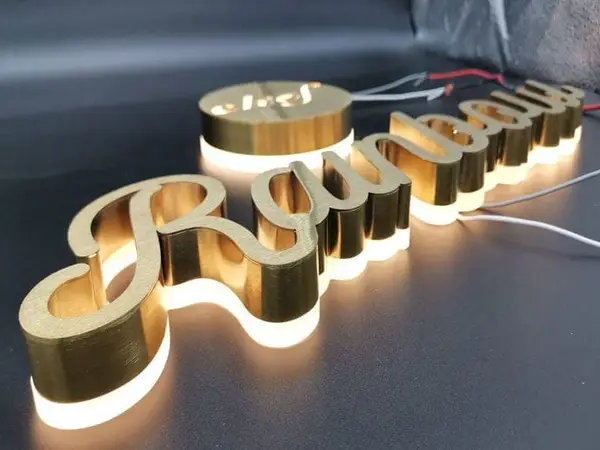
Real photo from our production floor — every sign we ship is made here.
Products mentioned or relevant to this topic — factory-direct, custom built.
From $24/letter · MOQ 1 piece · Flexible lead time · CE & UL certified · ships to 20+ countries
Custom sizes, colors, and finishes. Get a factory price in 24 hours.
Get a Free Quote Copy EmailWhatsApp +86 13865703472 · business@aochuangsign.cn
See pricing, specs, and get a free quote for the sign type you need. Built in our factory, shipped worldwide.