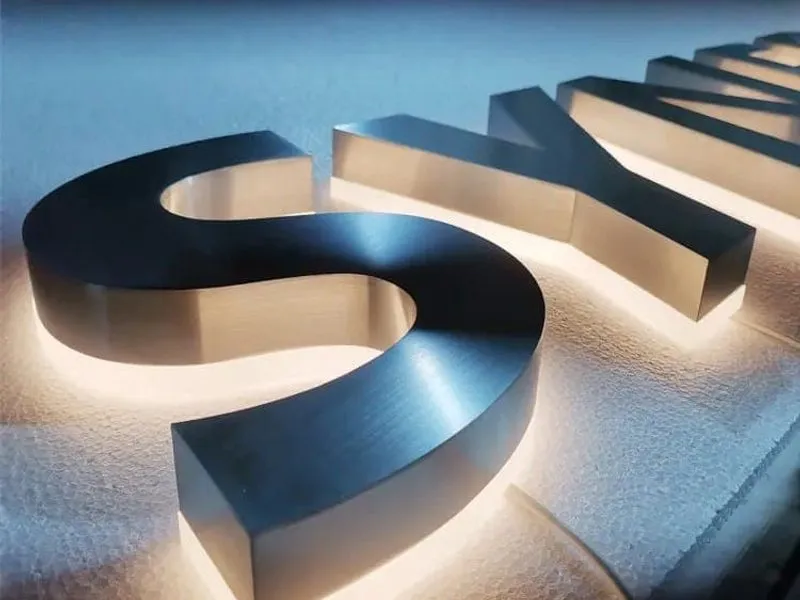
Let's cut the BS before we start
I've been building signs since before most of you had a driver's license.
The question I get every single week from someone who just lost a sign to water damage is simple: "Do I really need the waterproof power supply, or is the standard one fine?"
Here's the truth: that question tells me more about your budget than your sign.
Look, I've watched sign shops pay $800 for a front-lit letter from a domestic fabricator and then try to save $12 on the power supply that runs it. Same 304 stainless, same Samsung LEDs. We ship that same letter for $120 from our factory in Lu'an, but the power supply is where cheap kills.
The difference between a waterproof IP65-rated driver and a standard open-frame unit isn't a marketing gimmick. It's about whether your
front-lit channel letters are still burning in year three or whether you're on a ladder with a screwdriver in the rain.
What actually kills power supplies
Not heat. Not voltage spikes. Water. And the corrosion that follows it.
A standard power supply has ventilation slots. Those slots let heat out. They also let moisture in. Once humidity gets inside the casing and hits the electrolytic capacitors, you're on borrowed time. The capacitors swell, the solder joints corrode, and the output drops until your LEDs start flickering like a cheap motel sign.
Here's what nobody tells you:
the L70 rating on your LEDs doesn't mean anything if the power supply dies first. I've seen Samsung modules rated for 50,000 hours fail at 8,000 because the driver was spitting dirty DC.
Waterproof power supplies are potted — epoxy or silicone encapsulation. No ventilation slots because there's nothing to vent. The heat gets managed through the aluminum housing. You're trading a little thermal efficiency for the ability to survive a rainstorm without dying.
IP ratings: the truth about the numbers
Every customer who's ever read a spec sheet thinks IP65 means "bulletproof."
IP65 sounds impressive. It means water jets from any direction. It does NOT mean your sign survives a Florida hurricane.
Here's what the numbers actually tell you:
- IP65: Dust-tight and protected against low-pressure water jets from any direction. This is the minimum for outdoor mounted signage. Rain, sprinklers, normal weather — fine. A hose held directly against the housing for five minutes? Maybe not.
- IP66: Powerful water jets. Still not submersible. This is what I spec for coastal areas and places with aggressive weather exposure.
- IP67: Temporary immersion up to 1 meter for 30 minutes. Overkill for most channel letters, perfect for ground-level installations that might see flooding.
- IP68: Continuous immersion. You don't need this for a storefront sign. You need this for a sign at the bottom of a koi pond.
The ugly truth is that most sign failures happen at the seals, not through the power supply housing itself. The grommet where the wire enters the case. The screw terminals that weren't torqued down. The junction box that was never properly sealed. I've opened up "waterproof" installations that were dead because someone left a drip loop pointed the wrong way and water ran straight down the wire into the driver.
What I've seen fail in the field
Let me tell you about a job from two years ago. A restaurant chain in Texas ordered
back-lit halo letters from us — beautiful 304 stainless with 3mm acrylic faces and Samsung 2835 modules. The customer's local electrician insisted on sourcing his own power supplies.
He bought standard open-frame units. Mounted them inside the letters, sealed the backs, and called it done. Busted in seven months.
When I pulled the driver out, the PCB was corroded green near the terminal block. Water had wicked up the wire through the conduit and sat in the bottom of the letter channel. The capacitor was swollen to twice its diameter. That was $40 of labor and $18 of parts to fix — if you don't count the lost revenue while the sign was dark.
I've seen this go wrong on
stainless steel letters more times than I can count. The 304 steel itself is rust-proof for 10+ years outdoors, but everything inside it still needs to be protected. The sign face can be perfect while the electronics are a science experiment in galvanic corrosion.
The actual cost difference
Let's talk numbers because that's what stops people from making the right choice.
A standard open-frame LED power supply — the kind you'd use indoors on an
acrylic LED sign in a lobby — runs you somewhere between $8 and $25 depending on wattage. A waterproof IP65 version of the same driver is maybe $15 to $40. The difference on a typical channel letter set? About $10 to $15 per sign.
Your labor to replace a failed power supply: if you're doing it yourself, that's a Saturday morning and a ladder. If you're calling a sign service company, you're paying $150 to $300 for a service call plus parts. That's the cost breakdown that hurts.
Look, you can do the math. One service call pays for waterproof drivers on ten signs. And that's before we talk about the cost of a dark sign — the lost customers, the cheap look, the franchise inspector who flags it.
For the size difference in price, spec the waterproof unit every time. Every. Single. Time.
What a real waterproof install looks like
When we build channel letters at our factory in Anhui, the power supply install follows a specific sequence. It's not complicated, but skipping any step is how you get a callback.
1. The driver is mounted horizontal in the letter back — never vertical, never inverted. Condensation collects at the bottom, and you need the drainage path to work.
2. The AC input wires get a drip loop before they enter the grommet. Water runs down, hits the loop, and drops off instead of going into the housing.
3. The grommet itself gets a bead of neutral silicone around the outside — not in the wires, around the junction. Neutral, because acidic cure silicone corrodes copper.
4. The whole assembly runs through an 8-12 hour aging test before packaging. We see the failures at the factory so you don't see them at your customer's site.
The Chinese factory power that comes into most of these units is 220V/50Hz. The US runs 120V/60Hz. If you buy from any overseas manufacturer, make sure they build your drivers for the voltage in your market. This seems obvious, but I've opened up more than one import that came standard with the wrong frequency rating, running hot and noisy from day one.
Why the warranty actually matters
Our factory warranty on LED modules is 2 years. The power supply carries 1 year. Here's what nobody tells you: the
real lifespan of quality LED modules is 5+ years — Samsung, Osram, or quality Chinese brands like Lan Jing. The 100-150 lumens per watt on SMD 2835 chips is the industry standard for a reason.
Cheap modules will last 12-18 months. I've seen them fail at 9 months when paired with a cheap driver. The combination is toxic.
The modules aren't the problem. The power supply is the only moving part — the only component that actually works hard, converting mains AC to low-voltage DC, 24/7. It's also the only component where cheap materials guarantee early failure.
When you're ordering
stainless steel letters for a storefront, ask what power supply is included. If the salesperson can't tell you the brand, the IP rating, and the warranty — run.
FAQ: The questions I hear every week
Can I just put a standard power supply inside a weatherproof enclosure?
Sure, if the enclosure is actually rated for outdoor use and properly vented. But I've opened more of those "weatherproof" boxes than I care to count, and the inside is full of corrosion. The condensation forms inside the enclosure when the sign heats and cools. The enclosure traps the moisture that would normally escape. Pay the $12 extra for the waterproof driver and skip the coffin.
Does IP68 mean I can install it anywhere?
No. It means it can survive submersion. It doesn't mean it was designed for it long-term. Install it in a location where water collects and you're still inviting trouble. Common sense is part of every spec.
My LEDs are rated 50,000 hours. Why did they fail in 3 years?
Because you ran them with a crappy power supply. Dirty DC, voltage ripple, and overdriving cause the chips to overheat. The solder joints crack. The phosphor degrades. Your 50,000-hour rating assumes correct operating conditions. Feed them garbage and they die young.
Do I really need to buy from a factory with certifications?
CE marking costs 20,000-50,000 RMB for a factory to get. Most factories will say they have it. Ask to see the certificate with today's date. Watch them sweat.
UL certification for the US market runs $4,000-15,000 and takes 4-9 months with quarterly audits. ETL is the same standards with a 10-30% cheaper price tag. If you're importing for the US market, these matter for insurance, inspection, and legal liability when something goes wrong.
I'd rather buy a certified unit from China and install it correctly than buy an uncertified "premium" unit that starts a fire in your wall.