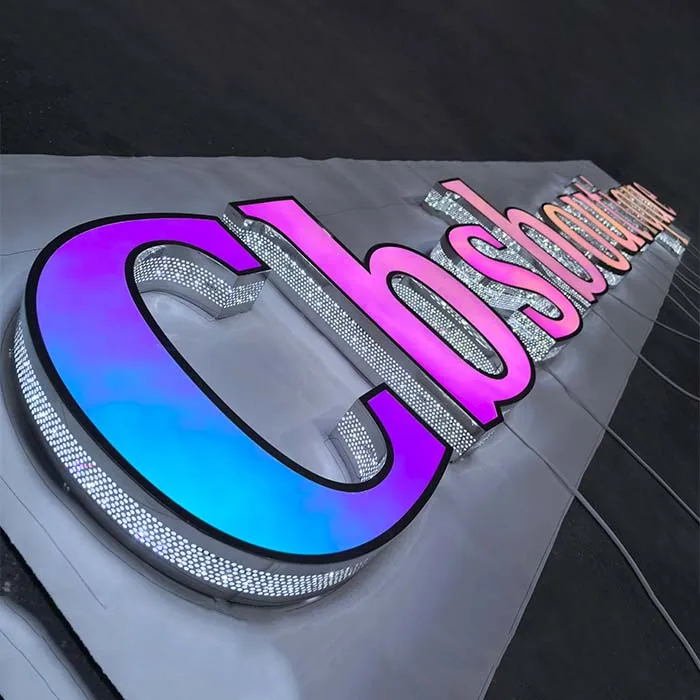
Let's cut the fluff. A channel letter sign is a 3D lightbox for each letter. You've got an aluminum return, an acrylic face, and LEDs inside. In 2025, a standard front-lit storefront set from a Chinese factory runs $20–$80 per letter. A US shop will charge you $200–$700 per letter, installed.
Each letter is its own self-contained lightbox. The sides are bent from 0.040–0.063" aluminum coil. The face is usually 2mm or 3mm acrylic, which transmits 90–92% of light. That's why they pop at night. Flat sign? No contest.
If you're ordering front-lit channel letters for a storefront, you're buying the single most recognizable sign format in American retail.
You've got four basic builds: front-lit, halo/back-lit, rimless, and dual-lit. Front-lit is the standard: aluminum can, acrylic face, LEDs inside. Back-lit halo letters reverse the light, so the glow bounces off the wall—cleaner, more architectural, and usually 75% more money.
Here's what nobody tells you: the LED is the cheap part. The aluminum bending and the acrylic face eat your budget.
A set of stainless steel non-lit letters costs $15–$40 per letter from the factory. Add LEDs and you're in the $20–$80 range for front-lit. Halo-lit runs $35–$120. 3D fabricated letters push $40–$120 per letter.
Rimless and dual-lit are for designers who want to flex. They're not harder to make, but they require tighter tolerances, and most shops charge accordingly. If you're not sure what the brand needs, front-lit is never a wrong answer.
Every channel letter we build goes through 10 steps: design confirmation, laser cutting, bending, TIG welding, grinding, CNC cutting the acrylic face, LED assembly, sealing, an 8–12 hour aging test, and 100% QC inspection.
The laser cuts to ±0.1mm. That's not bragging; it's the difference between a face that snaps in and one you have to caulk to death. We TIG weld the returns, not glue them. If you see a channel letter with glued corners, walk away.
The ugly truth is many factories skip the aging test. We don't. An LED that dies in the first 8 hours of continuous power gets caught before it ships. The letters then get sealed with neutral silicone, packed in foam, carton, and a plywood crate.
Total lead time: 7–15 days.
I've watched sign shops pay $800 for a front-lit letter from a domestic fabricator. Same 304 stainless, same Samsung LEDs. We ship that letter for $120. That's not a typo.
Factory-direct savings run 50–65% on product cost. A 10-letter front-lit set might cost $400–$800 factory, versus $2,000–$7,000 installed from a US shop. Shipping adds cost—express is 7–15 days at $30–$100 for small orders, sea freight runs 50–70 days at $80–$200 per cubic meter LCL—but you still come out way ahead.
Energy-wise, quality SMD 2835 LEDs run 100–150 lumens per watt. L70 lifespan is 50,000 hours or more. Quality modules from Samsung, Osram, or Blueview last 5+ years real-world. Cheap modules last 12–18 months. The solder joints tell you which is which: dull gray means dead in a year. Shiny silver means proper lead-free solder.
ROI on a commercial channel letter sign is usually under two years for retail, because the sign works 24/7. Amortize a stainless steel letter set over its 10+ year outdoor life and you're paying pennies a day for the best advertising you can buy.
Here's what nobody tells you: your local sign code, not your designer, decides whether you can direct-mount letters to the facade or whether you have to use a raceway. Wind load calculations, UL 48 or ETL listing requirements, height and setback rules—these vary by municipality, and they'll bite you if you skip the permit stage.
The material choice is where rookies screw up. 304 stainless gives you 10+ years outdoors. 316 adds molybdenum and gets you 15+ in Miami Beach, but it costs 20–30% more. For a strip mall in Ohio, 304 is fine. For coastal, pay for 316 or you're replacing stainless steel letters in 3 years.
Acrylic matters more than you think. UV-resistant acrylic from Mitsubishi or Degussa lasts 5–8 years before yellowing. Domestic acrylic starts yellowing in 1–2 years.
If your letter height is over 2.5 meters, use 5mm acrylic instead of 3mm. A 3mm face cuts 92% light output; 2mm cuts 90%. Your customer won't notice the 2%, but they will notice the 40% cost bump if you spec 5mm on a small sign. If you're buying acrylic LED letters, ask what brand of acrylic the factory uses.
Compliance isn't optional. UL 48 listing costs $4,000–$15,000 and takes 4–9 months with quarterly audits. ETL is 10–30% cheaper and accepted in most US jurisdictions.
IP65 is the minimum for outdoor signs—it means dust-tight and protected against water jets. IP66 is for coastal, IP68 for extreme weather. NEC Article 600 governs US electrical signage. ADA tactile signs need 48–60" mounting, non-glare finish, and Grade 2 Braille.
The ugly truth is most factories will tell you they have CE marking. CE costs 20,000–50,000 RMB and takes 2–8 weeks. Ask to see the certificate with today's date. Watch them sweat. Same with UL—if they can't produce a valid file number, they don't have it.
I've seen this go wrong: a contractor in Phoenix ordered from the cheapest Alibaba listing, got letters with dull gray solder joints, and 14 months later half the LEDs were dead. The fix cost more than the original sign.
You want a factory that answers three questions straight: what LED brand they use, what acrylic brand they use, and whether they have current UL or CE certificates with dates. Ask for a photo of the solder joints. Ask about the aging test. If they dodge, move on.
Here's the spec we work from at Aochuang Sign. 3,000m² production facility. 50+ skilled workers. CE and UL certified. MOQ 1 piece. Lead time 7–15 days. 2-year warranty on LEDs, 1-year on power supplies.
We use Samsung, Osram, or Blueview LEDs. We use Mitsubishi or Degussa acrylic. We TIG weld the returns, we don't glue them. And we run every sign through an 8–12 hour aging test before it ships.
Q: Are channel letters the same as lightbox signs?
No. A lightbox is one big rectangular cabinet with a face. Channel letters are individual 3D letters, each with their own light source. Different tools, different looks, different cost.
Q: Do I need a raceway or can I direct mount?
That's a local code question, not a style question. Some municipalities require raceways for electrical consolidation. Others allow direct mount with a UL-listed power supply. Check before you order.
Q: How long do channel letter LEDs actually last?
Quality modules from Samsung, Osram, or Blueview last 5+ years real-world, with L70 at 50,000 hours. Cheap LEDs last 12–18 months. The difference is visible in the solder joints before you install.
Q: Can I order a single channel letter?
Yes. Our MOQ is 1 piece. You don't need to order 50 letters to get factory pricing. One piece, 7–15 days, shipped worldwide.
Products mentioned or relevant to this topic — factory-direct, custom built.
From $16/letter · MOQ 1 piece · 7–15 day production · CE & UL certified · ships to 20+ countries
Custom sizes, colors, and finishes. Get a factory price in 24 hours.
Get a Free QuoteWhatsApp +86 13865703472 · cairuisheng@aochuangsign.cn