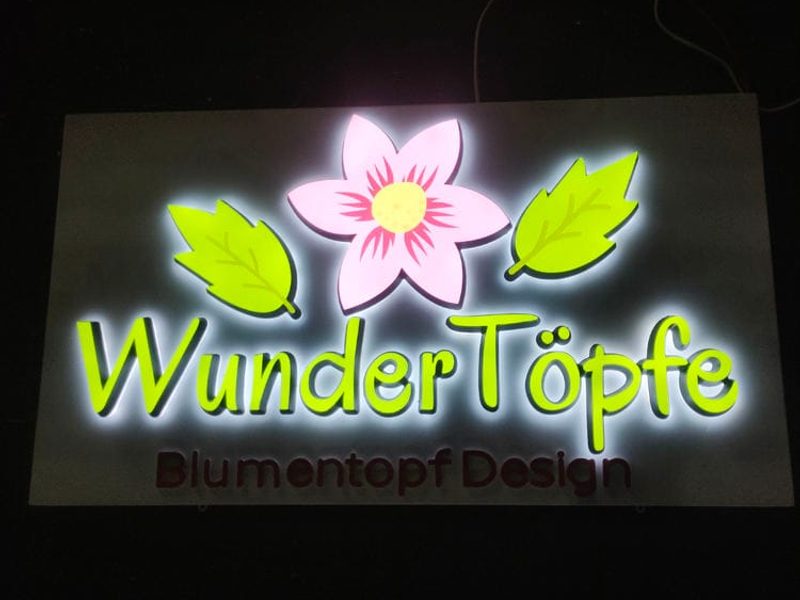
An RGB channel letter sign is just a channel letter with red, green, and blue LED modules stuffed inside, which means the sign can change color whenever you want it to. Wall-mounted RGB letters from our factory start at $1.25–$1.50 per centimeter of letter height. So a 60cm-tall "BAR" sign runs about $225–$270 before freight. That's factory-direct pricing. Not a domestic quote with three markups stacked on top of it.
Look, I've been on the floor since 2010, and RGB is the one product that makes standard sign shops nervous.
Because the wiring, the color consistency, and the programming are all on you. Get it wrong and the client calls you at 10pm asking why the sign is green when it's supposed to be white. So here's what actually matters.
Take a standard channel letter housing and swap the single white LED string for red, green, and blue modules—that's an RGB letter. The housing is usually an aluminum or stainless steel return with a 5mm acrylic face, same as any front-lit letter. The difference is the light engine. Each module carries an SMD 5050 chip that mixes those three colors into whatever shade you program.
You can hang them on a wall, stand them on the floor, or run them along an edge.
For a storefront, the two versions I sell most are color-changing acrylic letters and stainless RGB letters. The acrylic one uses a metal return can with an acrylic face. The stainless one uses a 304 or 316 steel body with a polycarbonate or acrylic lens. Same controllers run both, and either one goes outdoor-rated if you spec the right IP.
Here's what nobody tells you: RGB isn't just "drop some colored LEDs in a box." Each module carries three tiny diodes on one SMD 5050 chip, and the controller varies current to each channel to blend the color. You need a DMX decoder or a plain RF remote to talk to the modules, plus a 12V or 24V power supply sized to the letter's wattage.
Voltage drop is real.
Run a long stroke like an "M" or "W" off a single feed and the far end comes back dimmer, with the color drifting pink when you asked for purple. Red LEDs draw differently than blue under load, and cheap modules don't compensate. We use Bluesky or Rishang modules because they hold up for 5+ years of real life—but even those need a clean wiring plan.
For programmable shows, you'll want to step up to DMX programmable controls.
I've watched this go sideways: a customer bought RGB letters online, hung three of them off one undersized supply, then called asking why the blue was teal on letter one and navy on letter three. That's LED binning and voltage drop. Not a defective product.
A standard front-lit channel letter uses SMD 2835 white LEDs running 100–150 lumens per watt at 4000–5000K. An RGB letter uses SMD 5050 chips because they can produce all three colors. But that white mode? It's not the same. RGB white is a dirty off-white next to a dedicated 2835, because you're mixing red, green, and blue to fake it.
Here's the ugly part: RGB costs about 60% more than standard white channel letters, even at the factory level. A stainless trim + acrylic front-lit letter runs $0.70–$0.90 per cm. An RGB wall-mounted letter runs $1.25–$1.50 per cm. You're paying for the controller, the extra wiring, the pricier modules, and the programming.
Maintenance changes too.
Standard letters have a power supply and LED modules. Period. RGB adds a controller and, if you're doing animations, a DMX decoder or a smart receiver. And if the controller dies, the letter doesn't just go dark—it can freeze on some ugly shade of orange and sit there until somebody reboots it.
Look, I'm not going to sell you on RGB for a law office. That's dumb. But for a bar, restaurant, gym, or any place that changes promotions or hosts events, RGB letters are a real tool. Flip the whole storefront green for St. Patrick's Day, red for Valentine's, or match a brand's exact Pantone with a DMX controller.
Quality modules carry an L70 lifespan of 50,000 hours. That's more than five years at eight hours a day. Our LED warranty runs 2 years, but the Bluesky and Rishang modules we install routinely outlast the power supplies.
Then there's the attention factor.
A static white sign just sits there. An RGB sign in color-cycle mode grabs the eye of anyone walking past, because movement and color change trip the same brain response as a flashing sale tag. That's not marketing fluff—it's why casinos and nightclubs have been running this tech for years.
You want a 304 stainless return with a brushed #4 finish and a 5mm acrylic face? Fine. Powder-coated aluminum returns in your brand's RAL color? Fine. Mirror-polished 304 with an edge glow? Fine, just pay for it.
The standard acrylic face is 5mm thick because 3mm cuts light output to 92% and 2mm cuts it to 90%. That 2% isn't worth chasing. And if you're building a giant floor-standing letter, 5mm also resists flexing.
Programming options run from a $15 RF remote all the way to a full DMX show with timecode and zones. Static colors, slow fades, chases, full animated sequences—your call. I've seen a gym run a red chase across 10 letters when a member hits a PR, wired to a button behind the front desk. That's the fun stuff.
Let's talk real numbers. Wall-mounted RGB letters run $1.25–$1.50 per centimeter of letter height from our factory. Floor-standing RGB letters at 60–120cm tall run $1.50–$1.80 per cm. RGB backlit letters are $1.30–$1.50 per cm. Want edge-running RGB? That's $1.70–$2.00 per cm. Those are starting prices and they don't include freight or import duties, but they should scare your local fabricator.
I've watched sign shops pay $800 for a front-lit letter from a domestic fabricator. Same 304 stainless, same Bluesky modules. We ship that letter for $120. The gap is factory overhead and middlemen.
Installation isn't harder than standard channel letters, but it's not plug-and-play either.
You're wiring power supplies, data cable between letters, and a controller. Every connection needs neutral silicone. Mounting outside? The whole assembly has to hit IP65 minimum—dust-tight and protected from water jets from any direction. IP65 does not mean it survives a Florida hurricane. I don't care what a sales rep told you.
ROI is color. A restaurant that changes its sign for trivia night, weekend brunch, and holiday promos gets more visual variety than a static sign at maybe 60% higher cost. Use the color and it pays. Set it to white and never touch it again, and you wasted your money.
Here's what most factories won't say out loud: they'll tell you anything to get a deposit. CE marking costs 20,000–50,000 RMB and takes weeks. So if a factory claims they have CE, ask to see the certificate with today's date. Watch them sweat. UL certification for the US market costs $4,000–$15,000 and takes 4–9 months with quarterly audits—so no, a factory that opened last year doesn't have it unless they bought the file.
And nobody puts this in the brochure: on LCL sea freight, your crate gets handled 6–8 times between our dock and yours. Every touch is a chance for damage.
At Aochuang Sign, we've been building letters since 2010 in a 3,000m² facility with 50+ workers. MOQ is 1 piece. Sample lead time is around 5 days, production around 15 days depending on quantity and complexity. We use 304 stainless as standard, 316 for coastal jobs at a 20–30% premium, and domestic acrylic only if you ask for it—because UV-resistant Mitsubishi or Degussa acrylic lasts 5–8 years before yellowing, while domestic acrylic goes 1–2 years.
Every RGB letter goes through a 10-step process: laser cutting at ±0.1mm, TIG welding, grinding, acrylic face CNC, LED assembly, neutral silicone sealing, an 8–12 hour aging test, 100% QC inspection, and export packaging with foam, carton, and plywood crate.
Ask for a sample.
If a factory won't send a 30cm letter sample for $50–$100, walk away. Just walk. You need to see the solder joints, the weld cleanup, and the color uniformity under a real controller before you order 40 letters.
Can I install RGB channel letters outside? Only if they're IP65 minimum, sealed with neutral silicone, and wired with marine-grade connectors. Skip the face sealing and water gets in, and the modules corrode in months.
Why do my RGB letters show different colors on different letters? Because the factory used cheap modules from three different bins, or you undersized the power supply and the far letters are dropping voltage. That's a wiring or quality problem. Not a mystery.
Do RGB letters use more power than white? Full white on RGB pulls more than a single color because all three channels are on. But a static single-color RGB setup isn't a huge power jump over standard white.
Can I just use a standard LED controller? No. RGB modules need a controller that drives three channels per zone. A standard single-color LED driver will light them all up white-ish and then die.
Products mentioned or relevant to this topic — factory-direct, custom built.
From $16/letter · MOQ 1 piece · 7–15 day production · CE & UL certified · ships to 20+ countries
Custom sizes, colors, and finishes. Get a factory price in 24 hours.
Get a Free QuoteWhatsApp +86 13865703472 · cairuisheng@aochuangsign.cn