The best sign for a liquor store? Front-lit channel letters. A 30-inch letter with a stainless trim cap and acrylic face runs $80 to $103 per letter straight from our factory floor. Your local sign shop quotes $400 and acts like they're doing you a favor. Wrong move. The product isn't complicated. The markup is criminal.
Most liquor store signs fail because the owner buys for the grand opening, not for year three. Your sign doesn't just sit there. It catches sun, rain, car exhaust, and the occasional drunk leaning on it at 11 p.m. Buy cheap, buy twice.
Liquor stores are a weird retail animal. Your customers aren't strolling by after brunch. They're driving past, usually at night, deciding in a split second whether to turn in or keep going. Your sign has to be legible at 40 mph under a streetlight. That means contrast and backlighting beat a cute logo.
Compliance is the other pain. Alcohol advertising rules change by state and county. Some cap window coverage. Some ban illuminated signs after closing hours. Call your state's Alcoholic Beverage Control board before you spend a dime. I've seen owners order $2,000 of neon, then get a violation letter because the word "vodka" was visible from a school bus stop.
Then there's the landlord. Most leases have a sign criteria package—size, illumination, raceway color, mounting height. Ignore it and you'll be repainting or replacing the sign before opening day. Ask for that document first. It costs nothing.
If you're ordering front-lit channel letters for a storefront, you're buying individual letters, each with its own LED modules, trim caps, and acrylic faces. That modularity saves your ass when a delivery truck clips the "R" and the landlord calls at 7 a.m. You replace one letter, not the whole sign.
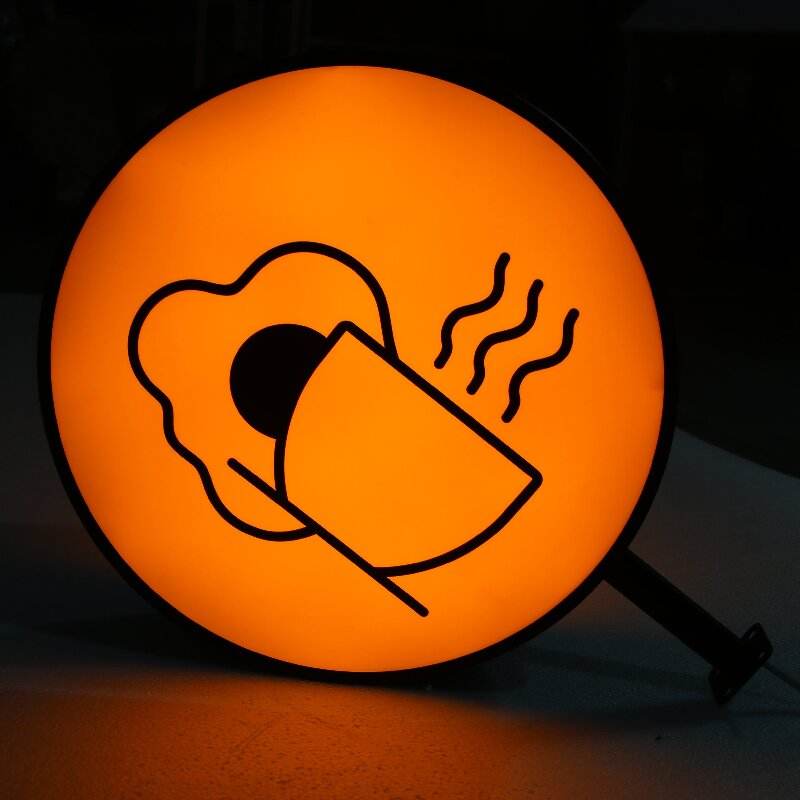
Cabinet light boxes cost less upfront. A 50 cm double-sided box runs $90 from us, compared to $470–$600 for a six-letter front-lit set at $1.05–$1.35 per centimeter. But a cabinet box is one giant face. If the acrylic cracks or the LEDs burn out, you replace the whole light panel. Labor eats the savings. They also look flat during the day unless you pay extra for push-through acrylic.
Here's the ugly truth: most cabinet light boxes under $200 use the cheapest acrylic face they can find. That face yellows in 18 months. Then your store looks like it's lit through a cigarette filter. Spec UV-stable acrylic from Mitsubishi or Degussa and you get 5–8 years before any noticeable shift. Domestic acrylic? 1–2 years, maybe.
For nighttime punch, front-lit channel letters win. A standard SMD 2835 LED module pushes 100–150 lumens per watt. That's enough to make a 30-inch letter readable from 200 feet. Cabinet boxes with the same modules can work, but the light is diffuse, not focused. You need bigger letters to get the same legibility.
If your store sits in a strip mall or on a highway, a building-mounted sign won't cut it. You need a pylon or monument sign to catch drivers before they blow past your turn. Pylon signs are the tall pole-mounted ones. Monument signs are the low, solid-looking structures near the entrance. Both demand more work than channel letters, and most small shops won't fabricate them in-house.
We don't build the giant pylons themselves. We do build the double-sided light boxes that mount on them. That's where the real cost hides: the cabinet, the structural frame, the foundation. A 50 cm box costs $90. The pole, concrete, and engineering might run you $3,000 to $15,000 depending on your town's wind load requirements.
Look, if your store sits in a center with a shared pylon sign, you're usually renting space inside a landlord-controlled cabinet. Read the lease addendum. Some charge a monthly fee. Some force you to use their vendor, who bills $800 for a plastic insert that costs $40. Not a typo.
Monument signs look more permanent, but they cost more to install because they need a footer and permits. If you need to open fast, start with storefront channel letters and add a pylon later. The storefront sign does 80% of the work for a fraction of the cost.
Digital LED signs and RGB channel letters are flashy, but for a liquor store they're often a waste of money unless you're a high-volume destination. Compliance is the roadblock. Most state liquor boards restrict animated or flashing alcohol-related signage. Some prohibit color-changing effects within X feet of a school, church, or residential zone. You can't just run a chasing RGB border and call it a day.
If you want a dynamic element, use it for non-alcohol content—store hours or an "Open" indicator. We make RGB-capable acrylic letters, but I'd only spec those for a party store or lounge, not a straight liquor retailer. The liability isn't worth it. One complaint from a neighborhood association and you're in front of a zoning board explaining why a 3-foot-tall red "WINE" sign was strobing at 9 p.m.
Technical reality: SMD 5050 modules can do RGB, but they run hotter and cost more than SMD 2835. For a liquor store, stick with 6000–6500K cool white or 4000–5000K neutral white. Warm 3000–3500K looks great for hospitality, but a liquor store wants the cold, bright, 'we're open and we have what you need' look, not a candlelit wine bar.
NEC Article 600 applies to all electric signs in the US. If you're importing, make sure the power supply and wiring meet local code. CE marking costs 20,000–50,000 RMB. UL 48 runs $4,000–15,000 and takes 4–9 months, with quarterly audits. Ask your vendor to show the certificate with today's date. Watch them sweat.
Spec 304 stainless steel letters for most outdoor liquor store applications. 304 has 18% chromium and 8% nickel, and it'll give you 10+ years outdoors without rusting through. Standard thickness runs 1.2–1.5 mm. For coastal towns or anywhere with salt spray, step up to 316 stainless. That adds 2–3% molybdenum for marine-grade corrosion resistance. It costs 20–30% more, but in Miami Beach it's not an upgrade—it's the only option that survives three years.
I've watched this go wrong: a store in Ohio ordered 316 stainless for a strip mall sign. They paid 30% more and got zero benefit. 304 would have lasted longer than the lease. Don't over-spec for geography. Use 316 only if you're within a few miles of salt water or heavy industrial fallout.
For the acrylic face, thickness matters less than most people think. A 3mm acrylic face cuts 92% of light output. A 2mm face cuts 90%. Your customer won't notice the 2% difference, but they'll notice the 40% cost bump if a vendor upsells you on unnecessary thickness. Use 5mm standard if you're mounting low where someone can punch it. Otherwise, 3mm is fine.
UV stability is where acrylic quality really hits. Mitsubishi or Degussa acrylic lasts 5–8 years before yellowing. Domestic acrylic can go yellow in 1–2 years. If the quote doesn't name the brand, assume it's the cheap stuff.
LED modules are the heart. Bluesky or Rishang modules last 5+ years real-world. Cheap no-name modules die in 12–18 months. Quickest way to spot bad LED modules? Look at the solder joints. Dull gray joints mean the manufacturer used cheap solder. It won't last 18 months. Shiny silver joints mean proper lead-free solder. Ask for a photo of the module board before you order.
IP ratings confuse people. IP65 means the sign is dust-tight and can handle water jets from any direction. It does NOT mean your sign survives a Florida hurricane. For outdoor liquor store signs, IP65 is the minimum. If you're in a coastal or high-pressure wash zone, go IP66. IP68 is submersible—you don't need that unless your sign is going underwater.
Permits are where liquor store projects stall for weeks. You need zoning approval, a sign permit, and sometimes a separate alcohol advertising permit. Many municipalities impose stricter size limits on illuminated signs in liquor retail zones than on other businesses. Don't assume the sign shop handles it. Most don't. You or your contractor pulls the permit, and if the application is wrong, you wait another 30 days.
Landlord sign criteria is the hidden mine. I've seen a landlord reject a $3,000 sign because the raceway wasn't painted to match the building's RAL color. That's a $400 mistake you can avoid by reading the criteria before fabrication. Ask for the sign package before you even call a vendor. If the landlord doesn't have one, get the approval in writing.
For US installs, NEC Article 600 governs electrical signs. Your sign must be listed or field-inspected. UL 48 certification is the gold standard, but it costs $4,000–15,000 and takes months. ETL is a cheaper alternative—10–30% less—and widely accepted. Don't fall for a vendor who says, "We have CE so we're fine for the US." CE is European. It means nothing to a US inspector.
ADA rules don't usually touch storefront signs, but if you have a restroom or entrance sign with tactile letters, mount it 48–60 inches high, non-glare, with Grade 2 Braille. That's a separate category, but people screw it up all the time.
Look, a sign that dies in 18 months isn't cheaper—it's a down payment on a second sign. Cheap LED modules fail at 12–18 months. A replacement service call runs $150–$400 even before parts. A factory-direct front-lit set with Bluesky modules costs more upfront but runs 5+ years. Do the math over three years and the cheap sign often costs double.
I've watched sign shops pay $800 for a front-lit letter from a domestic fabricator. Same 304 stainless, same Samsung LEDs. We ship that letter for $120. The markup isn't quality; it's rent, middlemen, and a sales rep's commission. If you're a sign contractor, import direct and keep the margin. If you're a store owner, find a contractor who'll pass through factory pricing instead of padding it.
For a typical 24-inch six-letter front-lit set, you're looking at $1.05–$1.35 per centimeter, so around $470–$600 factory-direct. Add shipping, import duty, and installation, and you're still under the $2,500 most local shops quote for the same sign. Sea freight takes 40–50 days fast, 65 days standard. Express runs 7–10 days if you're in a rush. Plan accordingly.
Don't forget the power supply warranty. We give 2 years on LED modules and 1 year on the power supply. The power supply is the component most likely to fail, especially if someone undersizes it or mounts it in direct sun. Spec a supply rated at least 20% above the total LED load. If your LEDs draw 60W, use an 80W supply. The extra cost is $5, and it prevents a burnout.
In the end, the best liquor store sign is a front-lit channel letter set with 304 stainless trim, UV-stable acrylic faces, and Rishang or Bluesky LEDs. Add a double-sided lightbox if you're on a corner or have drive-by visibility. Skip the RGB unless your city allows it and your brand is party-oriented. And for God's sake, check the compliance before you cut the check.
Q: What's the cheapest sign type for a liquor store?
A wall-mounted single-color bulb letter runs $1.05–$1.20 per centimeter. But 'cheapest' usually means 'replace in two years.' I've said this a hundred times: buy the sign you want to install once.
Q: Can I use neon instead of LED?
You can, but neon costs more to run and maintain. LED neon flex looks close and uses a fraction of the power. If you want that look, use LED neon flex. Real glass neon is for restaurants that want to be Instagram backdrops, not for a liquor store that needs to be open at 10 p.m.
Q: How long does production take?
A sample letter takes about 5 days. A full bulk order runs around 15 days, depending on quantity, size, and complexity. Shipping adds 7–10 days express or 40–65 days sea. If you wait until the week before your grand opening, that's your fault, not the factory's.
Q: Do I need UL certification for a liquor store sign?
If it's a hardwired electric sign in the US, yes, it needs to be listed or field-inspected. UL 48 is the most recognized. ETL works too and costs 10–30% less. Don't accept 'CE marked' as a substitute. I can't believe I still have to explain this.
Products mentioned or relevant to this topic — factory-direct, custom built.
From $24/letter · MOQ 1 piece · Flexible lead time · CE & UL certified · ships to 20+ countries
Custom sizes, colors, and finishes. Get a factory price in 24 hours.
Get a Free QuoteWhatsApp +86 13865703472 · cairuisheng@aochuangsign.cn