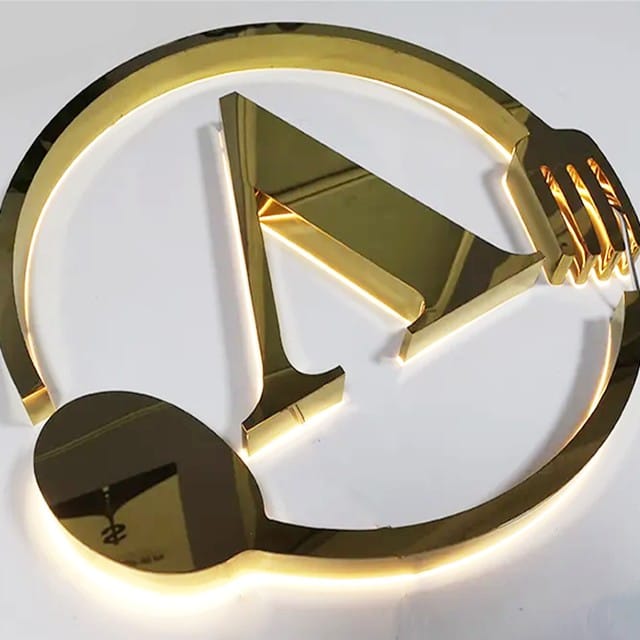
For a yoga studio, the exterior sign that actually works is a front-lit channel letter set running 3000–3500K warm white LEDs behind a 5mm acrylic face. Budget $1.05–$1.35 per centimeter of letter height. A 30cm letter runs about $32–$41 before install. That's Aochuang Sign's factory-direct price, not a guess. A domestic fabricator charges $800 for the same 304 stainless and Samsung-grade LEDs. Same product. Different middleman.
Yoga studios live and die by walk-ins and neighborhood visibility. You're not a steakhouse. You're the place someone drives past twice a day and finally decides to try.
Look, a yoga studio sign isn't decoration. It's a sales tool. I've watched sign shops pay $800 for a front-lit letter from a domestic fabricator. Same 304 stainless, same Samsung LEDs. We ship that letter for $120. The markup isn't magic—it's middlemen.
A sign that's too dim, too cold, or too cluttered sends the wrong signal. Your clients come to de-stress. If your sign looks like a vape shop, they'll keep driving.
Spend your budget on exterior first. Interior signs can wait—if a client's already inside, they've found you.
For the storefront, front-lit channel letters are the workhorse. They're visible day and night, they survive weather, and they read clean from the street. For the lobby or studio room, acrylic LED letters with warm white 3000–3500K create the calm you're selling. The exterior letter set brings people in. The interior sign makes them stay.
Here's the part nobody mentions: a 2mm acrylic face cuts 90% of light output, and a 3mm face cuts 92%. You don't need to pay 40% more for 3mm when the light loss is only 2%. Put that cash into good LED modules.
Yoga studios are rough on signs. Hot yoga rooms push 105°F and 40% humidity. A cheap domestic acrylic face with no UV stabilizer yellows in 1–2 years. Mitsubishi or Degussa UV-resistant acrylic lasts 5–8 years. Guess which one makes your studio look shabby after two New England winters?
For exterior letters, 304 stainless steel letters run 10+ years outdoors. That's 18% chromium, 8% nickel. If you're near the coast, 316 stainless with 2–3% molybdenum costs 20–30% more but won't pit in salt air. For a strip mall in Ohio, 304 is fine. For Miami Beach, pay for 316 or you're replacing letters in 3 years.
Aluminum weighs one-third as much as steel, won't rust, and lasts 8–12 years outdoors. If wall load or mounting brackets worry you, anodized or powder-coated aluminum works. But if you want that premium architectural feel, stay with brushed #4 or mirror #8 stainless.
Most small business owners don't learn ADA signage laws until a customer complains or an inspector writes them up. US law requires tactile signs for yoga studios. You mount them 48–60 inches from the floor, use a non-glare finish, and include Grade 2 Braille. Federal law, not a suggestion.
Your interior wayfinding and directional systems need to point to restrooms, changing rooms, and the studio floor without making clients feel like they're in an airport. But they still have to meet ADA contrast and mounting specs.
I've seen this go wrong: a yoga studio signs a lease in a historic building, orders custom backlit halo letters, then finds out the landlord only allows flat wall-mounted signs with no illumination. They ate $2,300. Check city sign code, HOA rules, and landlord sign criteria before you send a deposit. Every time.
If your classes start at 5:30 a.m. or run past 8 p.m., you need illumination. Period.
Non-illuminated signs only work for daytime foot traffic. Yoga studios aren't gyms with 24/7 neon. A warm glow at 7 p.m. signals "we're open" better than a dark sign. Use LED modules: SMD 2835 delivers 100–150 lumens per watt, industry standard. Our modules from Bluesky and Rishang run 5+ years real lifespan. Cheap no-name modules die in 12–18 months.
The quickest way to spot bad LED modules? Look at the solder joints. Dull gray means they won't last 18 months. Shiny silver means proper lead-free solder. If you're ordering from a factory, ask for photos of the solder joints before production.
A yoga studio sign should feel like a spa, not a gas station. 3000–3500K warm white is non-negotiable for a wellness brand. 4000–5000K neutral reads corporate. 6000–6500K cool reads industrial. Your clients want the first option.
Don't let a graphic designer talk you into a script font. Script says wine bar or wedding venue. Use a clean, thin sans-serif with generous letter spacing. Keep the face matte or anti-glare. Nothing ruins a "calm" brand like a glossy acrylic face reflecting the setting sun into someone's eyes.
Face material matters more than font. A 5mm UV-resistant acrylic face has 90–92% light transmittance and won't yellow for 5–8 years. A domestic face might look identical on day one, but it'll cloud over in 18 months. That's the difference between a studio that looks established and one that looks tired.
If you buy from a local sign shop, you're paying for their markup, their overhead, and their subcontracted fabrication. Factory-direct changes the math.
Let's talk real numbers. Front-lit stainless trim + acrylic letters run $1.05–$1.35 per centimeter of letter height. Go electroplated, and it's $1.50–$1.80 per cm. Baked-paint stainless trim is $1.20–$1.65 per cm. A 30cm "YOGA" letter set—three letters—at $1.25/cm is $112.50. A domestic shop might want $2,400 for that same set. I've seen that exact markup.
You don't need to order 50 letters. MOQ is 1 piece. A sample takes about 5 days. Bulk production runs about 15 days, depending on quantity, size, and complexity. Warranty: 2 years on LED, 1 year on power supply.
For shipping, express runs 7–10 days, air about 10, fast sea 40–50, standard sea about 65. Freight cost depends on destination and volume. Anyone who quotes a flat $200 sea freight without asking your port is guessing.
My shop is Aochuang Sign in Lu'an, Anhui. 3,000 square meters, 50+ workers, CE and UL certified since 2010. If a factory says they have CE certification but can't show you a certificate with today's date on it, walk away. CE marking costs 20,000–50,000 RMB and takes 2–8 weeks. Ask to see it. Watch them sweat.
For US electrical signs, UL 48 listing costs $4,000–$15,000 and takes 4–9 months. If your supplier claims UL listed, ask for the file number. I can't count how many times that question ends a phone call.
Quick FAQs I'm tired of answering:
Do I need a permit for a yoga studio sign? Yes. Almost always. City sign codes, landlord/HOA rules, sometimes historic district review. Skip it and get caught, you'll pay double—removal plus reinstall plus fines.
Can I install it myself? Sure, if you like voiding warranties and failing electrical inspection. NEC Article 600 applies to sign wiring. Hire a licensed electrician. This isn't a DIY weekend project.
What's the cheapest sign that still looks decent? Non-illuminated baked-paint 304 stainless letters at $1.05–$1.20 per cm. But if you're open past dark, illuminated isn't a luxury. People need to find you.
How long do the LEDs actually last? Our modules from Bluesky and Rishang run 5+ years real lifespan. No-name modules die in 12–18 months. If a quote is half the price, ask what brand. Then ask for the module spec sheet. If they can't produce it, that's your answer.
Products mentioned or relevant to this topic — factory-direct, custom built.
From $24/letter · MOQ 1 piece · Flexible lead time · CE & UL certified · ships to 20+ countries
Custom sizes, colors, and finishes. Get a factory price in 24 hours.
Get a Free QuoteWhatsApp +86 13865703472 · cairuisheng@aochuangsign.cn