Eleven years on the factory floor, and I'll tell you the same thing I told the last shop owner who called me at 9pm: a dance studio sign isn't decoration. It's a 24-hour sales rep bolted to a wall. If it's dull, peeling, or wired by somebody's cousin, every parent driving past thinks "cheap." They don't know why. They just feel it.
I've seen this go wrong: a studio in Texas ordered backlit acrylic letters from a local fabricator, paid $4,800 installed, and six months later the LEDs were flickering because the power supply sat in a sealed aluminum raceway with zero ventilation in 100°F heat. The sign wasn't bad. The install was. This trade punishes shortcuts.
Here's what nobody tells you: dance studios combine two harsh environments—sweat-heavy humidity and constant vibration from sprung floors. Your standard indoor sign adhesive will fail. The 3M tape that holds a lobby plaque in a law office will peel off a mirrored wall by August. We've tested it. Use mechanical fasteners or neutral silicone rated for wet zones.
Let's get into it.
A dance studio has maybe three seconds to convince a parent the tuition is worth it. The sign is the first thing they see from the parking lot. Look, I've walked past a hundred strip-mall studios. The ones with front-lit channel letters in clean 4000K white with a deep return get walk-ins. The ones with a backlit flex face that looks like a faded beer sign get "I'll call later." They never call.
Your sign sets the price anchor. A mom sees back-lit halo letters with a soft 3000K warm glow and she assumes monthly tuition is $150. She sees a vinyl banner and assumes $40. Same classes inside. Different sign, different perceived value. That's not marketing fluff—that's why an installed US retail halo letter runs $400–1,000 per letter, and a factory-direct import costs $35–120 per letter.
The ugly truth is most sign shops sell dance studios the same generic sign they'd sell a dentist. No consideration for mirror glare, no moisture-rated LEDs, no thought about what happens when 20 kids jump in unison. That's the gap. Fill it and you own the niche.
Here's what nobody tells you: dance studio owners talk to each other. A bad sign in one studio becomes a warning in three local Facebook groups. A good one becomes a referral. We ship worldwide from our 3,000m² facility in Lu'an, Anhui, and I can tell from reorder patterns which shops get that. We've been doing this since 2010, 50+ workers, and our MOQ is one piece. That matters when a studio needs a single replacement letter after a door ding.
Exterior is simple: you need channel letters or a lightbox. Don't reinvent the wheel. A 2mm or 3mm acrylic face on front-lit channel letters gives you 90–92% light transmittance. Use 5mm+ if the letters span over 2.5m or a kid can reach them. For a dance studio storefront, front-lit channel letters are the bread-and-butter, and they run $20–80 per letter at factory price. Add a power supply with a 1-year warranty and LEDs with 2-year coverage.
Interior is where most shops screw up. A dance studio has three zones. The lobby is dry-ish, the hallway is humid, and the studio itself is humid plus vibration. For a lobby, acrylic LED letters work fine—they're versatile indoor/outdoor and can take some humidity. But don't stick them to a mirror with VHB tape. I said this already. I'll say it again because rookies ignore it.
The studio itself? Put lettering on a non-glare material or install back-lit halo letters above the mirror line, not on it. Mirror condensation will kill unprotected LEDs in 18 months. Cheap LED modules last 12–18 months. Quality Samsung, Osram, or Blueview modules run 5+ years real-world and hit L70 at 50,000 hours. That's the difference between a warranty call and a repeat customer.
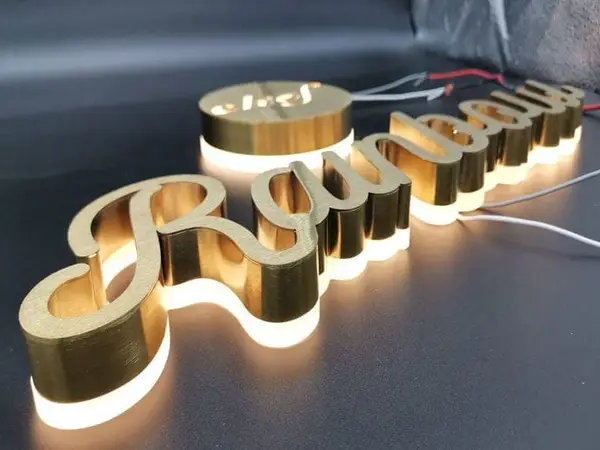
For a premium architectural look, back-lit halo letters cast a soft glow on the wall. They're $35–120 per letter factory-direct, $400–1,000 installed retail. That's margin. For a metal sign in a coastal studio, use 316 stainless, which has 2–3% molybdenum and lasts 15+ years in marine air. 304 is fine for Ohio. 316 costs 20–30% more, but you're not replacing it in three years. We make 304/316 stainless steel letters with a 10+ year outdoor life.
Here's what nobody tells you: fonts matter less than contrast and color temperature. A dance studio sign should never be 6000–6500K cool white unless it's an industrial highway sign. For a studio, 3000–3500K warm white makes skin tones look healthy and the space feel safe. 4000–5000K neutral works for a corporate or retail strip. Cool white makes a ballet studio look like an operating room.
Colors: contrast drives legibility. A polished stainless face with black returns reads from 100 feet. Mirror polished letters are gorgeous but only if the wall behind is dark. Don't put mirror polished letters on a white wall—they'll disappear. For most dance studios, acrylic faces with routed push-through lettering win. They're durable and cheap.
Imagery: skip the cartoon ballerina. A simple silhouette or a clean monogram works. If you do full graphics, use UV-resistant inks and laminate. Our acrylic faces use Mitsubishi or Degussa UV-resistant material that lasts 5–8 years before yellowing. Domestic cheap acrylic yellows in 1–2 years. That's not a typo. If you're buying from a supplier who can't name their acrylic source, that's domestic. If you're saving money there, you're buying a warranty problem.
For interior neon, LED neon flex is the move. It's energy-efficient, cool to the touch, and you can bend it into a dancer silhouette. We have LED neon flex from $30–200 per sign. It's not glass. It won't shatter when a kid knocks a bag into it. But use IP65 at minimum for outdoor, IP66 for coastal or splash zones.
The ugly truth is most sign shops quote a dance studio sign without reading the landlord's sign criteria. Then they get hit with a redesign fee. Pull the sign plan before you quote. ADA requires tactile signs mounted 48–60 inches to the center of the tactile characters, non-glare finish, Grade 2 Braille. That's for room identification. Your main exterior sign doesn't need Braille, but interior wayfinding and restroom signs do.
For electrical, NEC Article 600 covers signs. UL 48 certification runs $4,000–15,000 and takes 4–9 months with quarterly audits. ETL is a cheaper alternative, 10–30% less. CE marking costs 20,000–50,000 RMB and takes 2–8 weeks. Ask to see the certificate with today's date on it. I've seen factories claim CE and then send a five-year-old PDF. Watch them sweat.
What about IP ratings? IP65 means dust-tight and protected from water jets. It's the minimum for outdoor. IP66 handles powerful jets. IP68 is submersible—overkill for a dance studio. Don't pay for IP68 unless you're mounting the sign at the bottom of a pool.
Here's what nobody tells you: a dance studio isn't a clean office. Humidity plus mirrors means condensation drips. Your power supply should live in a ventilated, dry location, not sealed behind the sign face. We run every sign through an 8–12 hour aging test before it ships. That catches the failures a cheap shop lets you discover on-site.
Let's do math. A studio owner pays you $2,800 for a four-letter front-lit channel letter set. You source it factory-direct for $320 plus $180 freight and tariff. Your material cost is $500. You install it in one day. Your labor and overhead maybe $600. You cleared $1,700. The studio owner's sign pulls two new students a month at $120 each. The sign pays for itself in less than a year. That's ROI you can show them.
Look, I've watched sign shops pay $800 for a front-lit letter from a domestic fabricator. Same 304 stainless, same Samsung LEDs. We ship that letter for $120. That's not a sales pitch—that's a 50–65% factory-direct savings on product. US Section 301 tariffs add about 30%, so do the math on your landed cost before you set your retail.
For a studio owner, the ROI argument is simple: if the sign brings one student, it's a profit. If it brings zero, the sign is bad or the location is bad. I've never seen a good sign fail to pay for itself in a dance studio with a real instructor. The returns are just too high when tuition is $100+ a month.
A dance studio sign package—exterior channel letters, interior neon, a few wayfinding pieces—should retail between $3,000 and $12,000 installed. Your factory cost lands around $1,200 to $4,000. That leaves room for mistakes, custom install, and follow-up.
Dance studios don't maintain signs. They wipe mirrors and forget the letter that's flickering. If you sell a sign, set up a 12-month check-in. Cheap LED modules start failing at 12–18 months. Quality modules last 5+ years, but power supplies have a 1-year warranty for a reason. Replacements are cheap. Call-backs kill your margin.
Here's what nobody tells you: cleaning acrylic with Windex and a paper towel scratches it over time. Use a microfiber cloth and plain water or acrylic-safe cleaner. Acrylic faces from UV-resistant material last 5–8 years.

Real photo from our production floor — every sign we ship is made here.
Products mentioned or relevant to this topic — factory-direct, custom built.
From $24/letter · MOQ 1 piece · Flexible lead time · CE & UL certified · ships to 20+ countries
Custom sizes, colors, and finishes. Get a factory price in 24 hours.
Get a Free Quote Copy EmailWhatsApp +86 13865703472 · business@aochuangsign.cn
See pricing, specs, and get a free quote for the sign type you need. Built in our factory, shipped worldwide.