Storefront 30 feet from the curb? You need 12–24 inch channel letters. Anything under 10 inches is decorative trim, not signage.
A 12-inch front-lit channel letter with a 3mm acrylic face lets 90-92% of the LED light through. The SMD 2835 modules inside push 100-150 lumens per watt. That's bright enough to read across a parking lot—but only if the letter is tall enough for your eye to resolve the letterform.
Here's what nobody tells you: a sign that's too small doesn't just look cheap—it fails its only job. I've watched a pizza shop owner order 6-inch letters because they "fit the budget" and then wonder why nobody stops. At 40 feet, 6 inches is a smudge.
Your sign isn't decoration; it's a salesperson. If the letters are too small, the LEDs inside are wasted. Quality LED modules carry an L70 rating of at least 50,000 hours—that's over five years of nightly use. A 6-inch letter with a 50,000-hour lifespan dies before anyone reads it.
Get the size wrong and here's what happens: a storefront runs 8-inch letters, the glow blurs at night, and cars drive right past. A 12-inch face with 3mm acrylic lets 90% of light through. You can read that letter. I've seen sign shops sell 6-inch letters as "modern minimalism"—that's just them covering for a bad spec.
Look, the rule I use in the shop is one inch of letter height for every ten feet of viewing distance. A storefront 40 feet from the parking lane means 4-inch minimum, but nobody reads 4-inch letters from a moving car. So I bump the exterior minimum to 10 inches, every time.
The real decision is where your customer sees it from. A 12-inch letter with 3mm UV-resistant acrylic (Mitsubishi/Degussa lasts 5-8 years, domestic acrylic yellows in 1-2) and SMD 2835 LEDs at 100-150 lumens per watt reads fine from 100 feet. At 200 feet, it's a glowing brick. If the road is 200 feet away, don't do 12 inches—go 18 or 24.
Here's the part nobody tells you: your city sign code doesn't care about my 12-inch rule. It cares about square footage, facade percentage, and sometimes a hard cap on letter height. I've seen this go wrong: a client ordered 30-inch channel letters for a strip mall in Ohio. The landlord's sign criteria capped letter height at 18 inches. The city approved the permit, but the landlord made them rip it down. That cost them $3,000 in install and patch work.
NEC Article 600 covers the electrical side. UL 48 certification runs $4,000-15,000 and takes 4-9 months—most small shops don't carry it, so ask the fabricator for proof. If they say "CE marked" for a US install, that's a red flag. CE is a European mark—costs 20,000-50,000 RMB—and means nothing to a US inspector.
Look, a 30-inch stainless letter doesn't just sit on the facade—it hangs there. Stainless 304 weighs 7.93 g/cm³. A set of 30-inch letters in 3mm stainless isn't going on drywall anchors.
Aluminum weighs one-third of steel, but it still needs a structural wall or raceway. If your storefront has a recessed entry or an awning, the available flat surface above the door caps the letter height. No flat surface? You can't direct-mount letters. That's when you go with a raceway-mounted front-lit channel letter or an embedded lightbox.
And if the letter itself tops 2.5m in height, don't use 3mm acrylic—use 5mm or it bows under its own weight. I've seen a 3mm face on a 2.5m letter look like a Pringle after one summer. The fix costs more than the initial savings.
Ugly truth: a 12-inch letter with the wrong depth looks like a neon pancake. Front-lit channel letters need a return deep enough to house SMD 2835 modules and a diffuser. Halo-lit letters need standoffs to create that back glow. If your stroke width is thinner than the module, the light spills ugly.
For a premium architectural look, back-lit halo letters need 1.5 to 2 inches of depth to cast the halo properly. A shallow 1-inch can won't do it. I've had clients ask for halo effect in a half-inch depth—that's not a halo, that's a leaky edge.
Color temperature matters too. Warm 3000-3500K for hospitality, neutral 4000-5000K for retail and corporate, cool 6000-6500K for industrial or highway signs. Size doesn't change color temp, but color temp changes how big the sign reads at night.
And don't fall for the IP65 hype. IP65 means dust-tight and water jets from any direction. It doesn't mean your sign survives a Florida hurricane. I've watched a shop owner brag about IP65 letters, then lose them to a tropical storm because the mounting wasn't rated for wind load.
Quickest way to spot bad LED modules: look at solder joints. Dull gray = won't last 18 months. Shiny silver = proper lead-free solder. Quality modules (Samsung/Osram/Blueview) last 5+ years. Cheap modules die in 12-18 months.
For a strip mall in Ohio, I'd spec 12-18 inch 304 stainless steel letters with a brushed #4 finish and 4000K neutral LEDs. Stainless 304 gives you 10+ years outdoors. It's rust-proof, and the brushed finish hides scratches.
For Miami Beach, I'll push 316 stainless—it contains 2-3% molybdenum, lasts 15+ years in salt air, and costs 20-30% more than 304. Pay it. Or replace your letters in three years. Ocean air pits 304 so bad it looks like Swiss cheese after two summers.
If the budget's tight and the location is covered, acrylic LED letters with UV-resistant acrylic (5-8 years) will do. Just don't use domestic acrylic outdoors—it yellows in 1-2 years. That's not a maybe; I've pulled domestic acrylic faces that looked like old headlights.
Restaurants and retail do fine with 12-inch warm 3000-3500K letters. Corporate headquarters and medical offices want 18-24 inch neutral 4000-5000K. Industrial parks and highway-facing signs need 24-inch+ cool 6000-6500K because drivers read them from hundreds of feet at speed.
Here's where size hits your wallet. Factory prices per letter run $20-80 for front-lit channel letters, $35-120 for back-lit halo, $15-40 for non-lit stainless. A 12-inch letter sits on the low end; a 24-inch letter on the high end. Same storefront, double the letter height, roughly double the material and shipping volume.
US retail installed front-lit letters run $200-700 per letter. That same 12-inch front-lit letter from our factory in Lu'an, Anhui costs $20-80 before shipping. Factory-direct savings land between 50-65% on product. The catch? You handle the permit, install, and the 30% Section 301 tariff on Chinese-made signs.
Shipping a set of 12-inch letters by express runs $30-100 and arrives in about 5-15 days. Sea freight for a full storefront sign costs $80-200 per cubic meter LCL and takes about 65 days. Plan accordingly. I've had clients order 24-inch letters and then panic because sea freight added six weeks to their opening date.
Our MOQ is one piece, lead time about 5-15 days, even for custom 24-inch sets. So size won't kill your opening—poor planning will.
Q: Can I just buy 6-inch letters and save money?
A: Sure. You'll also save on electricity because nobody will see them. 6-inch letters are for interior door signs, not a storefront 40 feet from the road. I've said this since 2010 and people still ask.
Q: What's the biggest channel letter I can legally install?
A: Ask your city, not me. Sign codes cap total sign area, not height. If your landlord has sign criteria, that caps it too. I've seen 30-inch letters get approved by the city and rejected by the landlord the next day.
Q: Do I need 316 stainless for a coastal storefront?
A: If you're within a mile of salt water, yes. 316 stainless contains 2-3% molybdenum; 304 doesn't. 316 costs 20-30% more, but 304 will pit in three years. That's not my opinion; it's corrosion chemistry.
Q: Can you make letters bigger than 2.5m without using 5mm acrylic?
A: No. A 3mm acrylic face on a 2.5m letter bows under its own weight and looks like a Pringle. You'll pay more in install and repair than you'd ever save on material.

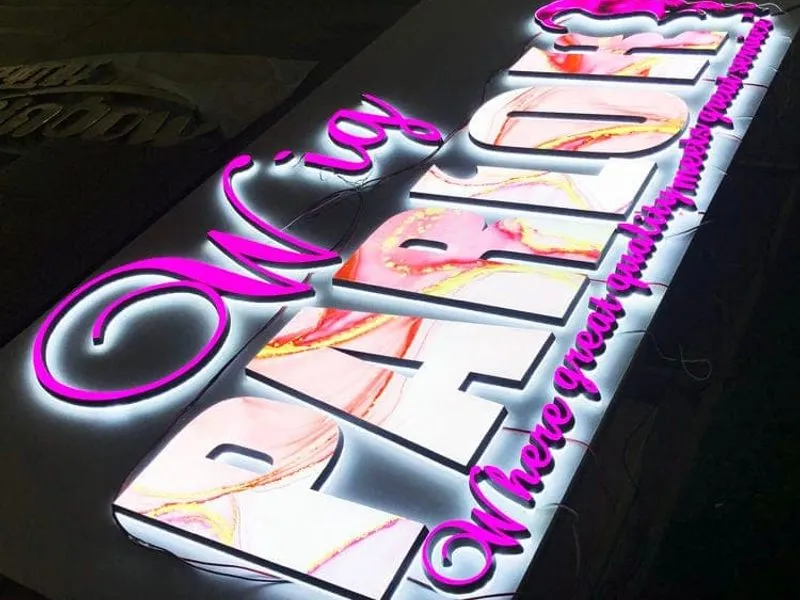
Real photo from our production floor — every sign we ship is made here.
Products mentioned or relevant to this topic — factory-direct, custom built.
From $24/letter · MOQ 1 piece · Flexible lead time · Project-specific compliance documents · ships to 20+ countries
Custom sizes, colors, and finishes. Get a factory price in 24 hours.
Get a Free Quote Copy EmailWhatsApp +86 13865703472 · business@aochuangsign.cn