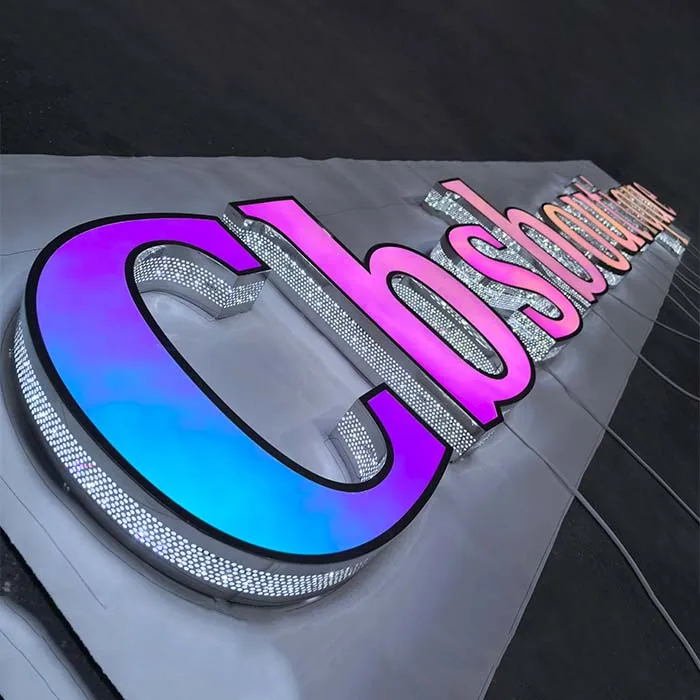
Front-lit channel letters are the best sign for a pet store, and they run $1.05–$1.35 per centimeter of letter height for stainless trim with an acrylic face. So a 40cm-tall letter costs $42–$54 before freight. I've built them since 2010 in a 3,000-square-meter plant in Lu'an, Anhui. I'd put that product on any strip-mall pet store without blinking. No brainer.
Look, a pet store sign isn't a decoration—it's the only employee working 24/7. If it's dark or washed out, the shop reads closed.
Here's what nobody tells you: cheap LED modules with dull gray solder joints die in 12–18 months. Shiny silver lead-free solder joints are the quickest tell of modules that'll hit the L70 ≥50,000-hour rating. We run Bluesky and Rishang modules for that reason. I still cut open competitor samples with a utility knife in front of clients.
A pet store in a shopping center has maybe two seconds to grab someone driving past. Two seconds. The sign has to do the same job as a good employee: look trustworthy, clean, and open for business. We quote front-lit channel letters at $1.05–$1.35/cm because they get the job done without blowing the budget. For warm, welcoming retail, 4000–5000K neutral white LEDs read fresh without looking like a hospital.
I've watched sign shops pay $800 for a front-lit letter from a domestic fabricator. Same 304 stainless, same Samsung LEDs, same acrylic face. We ship that letter for $120.
Here's the ugly truth: a faded, yellowed acrylic face tells every pet owner the store cuts corners. They'll assume you cut corners on pet food too.
Front-lit channel letters beat cabinet signs for pet stores. They read as an actual brand, not a generic strip-mall box. A cabinet sign from a low-cost supplier usually uses domestic acrylic on the face. That starts yellowing in 1–2 years. Mitsubishi or Degussa UV-resistant acrylic lasts 5–8. The letters themselves are 304 stainless returns at 1.2–1.5mm thick. They'll survive a shopping cart or an angry toddler. If your client wants a premium architectural look, front-and-back lit letters run $1.50–$1.95/cm. Most pet stores don't need that upcharge.
Cabinet signs hide bad wiring longer because the whole face diffuses light. That's not a selling point. A pet store needs the sharp, dimensional look of individual letters when the customer's memory is competing with three other stores in the same plaza.
I've seen this go wrong: a pet shop owner bought a cheap cabinet sign with non-UV acrylic. In two years the white face looked like it had been soaked in cat urine.
Window graphics are the cheapest first move. They work because they put the brand right at eye level. Don't try to make a window graphic your only sign—municipalities and landlords want an illuminated facade sign in most commercial districts. If you're doing an interior window backlit display, spec UV-resistant acrylic LED letters with Mitsubishi or Degussa face material. Avoid domestic stock that yellows in 1–2 years.
Here's what nobody tells you: window graphics don't need UL listing because they're not hardwired. The moment you add electrical components behind them, NEC Article 600 and IP65 become your problem.
Aluminum frames and acrylic faces in window displays weigh a third of steel. You're not fighting the install. A 1.6mm aluminum backing with a 5mm acrylic face is our standard for interior window signs.
If the pet store runs adoption events or grooming specials, an LED message center earns its keep. SMD 5050 modules handle RGB color shifts. SMD 5730 chips pump 40–60 lumens per chip for daylight visibility. For animated effects, you need a DMX programmable controller, not a static power supply. Don't specc RGB on the main storefront letter set unless the customer asks for it. Most municipalities and landlords find it too flashy.
RGB letters aren't a gimmick if the client sells fish tanks or reptile lighting. But they are a budget line item. Full-color changing backlit letters in our catalog start at $1.95/cm. A 50cm set can climb past $100 per letter with controllers.
For outdoor pet store signs, the material stack is simple: 304 stainless steel returns, UV-resistant acrylic faces, and aluminum backs. 304 stainless has 18% chromium and 8% nickel and gives a 10+ year outdoor life. 316 stainless adds 2–3% molybdenum for marine environments—worth the 20–30% cost premium if the store is within a few blocks of salt water. Aluminum is a third the weight of steel and lasts 8–12 years. That's our go-to for large backs and raceways. Acrylic faces in 5mm thickness transmit 90–92% of light.
Here's the ugly truth: PVC has no business in an exterior pet store sign. It won't hit IP65 minimum outdoor sealing without extra gaskets. It doesn't carry the same structural life as 304 stainless or aluminum.
If a supplier quotes "stainless steel" without specifying 304 or 316, assume it's 201. Lower cost, lower nickel, and not the 10-year outdoor material your client expects.
Use 4000–5000K neutral white for the main letter set. 3000–3500K warm looks too dim for a lively pet store. 6000–6500K cool reads industrial. The LED color temperature decision matters more than the paint color on the face.
Look, if the font's stroke width goes below the acrylic face thickness, you'll get heat warping around the LED modules and light bleed that turns "Paws & Claws" into a blur after dark. Our CNC routers cut faces to ±0.1mm. The design file still has to account for a min stroke width that can hold a 5mm face.
High contrast beats cute. White acrylic with red trim reads at 300 feet. Brown with beige doesn't. If the pet store has a dark brand palette, talk them into a white or warm white illuminated return. The sign isn't the logo—it's the recruitment tool.
For US installations, any hardwired pet store sign has to meet NEC Article 600. You need UL 48 listing or an ETL alternative, plus IP65 minimum for outdoor exposure. UL 48 costs $4,000–$15,000 and takes 4–9 months with quarterly audits. ETL runs 10–30% cheaper. Here's what nobody tells you: most factories will say they have CE. A real CE certification costs 20,000–50,000 RMB and takes 2–8 weeks. Ask for the certificate with today's date.
Here's the ugly truth: maintenance costs live in the power supply and the LED modules, not the metal. We warranty LEDs for 2 years and power supplies for 1 year. Power supplies die first in the heat.
Freight and installation are part of the sign, not an afterthought. Standard sea freight runs about 65 days, express 7–10 days. LCL crates get handled 6–8 times between our dock and yours. Every touch is a chance for damage. Order a sample first (about 5 days) and then production (about 15 days) before you promise an opening date.
Can I just use a banner for a pet store? Banners are for a weekend sale, not a storefront. They tear, fade, and make you look like a pop-up that might not be there next month.
Do I really need UL/ETL listed letters? If it's hardwired in the US, yes. The inspector will ask. If your supplier can't show a cert, you'll be the one paying for rework.
What's the cheapest durable option? Front-lit channel letters with baked-paint stainless at $1.05–$1.35/cm. Cheap LED modules will steal from you in 18 months.
Why not just use a cabinet sign? Because cheap domestic acrylic in a cabinet face yellows in 1–2 years. Channel letters give you the same lit effect with better durability and a sharper brand.
Products mentioned or relevant to this topic — factory-direct, custom built.
From $24/letter · MOQ 1 piece · Flexible lead time · CE & UL certified · ships to 20+ countries
Custom sizes, colors, and finishes. Get a factory price in 24 hours.
Get a Free QuoteWhatsApp +86 13865703472 · cairuisheng@aochuangsign.cn