Why Sign Shops Go Factory Direct
You're a sign shop owner. You've been burned by middlemen who mark up
channel letters 300% and call it "distribution." Or maybe you're tired of losing bids to the shop across town that somehow quotes $400 less than your cost on the same job.
Here's what nobody tells you: that shop across town is likely buying factory direct. Not through a rep. Not through an import broker. Direct from the factory floor in China, paying $35-75 per letter instead of $200-700.
We're Aochuang Sign. We've been building channel letters, light boxes, and metal signage since 2010 in Lu'an, Anhui. 3,000 square meters. 50+ workers. We ship to sign shops, contractors, and importers worldwide. This guide tells you exactly how wholesale signage works, what pricing you should expect, and what you need to demand from any factory before sending a deposit.
The Price Breakdown Nobody Shows You
Factory pricing for
front-lit channel letters runs $20-80 per letter. Back-lit halo runs $35-120. Stainless steel non-lit, $15-40. Fabricated 3D letters, $40-120. Aluminum, $10-25.
Light boxes, $80-250 per square meter.
A typical storefront sign — 30 letters, front-lit, 3mm acrylic faces, 304 stainless backs, Samsung LEDs — costs roughly $900-1,800 at our factory. The same sign installed in the US retail market fetches $200-700 per letter, meaning $6,000-21,000 before installation labor.
The ugly truth is that most of that margin protects a supply chain that doesn't need protecting. Get a wholesale account and you cut freight and middleman markup out of the equation. The factory-direct savings on product alone run 50-65%. That's not a promotional number. That's just what happens when the guy building your sign is also your supplier.
Front-lit channel letters in real numbers:
Factory cost: $35-75/letter
US retail installed: $200-700/letter
Your margin at wholesale: 70-85%, minus freight and tariffs
Materials: Sorting Quality from Marketing
Acrylic — Here's what nobody tells you: not all acrylic is the same, and the cheap stuff will cost you a customer in 14 months. Mitsubishi and Degussa acrylic carries 90-92% light transmittance and holds up 5-8 years against UV. Domestic Chinese acrylic? Yellowing in 1-2 years. You want the good stuff for outdoor work, period. Thickness rules: 2mm and 3mm for standard letters, but anything over 2.5 meters tall, go 5mm or you're building a flimsy sign.
Stainless steel — 304 is the workhorse for outdoor signage: 10+ year life, 18% chromium, 8% nickel.
Stainless steel letters in brushed #4 finish are the industry standard for a reason. For coastal or industrial environments, 316 marine grade adds molybdenum and costs 20-30% more. For a strip mall in Ohio, 304 is fine. For Miami Beach, pay for 316. Don't let anyone upsell you into 316 where it's not needed, and don't let anyone put 304 on a sign that'll face salt spray for a decade.
Material cheat sheet for wholesale quoting:
- Acrylic: Mitsubishi/Degussa, 3mm standard, 5mm for big letters
- 304 stainless: strip malls, inland, standard jobs
- 316 stainless: coastlines, chemical plants, 20-30% premium
- Aluminum: 1/3 the weight of steel, naturally rust-proof, 0.040-0.063"
- Brass: luxury look, but it oxidizes — protect it or embrace the patina
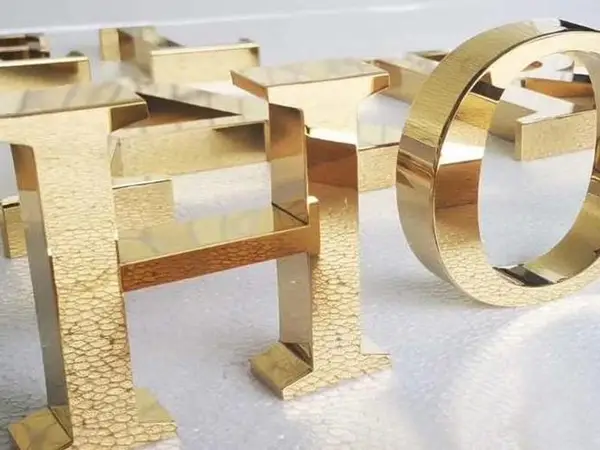
Brass letters say "expensive law firm" better than any other material, but only if the client understands maintenance
LED Quality: Where Your Reputation Lives or Dies
I've seen this go wrong: a sign shop saves $2 per letter on cheap LED modules, installs the sign, and gets a call in nine months that the "T" is out. They pay the service call. They pay for the lift. They pay for the replacement module. They lose the customer's trust. All to save $2.
SMD 2835 modules delivering 100-150 lm/W are the industry workhorse. SMD 5050 gives you RGB. SMD 5730 is the bright one at 40-60 lm/chip. All of them carry L70 ratings of 50,000 hours or more on paper. But here's the reality: quality modules — Samsung, Osram, or Blueview — actually live five years or longer in the field. Cheap modules die in 12-18 months, and the L70 rating on those boxes is fiction.
When you're quoting wholesale signage, ask your factory exactly which LED brand goes in the product. If they say "compatible with Samsung" or "equivalent to Samsung," they're telling you they use knockoffs. Demand the name printed on the reel.
Pricing Tables: What Factory Direct Actually Costs
Here are honest door-to-door numbers we quote sign shops every week:
| Product | Factory Price Range | Notes |
|---|---|---|
| Front-lit channel letters | $20-80/letter | 3mm acrylic, LED, 304 stainless |
| Back-lit halo letters | $35-120/letter |
Back-lit halo letters for premium jobs |
| Stainless non-lit | $15-40/letter | High-end look, zero electrics |
| Aluminum letters | $10-25/letter |
Aluminum letters for easy install |
| 3D fabricated letters | $40-120/letter | Builders' favorite for big installations |
| Light boxes | $80-250/sqm |
Acrylic light boxes cover storefronts, gas stations, and
restaurant menu signs |
| Neon flex | $30-200/sign |
Neon flex signs for interior and trendy storefronts |
Those numbers change weekly with acrylic and steel prices. If a factory quotes you numbers that never move, they're inflating margins somewhere else.
Here's the rule for
dual-lit channel letters: if your client needs the sign visible in daylight AND at night, don't let them cheap out on single-lit. The upcharge is brutal relative to the upfront cost difference.
Shipping and Tariffs: The Honest Cost of Going Global
Sea freight runs $80-200 per cubic meter for LCL, or $1,200-3,000 for a full container. Air freight is $4-12 per kilogram. Express delivery for small sample orders runs $30-100 and arrives in about 5-15 days. Air freight gets there in about 10 days.
The ugly truth about the US Section 301 tariff: it adds roughly 30% on Chinese signage products. Factor it into every quote. A $5,000 order becomes $6,500 at the border, and if you haven't calculated that into your margin, you'll eat it.
Budget 10-15% of your product cost for freight and tariffs on LCL shipments. It's not a bad number. It's the real number.
Processing and Production: What a Real Factory Does
The
rimless channel letters and standard product lines we produce follow the same 10-step blood trail:
1. Design confirmation — 1 day. We review your files, flag issues, lock the artwork.
2. Laser cutting — 1-2 days. Tolerance of ±0.1mm. CNC routing for acrylic faces.
3. Bending and welding — 1-2 days. TIG welding for stainless.
4. Grinding and polishing — 1-2 days. A welder's seam that's not ground flush is a visible seam.
5. Acrylic face CNC — 1 day. Waterjet and CNC routing.
6. LED assembly — 1-2 days. Wiring, mounting, testing each run.
7. Sealing — 1 day. Neutral silicone only. Acidic silicone corrodes electronics.
8. Aging test — 8-12 hours. Every sign is powered continuously.
9. QC inspection — 100% of units, not a sampling.
10. Export packaging — Foam, carton, plywood crate.
Total elapsed: about 5-15 days. That doesn't include sea freight, which is about 65 days door to door. If a factory tells you "2 weeks door to door by sea," they're lying or they're already shipping from a US warehouse.
I've seen this go wrong with accounts who expect every sign to ship the same week. You want better lead times? Place orders monthly. Reserve production slots. Communicate your schedule so we can build to a calendar, not a crisis.
Certifications: What Actually Matters
UL 48 costs $4,000-15,000 and takes 4-9 months with quarterly factory audits. ETL runs 10-30% cheaper as a UL alternative. CE certification runs 20,000-50,000 RMB and takes 2-8 weeks. IP65 means dust-tight and water jets from any direction — that's the minimum for outdoor. IP66 is for powerful jets, and IP68 is for submersible applications like sidewalk signs near fountain areas.
For the US, NEC Article 600 governs electrical signage. ADA compliance for tactile signs requires 48-60 inch mounting height, non-glare surfaces, and Grade 2 Braille. Don't skip these certifications if you're selling to US clients. Don't trust a factory that says "we handle it" without showing you a current certificate.
When quoting, ask for the specific certification number and the issuing body. A 2023 CE certificate means nothing if your 2025 order uses different components.
A quick word on IP ratings: a factory that claims IP68 but has never shown you their test setup is full of it. IP68 is submersible, and it's rare in signage for a reason. Most times, IP65 is fine. Don't overpay for ratings you don't need.
1-Piece MOQ & 2-Year LED Warranty: Why It Matters
We're not like most factories that won't touch an order under 50 pieces. Our MOQ is 1 piece. That's not an accident — it's how we built our account base. A sign shop that orders a single prototype to test quality will come back for 200 letters next quarter. I've watched this happen dozens of times.
Our standard warranty: 2 years on LEDs, 1 year on power supplies. We'll always honor it, but honest advice? The real protection is in the build quality — good modules run 5+ years real lifespan. Warranty claims are the exception, not the rule.
Qualifying Your Factory: 8 Questions We Expect You to Ask
A good factory should welcome hard questions. Here's what we tell sign shop owners to ask any supplier, including us:
1. What LED modules do you actually use? Brand, model, lumen output.
2. What acrylic brand is in the quote? Mitsubishi/Degussa or domestic?
3. Can I see a current CE/UL certificate — not an expired one?
4. What happens when a letter fails during the warranty period?
5. Do you charge a restocking fee for order changes?
6. What does your export packaging actually look like? Ask for photos.
7. Do you test 100% of units, or sample?
8. What's the silicon sealant? If it's acetic acid-based, walk away.
If a factory dodges any of these, find another partner. There are thousands of
sign factories in China. The good ones answer questions directly because they have nothing to hide.
Here's what nobody tells you about wholesale accounts: honesty is worth more than the lowest price. We'd rather tell you that your design won't survive manufacture than take your money and ship garbage.
Sign Shop Owner's Decision Checklist
The factory-direct process works like this: you send your files, we confirm the design, you approve the proof, we build in about 5-15 days, you get photos and QC reports before shipment, and we handle export paperwork.
If you're comparing suppliers, the best way to judge is to order a single letter first. Not a full sign. A single letter tests everything: quality, packaging, communication, timeframes. If the letter arrives looking like the proof, you've got a partner. If it arrives damaged, chipped, or wired wrong, find someone else.
What We Can't Do (So You Don't Have to Find Out the Hard Way)
I'll give you the other side of that honesty coin.
We can't make your $0.70/letter aluminum sign last ten years outdoors. It won't. The materials don't allow it. You want a 10-year outdoor life, that's 304 stainless or proper aluminum thickness — and it costs what it costs.
We also can't beat every quote. There's always a cheaper factory. They're using laser-cut plastic instead of real metal. They're using 1-year LEDs. They're making letters that hold up for a year and a half and then fail. So when someone quotes you 30% less than us, you know from the start what you're signing up for.
But when we say we'll do something, we do it. That's why our accounts keep coming back — they know they can quote our pricing into their bids without worrying about a flop.
When you're ready to compare, send us a basic idea of your letter sizes and quantities and we'll get you a quote within 48 hours. Ask about a single-letter sample. Then judge for yourself.