Past 11pm and I just got off the floor. Spent the last hour arguing with a supplier about LED solder joints—again. You want the truth about custom
channel letter pricing? Fine. Here. From someone who's been building these things since 2010, not some content marketer who Googled "channel letters" last Tuesday.
Look, if you're budgeting, stop asking "how much per letter" like it's a flat rate. It isn't. Here are factory-floor ranges from our shop in Lu'an, Anhui—3,000 square meters, 50-plus workers, exports worldwide.
For a standard
front-lit channel letter, the raw fabrication cost runs $20–80 per letter. That's the bare letter with LED modules, acrylic face, trim cap, and return. A US sign shop will charge you $200–700 per letter to buy and install it. Yes, that markup is real. I've watched sign shops pay $800 for a
front-lit letter from a domestic fabricator. Same 304 stainless, same Samsung LEDs. We ship that letter for $120. That's not a brag—it's the math.
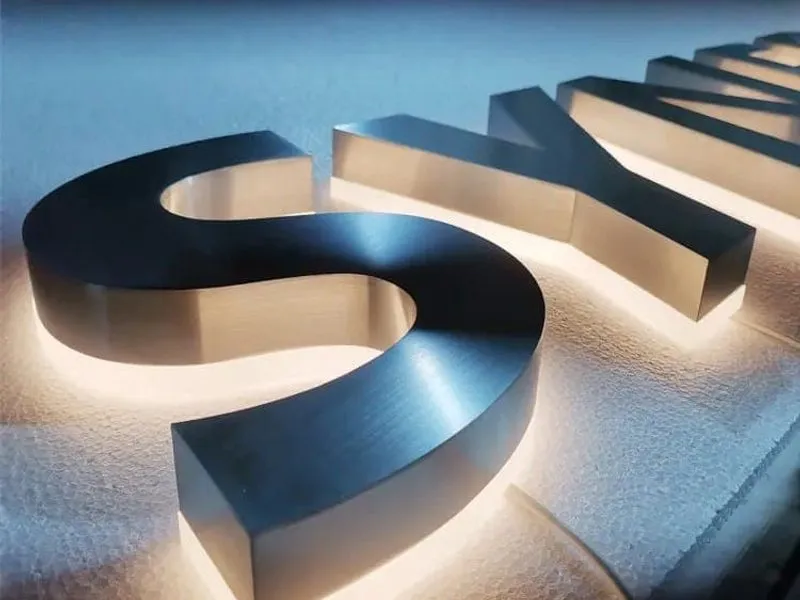
Back-lit halo letters cost more because the light source sits behind a solid face and you need standoffs, extra fabrication, and cleaner edges. Factory price: $35–120 per letter. US retail installed: $400–1,000. If you want that fancy upscale look, you'll pay for it.
Non-lit stainless letters run $15–40 factory. 3D fabricated letters $40–120. Aluminum letters $10–25. Those are raw fabrication numbers. Not installed. Not shipped. Not permitted. Hold that thought.
Material and Finish Price Drivers: Acrylic, Aluminum, Trim, and Backing
Nobody tells you this: the acrylic face on a channel letter isn't all the same, and buying the cheap stuff will yellow in 18 months. We use Mitsubishi or Degussa UV-resistant acrylic with 90–92% light transmittance. That lasts 5–8 years outdoors. Domestic acrylic? You'll see yellowing in 1–2 years. I've had customers come back complaining their sign looks like a smoker's teeth. They bought the cheap face.
A 3mm acrylic face cuts 92% light output. A 2mm face cuts 90%. Your customer won't notice the 2% difference. But they'll notice the 40% cost bump if you spec 5mm on a small sign for no reason. For any letter face over 2.5 meters, go 5mm or it'll sag like a tired old banner. That's not opinion—that's physics.
Now the return and trim. Aluminum backing and returns are standard because aluminum weighs one-third of steel and lasts 8–12 years outdoors. Common thickness is 1.0–1.6mm. It's naturally rust-proof. If you're using stainless,
304 stainless steel letters run 10-plus years with 18% chromium and 8% nickel. Density 7.93 g/cm³, common thickness 1.0–3.0mm. Brushed #4, mirror #8, PVD, powder coated—all price differently. 316 stainless costs 20–30% more thanks to its 2–3% molybdenum. For a strip mall in Ohio, 304 is fine. For Miami Beach, pay for 316 or you're replacing letters in three years. I've seen this go wrong: a client ignored that advice and the salt air ate through the welds in two winters.
LED and Illumination Costs: Standard, High-Output, and RGB
Ugly truth: LED module quality is the single biggest cost driver inside your letter. You can't see it from the street, but you'll see it when the sign dies in 18 months.
SMD 2835 modules are the industry standard—100–150 lumens per watt. SMD 5050 gives you RGB capability. SMD 5730 gives 40–60 lumens per chip, highest brightness. Quality modules from Samsung, Osram, or Blueview? They last 5-plus years. Cheap no-name modules? 12–18 months before they start flickering like a haunted house.
Free tip: look at the solder joints. Dull gray solder means it won't last 18 months. Shiny silver means proper lead-free solder. Ask your supplier for a close-up photo. If they won't send one, walk away.
Color temperature matters. 3000–3500K warm for hospitality. 4000–5000K neutral for corporate or retail. 6000–6500K cool for industrial or highway. I've seen this go wrong: a wine bar ordered "white" letters and got 6500K cool white. Looked like a hospital hallway. Specify your Kelvin, or don't complain.
If you want color changing,
acrylic RGB letters add controller costs, more complex wiring, and typically 15–25% on top of standard single-color. Worth it for a nightclub, overkill for a law office.
Size, Depth, and Stroke Complexity: How Dimensions Change Pricing
Look, a 4-foot letter doesn't cost twice a 2-foot letter. It costs 2.5 times. Why? Acrylic sheet yield drops, LED module density goes up, and the return bending takes longer. Stroke complexity is the silent killer. A simple block letter with straight returns is fast. A script letter with tight radiuses and serifs? That's hand work. TIG welding, grinding, polishing—each curve is another hour.
Depth matters too. Standard channel letter depth is 3–4 inches. Shallow 2-inch letters work for interior or tight facades, but they force the LEDs closer to the face, so you need more modules per square inch. Deep 5-inch letters give better light diffusion but use more aluminum and cost more to ship. Over 2.5 meters, you step up to 5mm acrylic face and heavier returns, which adds 20–30% to material cost.
Nobody tells you this: the cheapest way to cut costs is to make the letter shallower and smaller. But then it washes out in daylight and looks cheap. A customer notices a cheap sign, even if they can't tell you why.
Quantity, Volume Pricing, and Factory-Direct Savings
Truth: most domestic fabricators import from factories like ours and mark up 3–4 times. That's not evil—they've got overhead, rent, and sales reps. But it means you're paying for their margin.
Our MOQ is 1 piece. One. You don't need to order 50 letters to fill a container. We turn around in 7–15 days from design confirmation to export packaging. Factory-direct savings on product run 50–65%. That's the gap between our $20–80 front-lit letter and the $200–700 installed price. Shipping eats some of it, but the math still works.
Order
backlit halo letters, and you'll save even more because US fabricators charge a premium for that look. Factory $35–120 versus retail $400–1,000. You do the math.
Volume pricing kicks in. Ordering 20 identical letters beats ordering 5 different ones—setup, programming, and labor amortize. But don't expect a 50% discount for going from 5 to 10. Material and LED cost doesn't drop much. It's labor and setup that dilute.
Installation, Permitting, and Hidden Costs to Budget
Here's the part they skip: the raw letter price is only 40–60% of your total installed project. You still need a UL-listed power supply, raceway, mounting pattern, permit drawings, a licensed electrician, and probably a bucket truck.
UL 48 certification costs $4,000–15,000 and takes 4–9 months with quarterly audits. ETL is 10–30% cheaper and accepted as an alternative in most US jurisdictions. CE marking? That's 20,000–50,000 RMB and 2–8 weeks. Most factories will say they have CE. Ask to see the certificate with today's date. Watch them sweat. They won't.
Next: NEC Article 600 for US electrical. Your sign needs proper disconnects, grounding, and wiring methods. Skip that and the inspector will red-tag you before the crane leaves.
Permits vary by city, but budget $200–1,500 for sign permits and drawings. Installation labor runs $500–2,000 depending on height and access. Don't forget freight. Express 7–15 days costs $30–100 for small parcels. Air 10–20 days at $4–12/kg. Sea 50–70 days at $80–200 per cubic meter LCL, or $1,200–3,000 for a full container. US Section 301 tariff adds roughly 30% on imported signs. That's not hidden if you read the invoice, but plenty of buyers don't.
One more thing: LCL sea freight means your crate gets handled 6–8 times between our dock and yours. Every touch is a chance for damage. That's not in the brochure.
How to Get an Accurate Custom Channel Letter Quote
Look, if you send me an email that says "how much for a sign?" you'll get an annoyed reply. Give me these details, and I'll give you a real number, not a guess:
Exact letter dimensions (height, stroke width, return depth). Material and finish—304 stainless, aluminum, acrylic, or something else. LED module brand and type—Samsung SMD 2835, Osram, or no-name. Color temperature in Kelvin. IP rating—IP65 minimum for outdoor, IP66 for coastal or pressure washing. Mounting surface—drywall, brick, concrete, stucco. Quantity and zip code for shipping.
And ask for a line-item breakdown. Material, LED, power supply, fabrication, packaging, shipping. If a supplier won't break it down, they're hiding their margin.
I've seen quotes that just say "channel letter $350." That's useless. $350 gets you a 12-inch front-lit letter with decent LEDs, or a 24-inch letter with junk LEDs that dies in a year. Same price. Completely different sign.
FAQ: I can't believe I still have to explain this.
Why is there such a huge price gap between two quotes? One uses 304 stainless, Samsung LEDs, and a Mean Well power supply. The other uses 201 stainless, no-name LEDs, and a $5 power supply from a market stall. You won't see the difference day one. You'll see it month 18.
Can I install channel letters myself? No. Unless you're a licensed electrician and know NEC Article 600. You'll void the warranty, fail inspection, and possibly start a fire. Pay the installer.
How long will my sign last? 304 stainless body: 10-plus years. Quality LED modules: 5-plus years. UV-resistant acrylic: 5–8 years. Cheap domestic acrylic: 1–2 years before yellowing. You can only cheap out on two of those three.
What's your minimum order? One piece. Really. I won't make you buy 50 letters to fill a container. Turnaround: 7–15 days. Warranty: 2 years on LED, 1 year on power supply. If that works for you, send specs. If not, good luck.