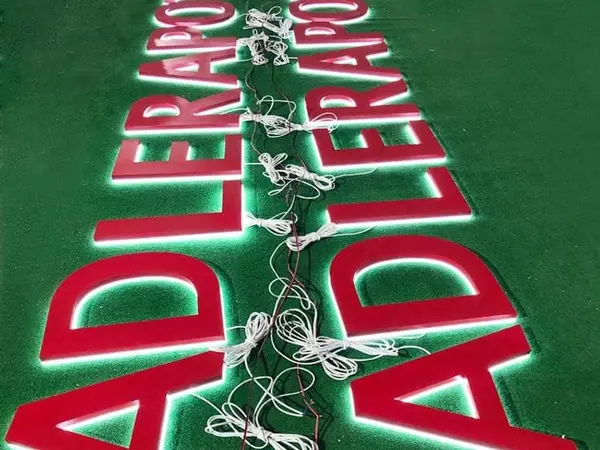
I’ve pulled a front-lit channel letter out of a shipping crate at 11pm and known by the weight it was under-spec’d. That’s the job. You learn to feel it.
A channel letter is a dimensional letter with aluminum sides, an acrylic face, and an LED module inside. It’s what you see on strip malls, gas stations, and restaurant storefronts. Back-lit halo letters are the same animal, but the light spills out the back against the wall instead of through the face. If you’re comparing, the face material matters more than the paint job.
Channel letters are three-dimensional signage built from three core parts: a metal return, an acrylic face, and an LED light source. Most are front-lit, some are halo-lit, and a few are both. You can have rimless, domed, or side-lit versions, but the construction logic doesn’t change much.
Acrylic faces run 2mm, 3mm, or 5mm. Over 2.5 meters, you go 5mm or you’ll watch the face bow like a cheap shower curtain. UV-resistant acrylic from Mitsubishi or Degussa holds 5 to 8 years before yellowing. Domestic acrylic? 1 to 2 years and it looks like a smoker’s teeth.
Here’s what nobody tells you: a 3mm acrylic face cuts light output by about 92%. A 2mm face cuts it by 90%. Your customer won’t notice that 2% difference, but they will notice the 40% cost bump when you buy thicker material thinking it’s automatically better.
Factory prices per letter right now: front-lit channel letters run $20 to $80. Back-lit halo letters run $35 to $120. Non-lit stainless steel letters run $15 to $40. 3D fabricated letters run $40 to $120. Aluminum letters run $10 to $25. Those are real numbers from our floor in Lu’an, not a brochure.
Compare that to US retail installed pricing. Front-lit letters installed run $200 to $700 per letter. Halo-lit installed run $400 to $1,000 per letter. I’ve watched sign shops pay $800 for a front-lit letter from a domestic fabricator. Same 304 stainless, same Samsung LEDs. We ship that letter for $120.
Factory-direct savings are 50% to 65% on product. That’s not a typo. The moment you add a US middleman, a fabrication shop, and a local installer, you’re paying for three layers of overhead.
Material is the big one. 304 stainless steel letters give you 10-plus years outdoors with 18% chromium and 8% nickel. 316 stainless adds 2% to 3% molybdenum and lasts 15-plus years in marine or industrial air. But 316 costs 20% to 30% more. For a strip mall in Ohio, 304 is fine. For Miami Beach, pay for 316 or you’re replacing letters in 3 years.
Aluminum is a different beast. It weighs one-third of steel and lasts 8 to 12 years outdoors. Thickness runs 1.0mm to 1.6mm. It’s naturally rust-proof and takes anodized or powder-coated finishes well. If you’re doing a huge monument sign, aluminum returns save you a fortune in freight.
LED quality drives long-term cost. SMD 2835 modules run 100 to 150 lumens per watt and are the industry standard. SMD 5730 chips hit 40 to 60 lumens per chip and are brighter, but they cost more. Quality modules from Samsung, Osram, or Blueview last 5-plus years real world. Cheap modules? 12 to 18 months and you’re renting a bucket truck again.
The ugly truth is most buyers only look at the unit price. Then they pay twice when cheap LEDs die and the sign looks like a jack-o’-lantern with half its teeth.
Material is maybe a third of the factory cost for a basic front-lit letter. The rest is labor and LEDs. Laser cutting holds tolerance to plus or minus 0.1mm, then bending and TIG welding take a day or two. Grinding and polishing take another day or two. The acrylic face gets CNC routed, then the LED assembly goes in. After that, sealing with neutral silicone, an 8-to-12-hour aging test, and 100% QC inspection. Total production: 7 to 15 days.
Acrylic LED letters are versatile for indoor or outdoor use, but the acrylic spec changes everything. 2mm face for small letters, 3mm for mid-range, 5mm for anything over 2.5 meters. Get that wrong and you’ll see face sag or crack.
Freight is where rookies bleed. Express runs 7 to 15 days and costs $30 to $100 for small packages. Air freight runs 10 to 20 days at $4 to $12 per kilogram. Sea freight runs 50 to 70 days at $80 to $200 per cubic meter for LCL, or $1,200 to $3,000 for a full container. Then add US Section 301 tariff at roughly 30%.
Installation is the cost nobody quotes over the phone. You need permits, a bucket truck, wiring, and a licensed electrician. NEC Article 600 covers the electrical side. ADA tactile signs have their own mounting rules: 48 to 60 inches to center, non-glare finish, Grade 2 Braille. Skip those and your inspector will make you rip it down.
Here’s what nobody tells you: LCL sea freight means your crate gets handled 6 to 8 times between our dock and yours. Every touch is a chance for damage. That’s not in the brochure. Budget for a possible rework rate of 5% to 10% if your packaging is foam plus carton plus plywood crate—and more if you cheap out on the crate.
Power supplies fail before LEDs. We warranty LEDs for 2 years and power supplies for 1 year. That’s not because we’re stingy. It’s because a power supply is the most common failure point in outdoor channel letters. Cheap power supplies die in six months. Good ones last 3 to 5 years.
IP65 sounds impressive. It means dust-tight and water jets from any direction. It does NOT mean your sign survives a Florida hurricane. IP66 handles powerful jets for coastal areas. IP68 is submersible for extreme weather. But if a palm tree goes through your sign, no IP rating saves you.
I’ve seen this go wrong: a contractor ordered 5mm acrylic for a 14-inch letter because he thought thicker was tougher. It cost 40% more, blocked more light, and the letter looked dull. The customer didn’t care about thickness. They cared that the sign didn’t glow.
Quickest way to spot bad LED modules: look at the solder joints. Dull gray means that module won’t last 18 months. Shiny silver means proper lead-free solder. Bring a loupe to your supplier visit. If they flinch, walk.
Send the vector file, not a napkin sketch. Include letter height, stroke width, mounting type, finish, LED color temperature, and whether it’s indoor or outdoor. 3000-3500K warm white is for hospitality. 4000-5000K neutral is for corporate and retail. 6000-6500K cool white is for industrial and highway signs. If you don’t specify, the factory will guess.
Ask for the CE certificate with today’s date. CE marking costs 20,000 to 50,000 RMB. Most factories will say they have it. Watch them sweat when you ask for a current copy. RoHS and ISO 9001 are nice, but CE is the one that matters for electrical safety in Europe. For the US, you want UL 48 or ETL, and those cost $4,000 to $15,000 with 4 to 9 months of testing plus quarterly audits.
Don’t compare unit price alone. Ask for total landed cost: product, crating, freight, tariff, brokerage, and a realistic rework allowance. A quote that looks $500 cheaper on paper can cost you $3,000 in hidden freight damage and downtime.
Order 304 stainless unless you’re on a coast or in an industrial zone. It’s 10-plus years of outdoor life and you save 20% to 30% versus 316. Put that saved money into better LEDs.
Use 2mm acrylic for small letters and 3mm for mid-size. Don’t buy 5mm unless your letter height is over 2.5 meters. The 2% light loss is irrelevant. The 40% price jump is not.
Spec Samsung, Osram, or Blueview LED modules. Cheap modules save $15 per letter up front and cost you $200 per letter in replacement labor later. That math only works if you hate your customer.
Factory-direct from a shop that has MOQ of 1 piece and a 7-to-15-day lead time means you don’t have to over-order to hit a minimum. Get a sample letter first. If the solder joints are shiny, the acrylic is UV-rated, and the packaging is foam plus carton plus plywood crate, you’re probably not getting burned.
Q: Why do your factory prices say $20-$80 per letter when my local shop quotes $500 per letter?
Because your local shop is buying from a middleman, paying rent on a showroom, and charging you for the privilege. We make the letter. They make a phone call.
Q: Is sea freight really worth it if it takes 50 to 70 days?
If you’re ordering 50 letters, yes. If you’re ordering 3 letters, use express or air. I can’t believe I still have to explain this.
Q: Should I get 316 stainless for a sign in Texas?
No. Unless you’re in Galveston with salt spray, 304 is fine. Paying 20% to 30% more for molybdenum you don’t need is like buying a life raft for a desert highway.
Q: Can I trust a factory that says it has CE but won’t send the certificate?
No. CE costs 20,000 to 50,000 RMB. If they can’t show a dated certificate, they don’t have it. Next question.

Real photo from our production floor — every sign we ship is made here.
Products mentioned or relevant to this topic — factory-direct, custom built.
From $24/letter · MOQ 1 piece · Flexible lead time · CE & UL certified · ships to 20+ countries
Custom sizes, colors, and finishes. Get a factory price in 24 hours.
Get a Free Quote Copy EmailWhatsApp +86 13865703472 · business@aochuangsign.cn