If you're pricing 3D letters right now, you've probably got three quotes on your desk and no idea why one says $85 and another says $600 for what looks like the same letter. I've been building these on a factory floor in Lu'an, Anhui, since 2010.
This isn't a mystery. It's math, material, and middlemen.
Look, most sign shops don't fabricate their own 3D letters. They buy from a wholesaler, mark it up, and add installation on top. A front-lit channel letter that costs $20–80 from a factory lands on a US storefront at $200–700 per letter installed. Nobody's lying—they just don't make the letter.
Material drives cost more than anything else. Cheap domestic acrylic yellows in 1–2 years. UV-resistant acrylic from Mitsubishi or Degussa holds 90–92% light transmittance for 5–8 years outdoors. You'll see that price difference in the quote.
Here's what nobody tells you: LED quality is where rookies get eaten alive. A quality SMD 2835 module runs 100–150 lumens per watt and lasts 5+ years. Cheap modules fail in 12–18 months. Quickest way to spot bad LED modules? Look at the solder joints. Dull gray means it won't last. Shiny silver means proper lead-free solder. Most factories won't show you those joints before you order.
I've seen this go wrong. A customer bought 40 cheap halo-lit letters, saved $900 upfront, and paid two service calls by month 14. The second call cost more than the savings. Certifications matter too. CE marking costs 20,000–50,000 RMB. Most factories say they have it. Ask to see the certificate with today's date. Watch them sweat.
Factory price ranges for March 2025: front-lit channel letters run $20–80 per letter. Back-lit halo letters run $35–120. That halo looks premium. But don't spec it for a dry cleaner. It lights the wall behind the letter, not the face.
Non-lit stainless steel letters made from 304 grade run $15–40 per letter. 304 has 18% chromium and 8% nickel, good for 10+ years. Within a mile of salt water, use 316—it has 2–3% molybdenum, lasts 15+ years marine, and costs 20–30% more. I've seen this go wrong: a Miami Beach restaurant ordered 304, saved $600, and replaced letters in three years.
Acrylic LED letters are versatile. A 2mm acrylic face cuts light by 10%, a 3mm face cuts 8%. Your customer won't notice the 2% difference, but they will notice a 40% cost bump. Rookie mistake: spec'ing 5mm acrylic for an 18-inch letter because it feels premium. It doesn't.
We run a 10-step process. Design confirmation, laser cutting at ±0.1mm, TIG welding, grinding and polishing, CNC acrylic, LED assembly, silicone sealing, 8–12 hour aging test, full QC, and export packaging with foam, carton, and plywood crate. That's 7–15 days. Skip any step and you get failures in the field.
Fabricated letters are hollow shells. Channel letters are built around the light. Look, a script font with tight loops takes twice as long to bend, weld, and polish as a clean block sans. A shop won't show you that labor line. They bury it in the per-letter price.
3D fabricated letters run $40–120 per letter factory price. That's for the seamless dimensional look. Order back-lit halo letters and expect to pay more. LED mounting, heat management, and silicone sealing have to be precise. A tiny pinhole means water gets in and you're on a ladder in February. Water intrusion doesn't care about your warranty.
Size doesn't scale linearly. Double the letter height and you're paying for four times the acrylic face. A 12-inch letter isn't double the cost of a 6-inch letter. If a shop quotes it that way, they're bad at math or cutting corners.
Here's what nobody tells you: over 2.5 meters in letter height, you need 5mm+ acrylic or the face flexes and cracks in wind load. Below that, 2mm or 3mm is standard. Stainless returns in 1.0mm are fine for small indoor logos. Go 3.0mm for big outdoor letters, or the sides oil-can.
Font complexity is the silent multiplier. Block sans costs the least. Scripts with overlapping strokes, tight counters, and serifs add hours of hand finishing. Ugly truth: many online quote tools don't account for this. If a quote looks too low for a complex script, ask whether the factory has actually seen the vector file.
Factory price is only half the story. US installed cost is $200–700 per letter for front-lit and $400–1,000 for back-lit halos. That's lift rental, permits, insurance, labor. I've watched sign shops pay $800 per letter to a domestic fabricator. Same 304 stainless, same Samsung LEDs. We ship that letter for $120.
Shipping blindsides people. Express takes 7–15 days and costs $30–100 for small orders. Air runs 10–20 days at $4–12/kg. Sea takes 50–70 days at $80–200/m³ LCL, or $1,200–3,000 for a full container. Add the US Section 301 tariff of about 30%. You still come out ahead on volume, but small orders get eaten by freight minimums.
Hidden cost: LCL sea freight means your crate gets handled 6–8 times between docks. Every touch is a chance for damage. We pack in foam, carton, and plywood crates. A forklift driver at a transfer warehouse doesn't care. That's not in the brochure. IP65 sounds impressive—it means protection from water jets from any direction. It does NOT mean your sign survives a Florida hurricane. For coastal hurricane zones, ask about IP66 or reinforced mounting.
Budget storefront: 10 front-lit channel letters, 12-inch height, 304 stainless returns, 2mm acrylic, quality SMD 2835. At $45 average per letter, factory cost is $450. Sea freight LCL maybe $120. Tariff about $135. Total landed around $700. A US shop installing that set would charge $2,000–7,000. That's factory-direct savings of 50–65% on product.
Premium architectural job: 8 back-lit halo letters, 316 stainless, 5mm UV-resistant acrylic, SMD 5730 LEDs. Factory cost averages $100 per letter, so $800. Air freight maybe $250. Tariff $240. Landed around $1,300. A US shop would charge $3,200–8,000 to install that same set. Still ahead, even with freight and tariff.
Look, I can't quote a photo. Send a vector file—AI, EPS, or CDR—with exact letter heights, material, thickness, finish, LED brand, color temperature, and IP rating. Don't just say "stainless." Is it 304 or 316? Brushed #4 or mirror #8? If you don't specify, the factory will guess, and the guess might be cheaper than you need.
Here's what nobody tells you: MOQ is 1 piece, but shipping and setup don't care about your MOQ. Ordering 20 letters brings per-letter cost down through material yield. Lead time is 7–15 days, but only if you approve drawings within 24 hours.
Ugly truth: most quote requests are missing the destination port and whether you need UL, ETL, or CE. These details change the price more than anything else. Tell me Miami, I spec 316 stainless and IP66. Tell me Ohio strip mall, 304 with IP65 is fine. One email with full specs gets you a factory price that makes domestic quotes look like a typo.
"What's the cheapest 3D letter material?" Aluminum, $10–25 per letter, powder coated or anodized. It's light, rust-proof, and lasts 8–12 years. If you're broke, start there.
"Is importing from China worth it for 3D letters?" Not for three letters—freight minimums kill you. For 10+ letters, factory-direct beats domestic by 50–65% even after 30% tariff. You need patience though. Sea freight takes 50–70 days.
"Why do domestic quotes vary by 300%?" Some shops fabricate in-house, some buy from a wholesaler and mark up. Overhead, labor, and local permits differ. Get three quotes, then ask each if they fabricate or outsource.
"How long will the LEDs last?" Quality SMD modules run 5+ years real world, with L70 at 50,000 hours. Cheap ones die in 12–18 months. If the quote seems too low, check the solder joints.

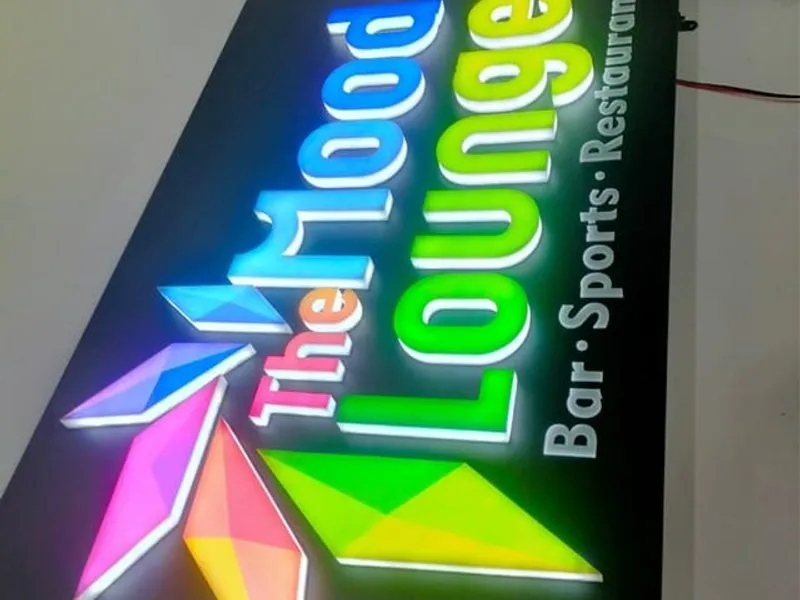
Real photo from our production floor — every sign we ship is made here.
Products mentioned or relevant to this topic — factory-direct, custom built.
From $24/letter · MOQ 1 piece · Flexible lead time · CE & UL certified · ships to 20+ countries
Custom sizes, colors, and finishes. Get a factory price in 24 hours.
Get a Free Quote Copy EmailWhatsApp +86 13865703472 · business@aochuangsign.cn