I’ve stood on a ladder at midnight in a cold drizzle, wiping down a 12-foot channel letter while my coffee froze. That sign is still burning bright 11 years later. Most aren’t. They die at year four or five because nobody touched them after install. A 10-year lifespan isn’t magic. It’s a schedule, and it’s dirt simple if you accept one thing: signs rot from neglect, not weather.
Every 90 days. Set a calendar reminder now.
Look, I don’t care if your shop is in Phoenix or Portland. Quarterly checks catch failures when they’re cheap. A loose seal or a dead power supply in month three is a $40 fix. Wait a year and that same problem becomes a $600 letter rebuild because water got in and fried half the LEDs. I’ve seen this movie a hundred times.
Here’s your checklist. First, walk the site at night with the sign lit. Any dim spots, flickering, or color shift? A 5% brightness drop across one letter means a driver is starting to cook. Replace it now, not later. L70 is 50,000 hours on paper, but that’s lab conditions. In a real metal canister in August, cheap LED modules degrade to 70% output in half that time. I’ve pulled modules after 12 months that were already at 60% because the driver was undersized. Don’t wait. During the same walk, look for water pooling inside letters. A tiny bead of moisture behind the acrylic face is the #1 killer of channel letters. The ugly truth is that many signs come from the factory with weep holes just barely adequate. I’ve seen 2mm holes clogged with pollen in one spring. Now you’ve got a swamp in there. Drill them out to 3mm if you have to, and verify they’re clear.
Do not use glass cleaner. Ever.
Ammonia and acrylic are mortal enemies. It micro-crazes the surface, and within a season you’ll have a foggy, yellowed face that transmits 60% less light. For standard 90-92% transmittance front-lit channel letters, that’s a lighting downgrade you’ll feel in foot traffic. I use a 50/50 mix of water and isopropyl alcohol, a soft microfiber cloth, and zero elbow grease. Twice a year, more if you’re on a highway collecting diesel soot. Clean the acrylic face gently, then run a dry cloth along every edge and return. Built-up grime on the trim corrodes the paint over time, especially on baked enamel finishes.
Here’s what nobody tells you: most cleaning crews at 10 PM are on autopilot. They’ll pressure-wash your sign from 20 feet because it’s fast. A pressure washer forces water past silicone seals—even silicone rated for 8-12 hour aging tests in the factory can’t take a direct 1500-psi blast from an angle. I’ve seen letters flooded the next morning after a single “cleaning.” If you outsource cleaning, stand there and watch them. Or better yet, use a service that understands signage, not building maintenance.
LEDs are not magic. They’re a consumable—just a long-life one.
SMD 2835 modules, the workhorse in commercial letters, put out 100-150 lumens per watt and rate L70 at 50,000 hours. That’s 5.7 years of continuous burn, or roughly 11 years at 12 hours a day. But here’s the catch: heat kills that curve. If the power supply is crammed tight inside a letter without ventilation, you’re baking those LEDs. I’ve measured 85°C inside a black aluminum back-lit halo letter in July sun. At that temp, the 50,000-hour rating drops by half. Swap power supplies every five years proactively. Factor that $30 component into your maintenance budget and you’ll keep the sign looking crisp a decade out.
Look, cheap LED modules are easy to spot. Take a letter down after a year and examine the solder joints. Dull gray joints mean lead-free solder that’s already oxidizing and losing conductivity. Those modules fail at 18 months like clockwork.

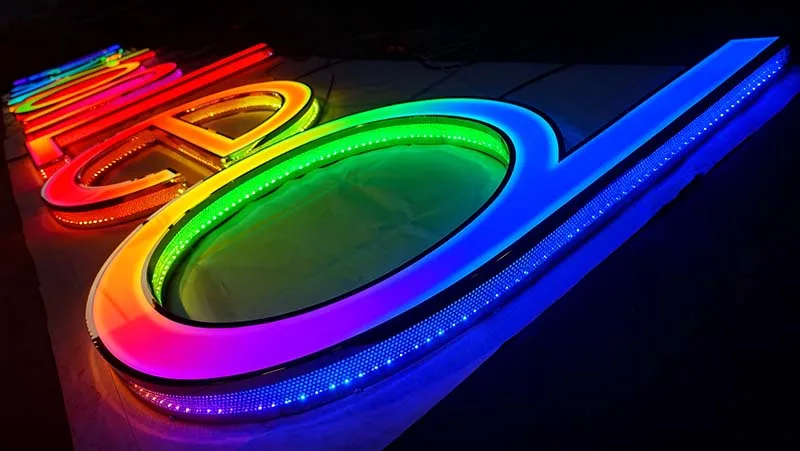
Real photo from our production floor — every sign we ship is made here.
Products mentioned or relevant to this topic — factory-direct, custom built.
From $24/letter · MOQ 1 piece · Flexible lead time · CE & UL certified · ships to 20+ countries
Custom sizes, colors, and finishes. Get a factory price in 24 hours.
Get a Free Quote Copy EmailWhatsApp +86 13865703472 · business@aochuangsign.cn
See pricing, specs, and get a free quote for the sign type you need. Built in our factory, shipped worldwide.