You’ve seen it happen. A $10,000 exterior sign install fails in under two years because someone used 1mm aluminum in a coastal environment. The property manager is furious. The tenants complain about the shabby entrance. And you, the sign shop or contractor, eat the replacement cost — or worse, the bad review.
The building signage industry doesn’t forgive cheap shortcuts. When you’re branding an apartment tower, a condominium complex, or a mixed-use development, every letter, every lumen, and every square foot of acrylic has to pull its weight for a decade or longer. This isn’t a pop-up shop on a 3-year lease. It’s a permanent asset.
Here’s what I know after 15 years on factory floors, from laser cutting to ocean freight: the difference between a sign that fades in 18 months and one that still pops after 10 years is rarely about the project’s budget. It’s about knowing exactly where to spend and where to save. This article breaks down materials, illumination, sign types, hidden costs, and the factory-direct importing strategy that puts six figures back into your pocket over a few years.
A multi-family building isn’t just selling square footage. It sells a feeling. You know it. A prospective tenant drives by at dusk. They see a warm 3000K halo-lit address number floating off a textured brushed stainless backplate. That single moment communicates luxury, permanence, and attention to detail. It’s more powerful than any social media ad.
The National Association of Realtors has long recognized that exterior building identification directly impacts perceived property value. And yet, property management firms routinely underfund signage in the capital stack, then overspend on emergency replacements. The thing is, a well-chosen, properly fabricated exterior sign set costs far less than one lawsuit or one lost anchor tenant.
But not all branding signage is created equal. A lobby directory wall made from 2mm domestic acrylic will yellow in 12–24 months under UV exposure from floor-to-ceiling windows. That same panel, fabricated with Mitsubishi or Degussa UV-resistant acrylic, retains its clarity and color for 5–8 years. The material price difference? About 30%. The total installed cost difference over an 8-year cycle, including re-fabrication and tenant disruption? Massive. This is the kind of math that separates builders who install once from those who call back every two years.
So when you spec signage for a condo or apartment project, you’re not just picking a font and a color. You’re picking a warranty liability, a maintenance schedule, and a public-facing promise. Get it right, and that lobby sign quietly does its job for a decade. Get it wrong, and you’ll know within 18 months.
Walk through any sign factory and you’ll hear it: “Material is the memory of the sign.” That’s a fancy way of saying that the metal and acrylic you choose today will tell the story of your project in five years. For apartment and condominium buildings, the three main materials are acrylic, stainless steel, and aluminum. Each has a specific job.
Acrylic faces. For interior lobby signs and protected exterior channel letters, acrylic is unbeatable. It transmits 90–92% of light, far better than polycarbonate. But thickness matters. Over a 2.5m span, you need at least 5mm acrylic. Below that, 3mm is standard; 2mm works for small indoor plaques. The real secret is the grade. Mitsubishi or Degussa acrylic carries a 5–8 year UV warranty. Domestic Chinese acrylic starts showing yellowing and micro-crazing in 1–2 years. That’s fine for a temporary leasing trailer; it’s a disaster on a $50 million high-rise.
Stainless steel 304. The workhorse of luxury building signage. 18% chromium, 8% nickel, density 7.93g/cm³. Common thicknesses for fabricated letters and architectural panels run 1.0mm to 3.0mm. You can spec a brushed #4 finish for subtle elegance or mirror #8 for a high-reflectance statement. A 304 letter set properly sealed with neutral silicone will live outdoors for 10+ years — no problem. Indoor, virtually forever.
But here’s the problem: property managers near the ocean often spec 304 because it looks like stainless and the cost is familiar. Within two years, pitting corrosion starts, and the letters weep rust streaks down the facade. That’s when you learn the hard way about stainless 316. It contains 2–3% molybdenum, which stops chloride corrosion. For coastal projects — think Miami, Long Beach, Dubai — 316 isn’t an upgrade. It’s mandatory. The cost premium is 20–30% over 304. The failure cost of using the wrong grade? Total replacement, often with scaffolding and tenant complaints. Ship 316 if the property is within 5 miles of saltwater.
Aluminum. A smart choice for large architectural panels and directional signs. It weighs one-third of steel, which reduces structural loads and installation labor costs. 0.040–0.063 inch (1.0–1.6mm) is typical. Aluminum won’t rust — it forms its own protective oxide. Anodized or powder-coated finishes deliver a consistent 8–12 year outdoor life. For horizontal monuments and pylon signs, aluminum letters at factory prices between $10 and $25 per letter are a clean, modern look at a fraction of stainless cost.
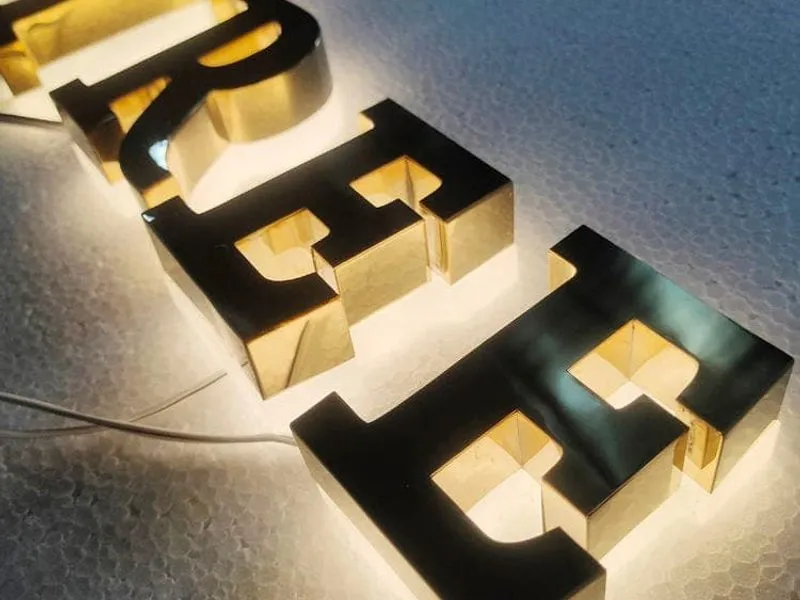
One more thing. PVD coating on stainless. You might spec gold or rose gold for a luxury condo entrance. PVD (physical vapor deposition) bonds color at a molecular level and won’t peel like paint. It’s more expensive upfront, but when you’re branding the address of a building where units start at $2 million, it’s the right call.
Every sign shop owner has swapped cheap LED modules on a ladder in the rain. It’s the job we all hate. The fix is simple: never put junk LEDs behind an acrylic face that’s sealed and installed 30 feet up.
For building signage, we use three primary SMD LED types. SMD 2835 modules are the industry standard, delivering 100–150 lumens per watt. They’re efficient, thin, and give uniform illumination for face-lit channel letters. SMD 5050 chips enable RGB color-changing effects, ideal for accent lighting on rooftop logos. SMD 5730 chips push 40–60 lumens per individual chip — the brightest option — and are great for tall letters that need to punch through ambient city light.
Real lifespan, measured as L70 (the point where light output degrades 30%), is 50,000 hours for quality modules from Samsung, Osram, or the Chinese brand Lan Jing. That’s over 10 years at 12 hours a night. But those numbers only hold if the power supply matches the load and runs cool. A cheap $2 driver will cook itself in a sealed sign can, and the entire string fails in 12–18 months. The warranty on a good LED module is 2 years; on a cheap one, you’re lucky to get a phone call back. And the power supply warranty from a reputable factory is 1 year because they know it’s the weakest link. Buy Mean Well or equivalent, and you’ll sleep better.
Color temperature also shapes the perception of the building. 3000–3500K warm white makes a residential entrance feel inviting. That’s hospitality lighting. 4000–5000K neutral white says corporate, clean, and modern — perfect for mixed-use retail podiums. 6000–6500K cool white screams highway sign. Don’t put that on a condo. It looks cheap and clinical. In our factory, we stock all three ranges and can run a test strip before final assembly so the property manager sees exactly what the glow will feel like at night. That 8–12 hour aging test before shipping is where we catch 90% of early failures.
Property management branding uses about six core sign categories. Each has a place. Choose based on mounting height, landlord’s taste, and how much abuse the sign will take from weather or vandals.
| Sign Type | Typical Use | Factory Price Range | US Installed Price (Approx.) | Durability & Notes |
|---|---|---|---|---|
| Front-Lit Channel Letters | Street-facing building ID, parking entrances | $20–80 per letter | $200–700 per letter | Acrylic face, aluminum or stainless returns. LED inside. 5–8 year face, 10+ year structure if sealed well. |
| Back-Lit Halo Letters | Lobby wall, luxury exterior monument | $35–120 per letter | $400–1,000 per letter | Stainless or aluminum face, light spills onto wall. Use 316 near coast. 3D effect, very premium. |
| Stainless Steel Non-Lit | Dimensional wall logos, interior directories | $15–40 per letter (304) | $100–300 per letter est. | 10+ year outdoors, beautiful brush or mirror finish. Add PVD for custom color. |
| Aluminum Letters | Pylon signs, monument, wayfinding | $10–25 per letter | $75–150 per letter est. | Lightweight, rust-proof, 8–12 year outdoor life. Anodized or powder coated. |
| 3D Fabricated Letters | Feature wall art, branded focal points | $40–120 per letter | $300–800 per letter est. | Complex shapes, welded and polished. Stainless or aluminum. A pure craftsmanship piece. |
| Light Boxes & Neon Flex | Leasing office, retail podium, garage entry | $80–250/sqm (boxes) $30–200/sign (neon) |
Double to triple factory cost | Even illumination, replaceable faces. Neon flex gives a vintage-modern vibe. IP65 minimum. |
The gap between factory and US installed prices is eye-opening: 50–65% savings on the product alone when you import directly. A set of five 24-inch halo-lit letters that costs $300–600 from the factory can run $2,500–3,500 installed domestically. That margin gets your attention fast.
ADA-compliant tactile signs are a separate category entirely. Apartment hallways, restrooms, exit doors — all need Grade 2 Braille signs. Mounting height must be 48 to 60 inches from floor to center of sign, non-glare finish, and correct braille spacing. Most factories that do custom channel letters can also produce ADA signs but they need a distinct process and strict QC. Don’t trust anyone who says “we’ll just add dots” — compliance violations can hold up a certificate of occupancy.
Importing signs from a factory in Asia isn’t just clicking “buy.” But once you learn the freight class and trade terms, it becomes a repeatable system. Our facility in Anhui, China — 3,000 square meters, 50+ workers — ships worldwide, and US projects are consistent business.
Shipping options for a typical apartment sign package (say 100 kg of letters):
Now the tariff elephant in the room. US Section 301 tariffs on Chinese sign products are roughly 30%. Factor that into your landed cost. But even with freight, tariff, and customs bond, the total landed price is typically still 40–50% below US retail product cost. You just need to plan the about 65 days ocean window. Smart property managers order during the construction frame so the signs arrive as the drywall goes up.
And don’t forget certifications. If you’re installing illuminated signs in a US building, the local inspector will want to see a UL 48 or ETL label. UL 48 certification costs a factory $4,000–15,000 and takes 4–9 months with quarterly audits. ETL is often 10–30% cheaper and accepted as equivalent by most AHJs. If your factory holds CE, RoHS, and ISO 9001 but no UL, you can still get field inspection — but it adds time and inspector risk. Ask for the certification docs before you pay the deposit. A manufacturer that has gone through the UL or ETL process will also build to NEC Article 600 standards without you having to remind them.
1. Neutral silicone is the difference between a sealed sign and a fish tank. We see it every week: an imported sign where the factory used acid-cure silicone to bond the acrylic face to the returns. Acid cure releases corrosive fumes that attack LED solder joints and cause early failures. Worse, it hardens brittle and cracks in thermal cycling. Neutral-cure silicone stays flexible, bonds to both metal and acrylic, and won’t eat your electronics. At our production line, sealing day is a separate step with dedicated jigs, and we still run every sealed letter through an 8–12 hour powered aging test. Water ingress kills more signs than lightning.
2. If the letter is taller than 2.5 meters, you’re in 5mm acrylic territory. The physics are simple: wind load. A 3-meter-tall channel letter on a pylon in Dallas will flex 3mm acrylic like a drumhead. Over a few years, micro-cracks develop around the trim cap retainers, water gets in, and the face pops off in a storm. 5mm acrylic with proper internal support ribs solves it. Cost goes up maybe 15–20%, but the letter doesn’t become a projectile. Property management insurance companies love that detail.
3. The cheapest power supply always costs the most. A quality Mean Well driver rated for outdoor damp location might cost $15–25 per sign. A generic supply costs $3. That $12 savings per unit becomes a $400 service call when it fails 14 months later and you have to rent a lift on a Saturday because the leasing office is open. In our warranty data, 80% of LED failures

Real photo from our production floor — every sign we ship is made here.
Products mentioned or relevant to this topic — factory-direct, custom built.
From $24/letter · MOQ 1 piece · Flexible lead time · CE & UL certified · ships to 20+ countries
Custom sizes, colors, and finishes. Get a factory price in 24 hours.
Get a Free Quote Copy EmailWhatsApp +86 13865703472 · business@aochuangsign.cn
See pricing, specs, and get a free quote for the sign type you need. Built in our factory, shipped worldwide.