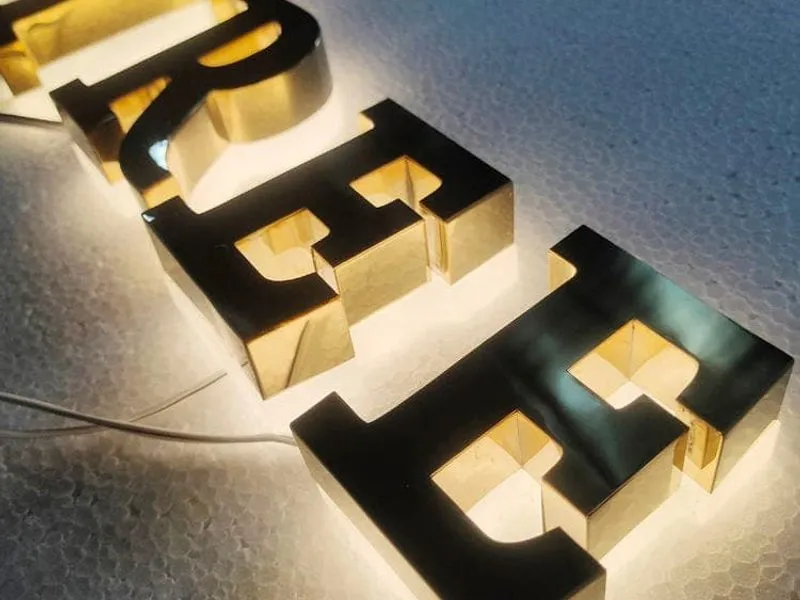
First thing I tell any shop owner asking about backlit channel letters: if your fabricator doesn't ask where the sign is going, walk away. Halo letters aren't just front-lit letters flipped around. They're a different animal.
Look, a true backlit channel letter has a solid metal back, metal returns, and LEDs inside aimed at the wall. Light spills out the open back and creates the halo. You've got three main builds: standard halo (light only from behind), front/back combo (sometimes called dual-lit), and rimless. Most storefronts don't want the fancy stuff. They want standard halo, even if their designer calls it something fancier. That's what our back-lit halo letters are built for.
Face material matters less here than on front-lit letters because the face sits dark. But you still can't cheap out on acrylic. UV-stable or it's yellow soup in two years. We spec 3mm acrylic with 90-92% light transmittance if any glow passes through. For metal, 304 stainless gives you 10+ years outdoors. If the sign's going within a mile of salt water, step up to 316. It costs 20-30% more. But you're not replacing letters in three years. Here's the rub: domestic acrylic yellows in 1-2 years. Mitsubishi or Degussa UV-resistant acrylic lasts 5-8 years. Your supplier won't volunteer which brand they're using unless you ask. Ask. Watch them squirm.
Here's what nobody tells you: a 50,000-hour L70 rating on an LED module doesn't mean your sign won't fail in year two. That number says the LED output drops to 70% at 50,000 hours in a lab. Heat, moisture, and cheap driver components kill systems faster in the real world.
Use SMD 2835 modules at 100-150 lumens per watt for most halo letters. That's the industry standard. Need RGB? Move to 5050. Need maximum punch for large letters? 5730 modules at 40-60 lumens per chip do the job. But the real tell is the solder joints. Dull gray solder usually means oxidized or cheap alloy. That module won't last 18 months. Shiny silver is proper lead-free. I've seen whole shipments with dull joints fail before the customer's grand opening.
Power supplies are where shops get cheap. A $20 no-name driver might run the sign for six months. Spend the extra $15 on a name-brand IP67 driver and you're replacing it in year five instead of year one. Cheap drivers die. Our standard warranty is 2 years on LED, 1 year on the power supply. That's not random.
For outdoor signs, IP65 is the floor. That rating means the enclosure is dust-tight and can handle water jets. It doesn't mean your sign survives a Florida hurricane. Coastal jobs need IP66 or IP68. And if you're importing into the US, make sure the sign meets NEC Article 600. Otherwise you'll fail inspection before you even flip the switch.
The ugly truth? Most hot spots come from someone trying to save six bucks on module count. They space LEDs too far apart and you see individual dots instead of an even halo. Proper module spacing depends on return depth, but you can't cheat physics. A 2mm acrylic diffuser cuts 90% of light. A 3mm cuts 92%. Your customer won't notice that 2% difference, but they'll notice the 40% cost bump if you spec 5mm for no reason.
For large letters over 2.5 meters, use 5mm acrylic and extra standoffs. Thin faces flex, crack, and eventually pull away from the wall. A flexed face lets moisture in. Then your LEDs are swimming. I've seen it go wrong: a chain ordered 40-inch letters with 2mm faces to save money. After one winter, half the letters had water pooling inside. They paid for a full re-fabrication.
And don't mount halo letters flush to a brick wall. The halo needs a gap—usually 1.5 to 2 inches. Less than that and you get a weak, uneven ring. More, and the fasteners become a wind-load problem.
Look, I've watched sign shops pay $800 for one front-lit letter from a domestic fabricator. Same 304 stainless, same Samsung LEDs. We ship that letter for $120. Not a sales pitch—just math. Factory-direct pricing for back-lit halo letters runs $35 to $120 per letter depending on size, material, and LED count. Front-lit channel letters run $20 to $80. Compared to typical US retail installed prices of $400 to $1,000 per halo letter, that's a 50-65% savings on product.
What drives the price? Material thickness, stainless grade, LED brand, and finish. Brushed #4 is standard. Mirror #8 or PVD coating add cost. Aluminum letters run cheaper at $10-25 per letter. But for backlit, you want the weight and rigidity of steel. On a tight budget? front-lit channel letters cost less to produce than halo because the light points outward, not against a wall.
Shipping is where importers get burned. Express runs $30-100 for small signs and takes about 5-15 days. Air freight costs $4-12/kg and takes about 10 days. Sea freight LCL runs $80-200 per cubic meter and takes about 65 days. LCL means your crate gets handled 6-8 times between our dock and yours. Every touch is a chance for damage. And don't forget the US Section 301 tariff on Chinese signage, around 30%. If your factory quote doesn't include that, you're in for a surprise.
Our 10-step process starts with design confirmation in one day, then laser cutting at ±0.1mm accuracy, then TIG welding and grinding. A good weld gets ground smooth and polished before the face goes on. I can't tell you how many signs I've seen with weld spatter still inside. Those loose metal shavings eventually short a module.
We CNC-cut the acrylic face, then assemble and seal the LED modules with neutral silicone. Neutral silicone won't corrode metal or cloud acrylic. After sealing, every sign runs through an 8-12 hour aging test, then 100% QC inspection. Packaging is foam, carton, then plywood crate. If your supplier skips the aging test, you'll find dead modules on-site instead of on their bench.
For acrylic LED letters, the face polish matters. A hazy edge ruins the halo effect. We polish every edge before assembly. Small step, big difference—between a sign that looks premium and one that looks like a garage project.
Here's what nobody tells you: the most common failure on a backlit sign isn't the LED. Water intrusion at the power supply connection kills more signs. Installers drill a hole, pop the wire through, and never seal the entry. Two seasons later, the driver is corroded and the sign is dark. Always use a sealed junction box. If the wall is stucco or brick, add a drip loop.
Maintenance is simple if you plan for it. Mount letters on a removable raceway or individual studs with service loops, so you can drop a letter without cutting the wall open. Wall repair on a stucco façade can cost more than the sign. I've seen it go wrong: a client wanted a seamless look, so they glued the backs directly to the wall. When one LED module failed, the contractor spent $2,000 repairing the wall after ripping the letter off.
If you're in a coastal area, 316 stainless is non-negotiable. It contains 2-3% molybdenum and survives marine air for 15+ years. 304 will pit and rust in 3-5 years within salt spray. The downgrade isn't worth the 20-30% savings. And don't trust a supplier who calls their 304 "marine grade" because it's polished. Ask for the mill certificate.
The energy angle is simple: LED modules like the SMD 2835 run at 100-150 lumens per watt, so a full storefront halo sign pulls about as much as a couple of incandescent bulbs. But the ROI story isn't about energy. The ROI comes from replacing a sign every 10 years instead of every 3. Cheap LED modules last 12-18 months. Quality Samsung, Osram, or Blueview modules last 5+ years. That's the sustainability win: fewer signs in the landfill.
For US commercial projects, you'll need either UL 48 certification or an ETL mark. UL 48 costs $4,000-15,000 and requires quarterly audits. That's why most Chinese factories don't have it. ETL runs 10-30% cheaper and most inspectors accept it. CE is common, but it only costs 20,000-50,000 RMB and people fake it all the time. Ask to see the certificate with today's date. Watch them sweat.
Retrofitting old neon or fluorescent channel letters? Factory-direct backlit letters with 304 stainless and quality LEDs pay back in 2-3 years just from avoided tube replacements and labor. Our warranty runs 2 years on LED and 1 year on power supply. Real-world lifespan with proper install is 5+ years. Don't buy a sign with a 6-month warranty. That's the manufacturer telling you they know it'll fail.
Q: Can I install backlit channel letters flush to the wall?
No. Don't do it. You'll get zero halo and a moisture trap. You need at least a 1.5-inch standoff. Close the gap and you'll be back on a ladder in six months.
Q: Is 304 stainless good enough for outdoor signs?
For 90% of the US, yes. Within a mile of salt water, pay the 20-30% premium for 316. Not a debate.
Q: How long do the LEDs really last?
Cheap modules last 12-18 months. Brand-name modules like Samsung or Osram last 5+ years. The L70 rating says 50,000 hours, but only if there's no water, no heat spikes, and a good driver.
Q: Why is factory-direct so much cheaper than my local sign shop?
Your local shop buys from the same factories and marks it up 3-4x. You're not paying for better quality. You're paying for their showroom and the sales rep's car.

Real photo from our production floor — every sign we ship is made here.
Products mentioned or relevant to this topic — factory-direct, custom built.
From $24/letter · MOQ 1 piece · Flexible lead time · CE & UL certified · ships to 20+ countries
Custom sizes, colors, and finishes. Get a factory price in 24 hours.
Get a Free Quote Copy EmailWhatsApp +86 13865703472 · business@aochuangsign.cn