I've been doing this since before LED modules were a thing. Back then we used neon — fragile, hot, and half the time the transformer would buzz like a pissed-off hornet. Today everyone wants that clean halo glow. And ninety percent of them screw it up.
Here's the ugly truth: I've seen custom backlit signs installed in a $5,000 lobby that look like a Christmas tree with half the bulbs out. Not because the sign shop was crooked. Because nobody thought about design. The spacing between letters. The acrylic thickness. The type of stainless steel. The small details that turn a sign from amateur hour to something that makes people stop and stare.
Backlit channel letters are all about depth and precision. Get the face depth wrong, and you get hot spots. Choose cheap LEDs, and six months later the sign is half dark. Pick the wrong acrylic, and it yellows faster than a nicotine-stained ceiling.
I've watched sign shops pay $800 for a single front-lit letter from a domestic fabricator. Same 304 stainless, same Samsung LEDs. We ship that letter for $120. But even at that price, the design has to be right.
Let's start with the face. Everyone says "use acrylic." Well, what kind? The cheap domestic stuff? It turns yellow in 1-2 years. I can spot it from a block away. Mitsubishi or Degussa UV-resistant acrylic — that's the real deal. 90-92% light transmittance. Lasts 5-8 years outdoors without going ugly. For letters over 2.5 meters, you bump to 5mm thick. Anything thinner and the wind will flex it, crack it, and you're back to square one.
Now the metal body. Stainless 304 is fine for inland — 18% chromium, 8% nickel, 10+ year outdoor life. But if you're anywhere near saltwater — Miami Beach, Galveston, even a parking garage two miles from the ocean — 304 will start pitting. You want 316 marine grade. It's got 2-3% molybdenum. Costs 20-30% more. But the alternative is replacing letters in three years. I've seen it. I've signed the change orders.
The ugly truth about aluminum: it weighs one third of steel. 8-12 year outdoor life if you anodize or powder coat it. Naturally rust-proof. But it dents easy. If you're putting these letters on a truck stop with drunk drivers bouncing off the curb, go stainless. If it's a climate-controlled mall interior, aluminum saves weight and shipping cost. Know your environment.
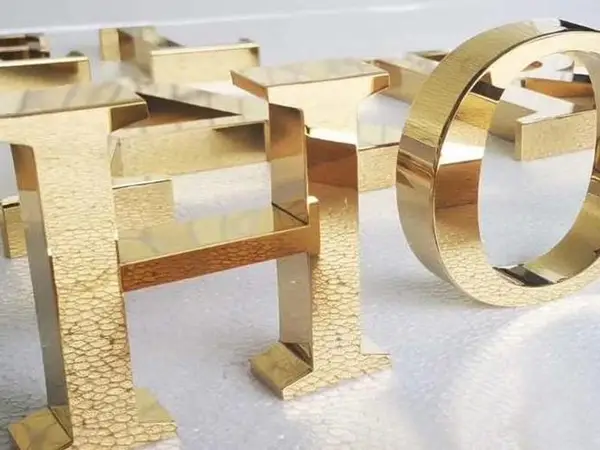
One more thing about finishes. Stainless can be brushed #4, mirror #8, PVD, or powder coated. Mirror #8 looks stunning but shows every fingerprint, every scratch. If your client has employees who clean with ammonia-based spray, mirror won't stay mirror. Brushed #4 hides wear. Do them a favor. Tell them.
Skip it. Don't even think about using cheap acrylic on a halo-lit sign. You'll regret it.
Here's what nobody tells you: the LED modules are the cheapest part of the sign, but they make or break the design. A backlit letter is essentially a light box with a hole in the back. Light bounces off the wall, creates that halo. Get the distance from the face to the wall wrong — less than 1.5 inches — and you get a sharp, ugly edge instead of a soft glow. I've seen architects specify 1-inch standoffs for a "modern look." It doesn't work. You need that gap.
Color temperature matters way more than most designers think. 3000-3500K warm gives a welcoming feel — good for restaurants, bars, hotel lobbies. 4000-5000K neutral feels clean and professional — typical for corporate offices, retail. 6000-6500K cool looks industrial, almost cold. Use that for highway signs, warehouse exteriors. But never, ever mix temperatures in the same sign. I've seen it. One letter warm, the next cool. Looks like you raided two different junk drawers.
The quickest way to spot bad LED modules: look at the solder joints. Dull gray = won't last 18 months. Shiny silver = proper lead-free solder. Also check the brand. Samsung or Osram chips inside quality modules from manufacturers like Lan Jing? Those can last 5+ years in real-world conditions. Cheap modules from no-name suppliers? 12-18 months and then half your sign goes dark. L70 rating of 50,000 hours means nothing if the driver board burns up in a year.
I've watched this go wrong: a designer specifies 2-inch deep faces but the LED modules are standard 12mm thick. The light hits the back of the acrylic unevenly. Hot spots. The fix? Use shallow-depth modules or increase face depth to 3 inches. Or add a diffuser layer — a second acrylic sheet to spread the light. But that costs money and eats brightness. Factory-direct, we charge $35-120 per halo-lit letter. Diffuser costs maybe $5 more per letter. Worth every penny for a smooth glow.
IP65 sounds impressive. It means water jets from any direction. It does NOT mean your sign survives a Florida hurricane. Or a Chicago blizzard. Or the wind tunnel between two high-rises. For outdoor signs, you need proper silicone sealing — neutral cure, not acidic that corrodes the metal. An 8-12 hour aging test before it leaves the factory. We do that. Many don't.
NEC Article 600 covers electric signs in the US. It requires proper grounding, strain relief, and a disconnect within sight of the sign. If your designer doesn't know that, the sign won't pass inspection. I've had to cut holes in buildings because someone forgot the pull box. If you're importing, make sure the factory understands UL 48 or at least ETL. UL costs $4,000-15,000 and 4-9 months with quarterly audits. ETL is 10-30% cheaper and accepted almost everywhere. Don't let a cheap import get flagged by the fire marshal.
For ADA tactile signs — yes, some backlit signs need to be ADA-compliant — mounting height 48-60 inches, non-glare surface, Grade 2 Braille. If your backlit letters are purely decorative, fine. But if they're part of a wayfinding system with required accessibility, you cannot skip this. The fines are brutal.
Shipping is its own horror story. LCL sea freight: your crate gets handled 6-8 times between our dock and yours. Every touch is a chance for damage. That's not in the brochure. We pack in foam + carton + plywood crate. Corners protected. Individual letters separated. Even then, I've seen crates dropped into the ocean. Not common, but it happens. Insure the shipment. For small orders under $800, express (7-10 days, $30-100) is safer than sea.
Factory-direct pricing: front-lit channel letters $20-80, back-lit halo $35-120, stainless steel non-lit $15-40, 3D fabricated $40-120, aluminum $10-25. Light boxes $80-250 per square meter. US retail installed: $200-700 per letter for front-lit, $400-1,000 for halo-lit. That factory-direct savings of 50-65% on product is real. But you still have shipping, tariffs (US Section 301 adds ~30%), and installation. If your total landed cost is still half of domestic, you're ahead. But not if the design is wrong and you have to re-order.
CE marking costs 20,000-50,000 RMB (about $3,000-7,000). Most factories will say they have it. Ask to see the certificate with today's date. Watch them sweat. We've got CE, RoHS, ISO 9001. But I've walked factory floors where the owner points to a framed piece of paper from 2014 and says "CE." Nope. That's expired or fake. Real certification gets renewed annually.
MOQ: 1 piece. Lead time: about 5-15 days. Warranty: 2 years LED, 1 year power supply. That's our standard. If a factory offers 5-year warranty on everything, they're lying or they charge you upfront for it. No LED module survives five years in direct sun without degradation. Even Samsung chips fade. The difference is gradual vs. catastrophic.
Here's a mini-story from last month: a client wanted halo-lit letters for a new steakhouse. He wanted mirror-finish stainless, 5mm acrylic, 3000K LEDs, and custom standoffs because the wall was brick. We quoted $2,800 for six letters, shipped. He went with a local guy who charged $4,500 and used 2mm acrylic with domestic LEDs. Five months later, the acrylic is yellowed, one letter is flickering, and the mirror finish is scratched from cleaning. He called us. We can make replacements but the cost of fixing a bad design is always higher than doing it right the first time.
Q: How deep should the letter face be for proper backlighting?
A: Minimum 2.5 inches. If you go less than 2 inches, you'll get hot spots and uneven light. For letters over 2 feet tall, bump to 3 inches. And don't believe anyone who says 1.5 inches works — they've never looked at their own sign at night. I've answered this question a hundred times. It's always the same answer.
Q: Can I use standard home-depot silicone to seal the letters?
A: Only if you want the sign to fail in 12 months. Acetic silicone — the stuff that smells like vinegar — corrodes stainless and aluminum. Use neutral-cure silicone, 100% silicone sealant made for outdoor signs. I can't believe I still have to say this. Every year a new contractor ruins a sign because they used bathroom caulk.
Q: What's the best power supply for backlit letters?
A: Mean Well or equivalent brand, rated for at least 20% more than the total load. Don't cheap out — a failed power supply kills every LED module downstream. We warranty power supplies for 1 year because they are the single most failure-prone component. If you want longer, pay for industrial
Products mentioned or relevant to this topic — factory-direct, custom built.

Real photo from our production floor — every sign we ship is made here.
From $24/letter · MOQ 1 piece · Flexible lead time · CE & UL certified · ships to 20+ countries
Custom sizes, colors, and finishes. Get a factory price in 24 hours.
Get a Free Quote Copy EmailWhatsApp +86 13865703472 · business@aochuangsign.cn
See pricing, specs, and get a free quote for the sign type you need. Built in our factory, shipped worldwide.