I’ve watched sign shops pay $800 for a single back-lit halo letter. We build that same letter from the same 304 stainless, same Samsung LEDs, and ship it for $120. The markup in between is where your money gets torched.
Here’s the supply chain nobody draws: factory sells at $120. Small importer marks up 40% to $200 to cover risk and container space. Regional wholesaler adds 35% to stock it in Cleveland or Dallas. Sign contractor tacks on labor, installation, and “project management” — now it’s $700–$850 per letter. Every layer adds a thick slice of margin because nobody wants to be the cheap guy who dies on a warranty call. But you, as the buyer who’s reading this, you can skip the middlemen. I’ll tell you exactly how the pricing works, what to look for, and which corners to never cut.
Factory-direct nets you 50–65% savings on product. That’s not a theory. It’s what our export invoices show year after year.
The ugly truth is most domestic sign companies are just resellers. They order from the same factories you can find, they just hide it behind a “fabrication partner” label. Cut that nonsense. Know your numbers. Let’s break down every damn cost.
Backlit halo letters aren’t magical. They’re 304 stainless steel faces and returns, a clear acrylic backing, LED modules, and a power supply. The price difference between a $55 letter and a $120 letter is inside those components.
Look, a $60 halo letter uses 0.9mm Chinese stainless, domestic acrylic, and cheapest LEDs. A $120 letter uses 1.2mm 304, Degussa acrylic, Samsung 2835, and a sealed Mean Well driver. That $60 difference today saves you $3,000 in failures. Don’t be the guy who learns that on year two.
Our MOQ is one piece. Yes, one single letter. But here’s what nobody tells you: shipping one letter costs more than the letter itself. The real wholesale game is in consolidation. A set of 8 letters for a storefront “B O U T I Q U E” means 8 letters at $90 each = $720, plus shipping.
Most factories will give you FOB pricing — that’s the cost loaded on a container in Shanghai. Your local costs, freight, duty, delivery, and installation, fall on you. Some importers get seduced by a $45/letter price but don’t realize they’ve bought C-grade acrylic and 0.8mm returns with sharp burrs. Read the specification sheet like a blood test. If it doesn’t say “304 stainless 1.2mm brushed #4 finish” and “Mitsubishi acrylic 3mm” and “Samsung LED 2835 IP65,” you’re about to get burned.
Our factory price for a standard 300mm (12-inch) backlit halo letter in 304 stainless, 3mm clear acrylic backer, Samsung LEDs, and Mean Well driver lands between $75 and $120. Height and stroke width alter it — a thin cursive “M” might be $72, a thickset “W” $130 because of the extra metal and LED strips. Request a per-letter breakdown. If a factory quotes a lump sum with no specs, run.
Even honest factories can’t control these, but they’ll inflate a quote faster than you can say “change order.”
1. Overall Height Over 800mm (32"). Big letters need internal framing, thicker steel, and more LEDs. Cost jumps 25–40%. Also, shipping a pallet of 1-meter letters needs more crating.
2. Return Depth. Standard is 30–50mm. If you need 80mm returns for dramatic shadow, steel use goes up and LED count nearly doubles to fill the cavity evenly. Adds 15–20% to material.
3. Custom Colors. Powder coating or PVD titanium finish adds $10–25 per letter. Mirror-polished #8 finish is labor-intensive. Our brushed #4 is standard and tough. If you want gold-plated brass letters to match a hotel lobby, we can do it — just expect that per-letter price to hit $200+.
4. Mounting Patterns. Stud-mount with a template is standard. Threaded standoffs with hidden fasteners cost extra for machining. Wall-penetrating wiring (instead of surface conduit) adds per-letter harness labeling and longer cables.
5. Consolidation & Crating. Air freight charges by volumetric weight. One halo letter might be 3kg actual but 8kg volumetric. We crate everything with plywood and foam, but that protection weighs money. LCL sea freight runs $80–200 per cubic meter; a full pallet of letters might be 0.5m³. Do the math before you order two letters air freight and weep at the $400 shipping bill.
Here’s what nobody tells you: the letter face cost is only 65% of the total landed cost. The rest is freight, crating, power supplies, and the damn tariff.
We follow 10 steps. If a factory can’t describe their process in this detail, they’re a trading company buying from a back-alley workshop.
I’ve seen this go wrong: a competitor shipped letters with no aging test. Half the LEDs failed after first rain because moisture crept through a pinhole silicone gap. Cost them a full resort reinstallation. The ugly truth is a 12-hour burn-in catches the stuff that kills your reputation.
CE is a start — it costs 20,000–50,000 RMB and we hold it. RoHS means no lead in solder. ISO 9001 means we have a quality system, not just a prayer. UL 48 is the American gold standard but takes 4–9 months and $4,000–15,000 in testing. ETL is a cheaper alternative. If you need UL-listed signs, ask before quoting. We can build to UL specs even if the label isn’t on yet, because the wiring methods and insulation are the same. Just tell the inspector the letters are CE-certified equivalent and use a listed remote power supply — most field inspectors accept that for small sign retrofits.
IP ratings: IP65 means dust-tight and protected against water jets. That’s your minimum for outdoor. IP66 handles powerful jets; good for car washes and coastal storms. IP68 is submersible. Every letter we seal gets IP65 silicone treatment. I once saw a client demand IP68 for a sign under a drive-through canopy. That was overkill, but we did it with extra silicone and breather valves. Point is, know the difference.
Here’s a brutal truth: a “CE certified” stamp is meaningless without a test report from TUV or SGS. I’ve seen factories photoshop certificates. Ask for a photo of the certificate next to today’s newspaper. It feels silly, but it works.
Take any quote and break it into these buckets. If they won’t give you line items, they’re hiding something.
Look, if a quote shows $85 per letter but the shipping line is blank, they’ll “figure it out later” and you’ll get a $600 bill for three letters. Always get shipping with tracking and crate dimensions up front.
I’m putting numbers here because I’m tired of the guessing game. All in USD, FOB Shanghai. For a 300mm (12") tall, simple sans-serif letter with 40mm return depth, 1.2mm 304 stainless brushed #4, 3mm Mitsubishi acrylic back, Samsung 2835 LEDs, Mean Well driver not included (separate), you’re looking at:
These prices include the halo letter, internal wiring, a 300mm pigtail, and mounting studs with template. Shipping, power supply, dimmer, and duty are separate. Add $12–25 per letter for a Mean Well LPV-60-24 driver depending on run length. One driver can power 4–6 letters.
Here’s what nobody tells you: I can ship you a $65 aluminum halo letter that looks identical to a $105 stainless one in the first month. By month 24, the aluminum one might have a slight dent from a kid’s football, and the cheap acrylic casts a sick yellow glow. The stainless one still looks crisp. That $40 delta is the cheapest branding insurance on earth.
Express (FedEx/DHL): 7-10 days, $30–100 for a small box. Good for samples or one tiny sign. Not for 20 letters.
Air freight: about 10 days, $4–12 per kg. Crated volume weight can be brutal. 40 lbs actual might bill as 90 lbs vol. Works for mid-size jobs.
Sea LCL: about 65 days, $80–200 per cubic meter. Your best bet for a full sign package. Budget $300–600 to ship a pallet of 15 letters. Plus $150–300 for customs broker and ISF filing.
Trucking from port to your shop: $200–800 depending on distance. You arrange this.
The ugly truth is ocean freight seems cheap until your client’s grand opening is in 6 weeks and the sign is still on a boat. Then you’re paying $90/letter for air freight anyway. Plan for 8–10 weeks from order to installation if using sea. Rush production at our end is 7 days; the ocean doesn’t give a damn about your schedule.
I’ve seen a contractor mount a 10-letter sign, then call me screaming that half the letters are dim. They used 18-gauge landscape wire and put all 10 letters on one 60-watt driver. Voltage drop killed the far end. Each letter draws 4–12 watts. Do the voltage drop math. Split runs. Put a driver every 20 feet. We include a wiring diagram with every order because I’d rather spend 10 minutes drawing than 2 hours on a video call watching you poke a multimeter at a sign 30 feet up.
Another gem: installer doesn’t seal the penetration holes on stucco. Water tracks inside the wall, wicks back to the letter, shorts the LEDs. We seal the letter back perfectly; you have to seal the building. Silicone the mounting holes before you thread the first nut.
We give 2 years on LEDs and 1 year on power supplies. Real-world, our Samsung modules in a properly sealed letter last 5+ years. If a driver fries in month 11, I’ll DHL you a replacement and eat the $15 shipping, because I want you to order the next project, not call your lawyer. If you dunk the letters in a fountain, no, that’s not covered. I had a client power them with a non-dimmable driver and a dimmer switch — the flickering burned out three LED strings. I still replaced them at cost, but I also sent a stern email.
Look, warranty is as good as the conversation when something fails. We’ve been exporting worldwide since 2010 with 50+ workers in a 3,000m² shop. We aren’t going anywhere. That matters when your sign is on a building in Perth and you need support at 2am your time. I answer WeChat at odd hours. It’s not slick, it’s just how we keep the trust.
Take factory letter cost + shipping + duty + local delivery + installation. That’s your total. For someone importing 12 backlit halo letters at $95 each, sea freight $350, duty 30% on product value only (not shipping), broker $175, local truck $250 — the per-letter landed cost is roughly $145 before installation. Pay an installer $50–75 per letter to mount, wire, and seal, and you’re at $200–220 per letter all-in. You charge your client $650–900 per letter installed. That’s a healthy margin and you delivered a premium sign that won’t yellow or die.
If you’re a sign shop, you can make 60% margin and still beat any local quote by 30%. If you’re an end user — a hotel or restaurant — you just saved $5,000 on a $15,000 job.
Don’t overcomplicate it. Buy the right stainless, use good acrylic, put Samsung or Osram inside, seal it like a fish tank, and pay for a Mean Well driver. That’s it. Everything else is marketing noise from guys who’ve never welded a return or smelled burning acrylic on a CNC. We have. Call or email and ask for a line-by-line quote. I’ll tell you where you can save money and where I’ll refuse to cut corners even if you beg.

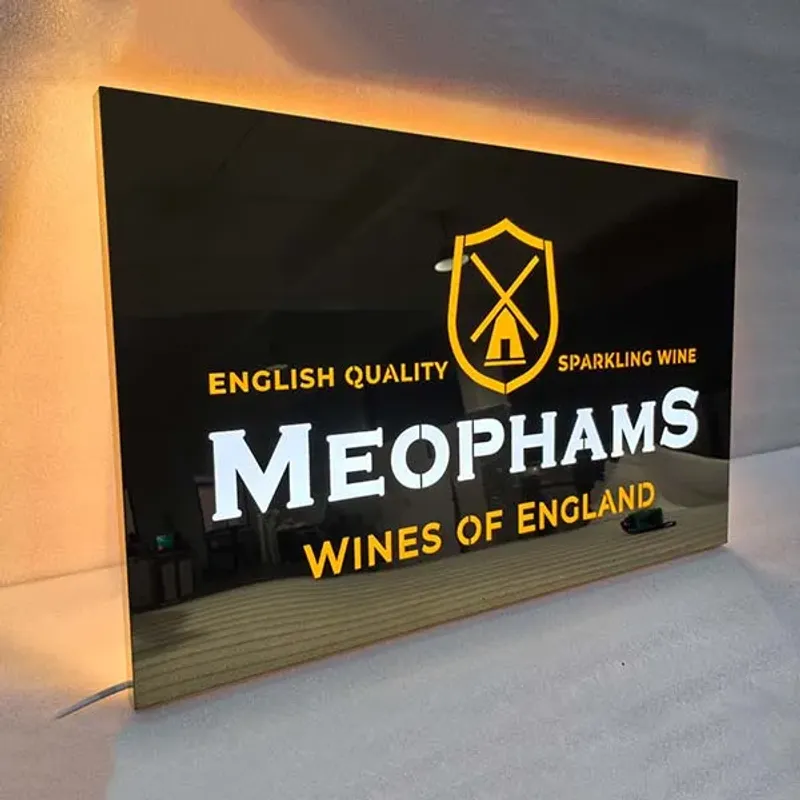
Real photo from our production floor — every sign we ship is made here.
Products mentioned or relevant to this topic — factory-direct, custom built.
From $24/letter · MOQ 1 piece · Flexible lead time · CE & UL certified · ships to 20+ countries
Custom sizes, colors, and finishes. Get a factory price in 24 hours.
Get a Free Quote Copy EmailWhatsApp +86 13865703472 · business@aochuangsign.cn
See pricing, specs, and get a free quote for the sign type you need. Built in our factory, shipped worldwide.