Here's the thing. Most guides online will tell you halo-lit letters are "premium" and backlit letters are "budget." That's lazy thinking. And it costs sign shops real money in rework and customer complaints.
I've spent 15 years on the factory floor. I've seen $20 LED modules fail in 12 months. I've watched cheap acrylic yellow in under two years. And I've pulled apart halo-lit signs that leaked water on day one because the installer skipped the silicone sealing step.
The truth is more nuanced. A backlit letter sign with quality diffusers and proper LED spacing can outperform a poorly built halo-lit sign in brightness consistency and longevity. While costing you 30% less upfront. But get the execution wrong, and you'll be back on site swapping out modules within a year.
This guide gives you the real specs—numbers you can use when ordering from a Chinese manufacturer like Aochuang Sign, or when quoting a client. No fluff. Just what works on the street.
Let's get the definitions straight. Backlit letters (also called front-lit or face-lit) have an acrylic face with light shining through it. The letter body is typically aluminum or stainless steel. LEDs sit inside, and the light pushes through a translucent acrylic panel. You read the sign by the light coming through the face.
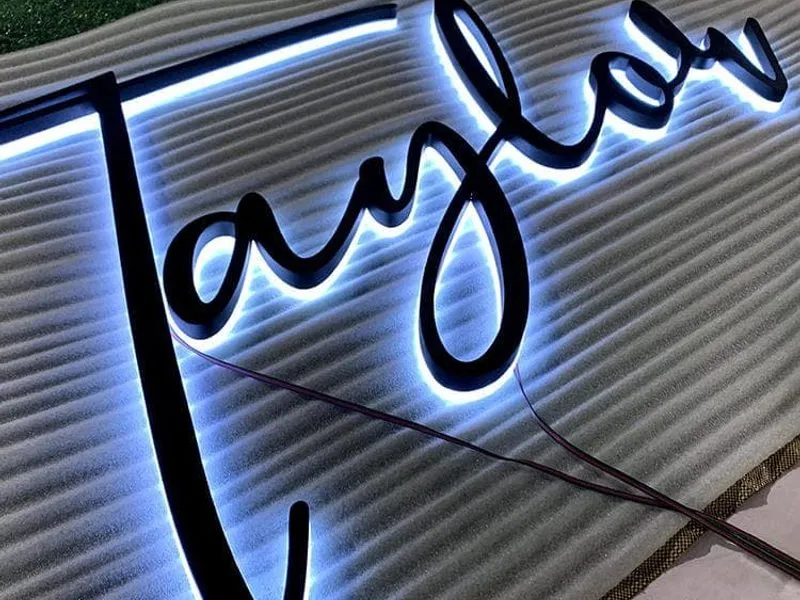
Halo-lit letters (reverse-lit) do the opposite. The letter face is solid metal or acrylic. LEDs inside shine backward onto the mounting wall. The light creates a halo effect around each letter. You read the sign by the silhouette of the letter against a lit background.
Both use the same basic components: laser-cut metal returns, acrylic faces or backs, waterproof LEDs, and transformer-driven power supplies. But the execution differs in ways that matter for your bottom line.
Your client wants a sign that pops at night. But they also need it readable at noon in direct sunlight. Here's how these two stack up.
| Condition | Backlit (Front-Lit) Letters | Halo-Lit (Reverse-Lit) Letters |
|---|---|---|
| Daytime readability | Excellent. High contrast between bright acrylic face and dark metal returns. | Good, but lower contrast. The solid face blends with the wall if colors match. |
| Nighttime visibility | Very bright. Light output 100-150 lm/W with SMD 2835 LEDs. Can be too bright if overdriven. | Softer, more elegant glow. Typically 40-60% less perceived brightness than backlit. |
| Direct sunlight | Can wash out if acrylic is below 2mm or LED density is too low. | Better resistance. The metal face doesn't fade. Light halo still visible. |
| Color accuracy at night | Dependent on acrylic quality. UV-resistant acrylic (Mitsubishi/Degussa) holds color 5-8 years. Domestic acrylic yellows in 1-2 years. | More consistent. LEDs reflect off wall, not through colored acrylic. Less color shift over time. |
The hard-won wisdom: Backlit letters win on raw brightness. But they force you into a quality trap. Use cheap 2mm acrylic and SMD 2835 modules spaced 4 inches apart, and you'll get hotspots and uneven glow. Use 5mm UV-resistant acrylic with tight LED spacing (2 inches center-to-center), and the result is museum-grade.
Halo-lit letters are more forgiving. The light doesn't pass through material. So acrylic yellowing doesn't affect the halo. But you need a clean mounting wall. Dark brick or textured surfaces will kill the halo effect.
I've watched contractors spend an extra half-day on halo-lit installations because they didn't account for the transformer location. Here's what you need to know.
Backlit letters are simpler. Each letter has a pre-wired LED module string inside. You mount the letter to the wall, run the wires through a raceway or the wall cavity, and connect to a transformer. Total wiring points: one per letter, typically. The transformer can be hidden in a ceiling or behind the sign.
Halo-lit letters require more precision. The LEDs face backward, so you need a minimum gap between the letter and the wall—usually 1 to 1.5 inches. That gap must be weatherproofed. If you skip the neutral silicone seal around the back edge, water will wick into the LED cavity. And if the wall is uneven, the halo will look patchy.
Here's a real number: For a 10-letter sign, a backlit installation takes roughly 4-6 hours for a two-person crew. Halo-lit takes 6-9 hours. That's $200-400 in extra labor at standard shop rates.
Also consider NEC Article 600 for US installations. All outdoor signs need proper grounding and GFCI protection. Halo-lit signs often require a larger transformer because the LEDs are farther from the wall, increasing wire resistance. Factor that into your bid.
I've seen signs fail in every possible way. Here's the pattern.
Backlit letter failures: The acrylic face is the weak link. Under direct sun, domestic acrylic yellows in 12-18 months. The sign starts looking like old Tupperware. Also, if the LED modules aren't properly sealed, moisture condenses inside the letter and shorts out the wiring. The fix? Use 5mm UV-resistant acrylic (Mitsubishi or Degussa) and neutral silicone sealant on every seam. That extends life to 5-8 years on the face.
Halo-lit letter failures: Water ingress behind the letter. The backlight cavity is exposed to rain and wind. If you use standard IP65 LEDs, they'll survive water jets—but not standing water. For coastal or heavy rain areas, you need IP66 or even IP68 modules. That adds cost. Stainless steel 316 with 2-3% molybdenum is your friend for marine environments. But it costs 20-30% more than 304.
Temperature matters too. In freezing climates, ice can build up behind halo-lit letters and push them off the wall. Backlit letters are less prone to this because the face is flush with the letter body. If you're in a snow zone, backlit is the safer bet.
Let's talk real money. Not the "factory-direct" fairy tale numbers you see on Alibaba. I'm using Aochuang Sign's actual pricing as a baseline. These are factory prices. Your retail markup will be 2-3x.
| Cost Category | Backlit Letters (per letter) | Halo-Lit Letters (per letter) |
|---|---|---|
| Factory price (3mm acrylic, 304SS, SMD 2835) | $20-80 | $35-120 |
| Transformer (per 10-letter sign) | $30-60 | $50-100 (larger capacity needed) |
| Installation labor (per sign) | $400-600 | $600-900 |
| Annual energy cost (12 hrs/day, $0.12/kWh) | $35-55 | $25-40 (less perceived brightness needed) |
| LED replacement (year 3-5) | $100-200 (cheap modules fail) | $50-100 (fewer modules, better access) |
| Acrylic replacement (year 2 if domestic) | $80-150 | Not needed |
| 5-year total cost (10 letters) | $2,500-4,500 | $3,500-6,000 |
The hidden cost nobody talks about: replacement part availability. If you buy backlit letters from a Chinese manufacturer that uses proprietary LED strips, you're stuck when one fails. Aochuang Sign uses standard SMD 2835, 5050, and 5730 modules. You can source replacements anywhere. Always ask your supplier what LED type they use. If they can't tell you, run.
Also factor in Section 301 tariffs on Chinese imports. That's roughly 30% on top of the factory price. A $50 backlit letter becomes $65 at the dock. Still cheaper than US fabrication, but it's real money.
Your client's logo is Pantone 186 C. You choose 6000K cool white LEDs. The sign comes out blue-ish. Client is furious.
Color temperature matters differently for each sign type.
Backlit letters: The acrylic acts as a filter. A warm white LED (3000K) behind a red acrylic face will look more orange. A cool white (6000K) will look truer red. Test this before production. Standard practice: use 4000-5000K for corporate and retail applications. It's neutral enough to not distort colors, but warm enough to feel inviting.
Halo-lit letters: The light bounces off the wall. So the wall color becomes part of the sign. On a white wall, 3000K gives a warm amber glow. On a dark wall, the halo is dimmer and cooler. For hospitality (restaurants, hotels), 3000-3500K is standard. For corporate, 4000-5000K. For industrial or highway, 6000-6500K.
Here's the insider tip: If you're importing backlit letters, specify the LED color temperature in your PO. Don't assume "white" means the same thing to every factory. Aochuang Sign offers 3000K, 4000K, and 6000K as standard. Ask for samples before you order 50 letters.
Backlit letters scream "open for business." They're bright, bold, and impossible to miss. Think McDonald's, Walmart, gas stations. They work for high-traffic retail, highway visibility, and any place where you need to grab attention from 200 feet away.
Halo-lit letters whisper "quality." They're subtle, elegant, and architectural. Think luxury hotels, law firms, medical offices, boutique retail. The halo effect creates depth. It says "we're established, not desperate."
But here's the nuance: You can combine both. A sign with backlit letters and a halo-lit logo or accent element gives you the best of both worlds. It costs more, but it's a differentiator. And the client will pay for it.
Individual letter failure is the nightmare. One letter goes dark. Do you replace the whole sign? Or just that one letter?
Backlit letters: Easy to repair. Remove the acrylic face, swap the LED module, re-seal. Total time: 30 minutes per letter. Parts: $5-15 for a quality SMD 2835 module. Problem: if the acrylic is yellowed, you replace the face too. That's $10-20 for a 3mm UV-resistant piece.
Halo-lit letters: Harder. You have to remove the entire letter from the wall to access the back cavity. Then re-seal and re-mount. Total time: 1-2 hours per letter. Parts: similar cost. But the risk of breaking the weather seal during repair is high. I've seen sign shops charge $200-300 just to fix one halo-lit letter because of the labor.
The lesson: If you're importing, buy at least 2-3 spare letters. Aochuang Sign has a MOQ of 1 piece. So order spares with your initial run. Store them in a clean, dry space. When a letter fails five years from now, you have a perfect match.
You need a sign in two weeks. Can you get it from China? Maybe. Here's the timeline.
Aochuang Sign's standard lead time is about 5-15 days. That includes design confirmation (1 day), laser cutting (±0.1mm precision, 1-2 days), bending and TIG welding (1-2 days), grinding and polishing (1-2 days), acrylic CNC (1 day), LED assembly (1-2 days), sealing (1 day), aging test (8-12 hours), QC inspection (100% of letters), and export packaging (foam + carton + plywood crate).
Shipping options:
For a 10-letter backlit sign weighing roughly 50 kg, air freight costs about $200-600. Sea freight is cheaper but takes two months. Plan accordingly. If your client needs the sign in 30 days, you're paying for air.
Backlit letters win both categories if built properly. During the day, the bright acrylic face contrasts sharply with the metal returns. At night, the light output from SMD 2835 LEDs (100-150 lm/W) is intense. Halo-lit letters are softer at night and less visible during the day, especially if the wall color matches the letter face. If daytime visibility is critical, go backlit.
Yes, but only with proper sealing and IP-rated components. Use at least IP65 LEDs (dust-tight and water jet resistant). For coastal areas, go IP66 or IP68. Seal the back cavity with neutral silicone. Use stainless steel 316 (15+ year marine grade) instead of 304. And ensure the mounting wall is flat—uneven surfaces create gaps where water enters. Skip these steps, and you'll have failures within months.
For backlit letters, 4000-5000K is the safe zone for most retail and corporate applications. The acrylic face will slightly shift the color, so test with your actual acrylic before ordering. For halo-lit, 3000-3500K works best for hospitality (warm, inviting), 4000-5000K for corporate/retail (neutral), and 6000-6500K for industrial or highway signs (cool, high contrast). Always specify the exact Kelvin value in your purchase order.
For backlit: transformer ($30-60), wiring ($20-50), installation labor ($400-600), and potential acrylic replacement in year 2 if you used domestic acrylic ($80-150). For halo-lit: larger transformer ($50-100), extra labor for precise alignment and weatherproofing ($600-900), and possible wall preparation if the surface is uneven ($100-300). Over 5 years, backlit typically costs $2,500-4,500 total; halo-lit runs $3,500-6,000. The hidden cost is always labor and replacement parts, not the letters themselves.
Backlit letters are significantly easier. Remove the acrylic face (held by clips or screws), swap the LED module, re-seal. Takes 30 minutes. Halo-lit letters require removing the entire letter from the wall to access the back cavity. That means breaking the weather seal, re-mounting, and re-sealing. Takes 1-2 hours. If you're running a sign shop with service contracts, backlit letters will save you hours of labor over the life of the sign.
| Metric | Backlit Letters | Halo-Lit Letters |
|---|---|---|
| Brightness (lumens per letter, typical) | 100-150 lm/W (SMD 2835) | 40-60% less perceived brightness |
| Contrast ratio (daytime) | High (acrylic face vs. metal returns) | Moderate (solid face vs. wall) |
| Contrast ratio (nighttime) | Very high (bright face, dark background) | High (halo silhouette) |
| Lifespan (LED modules, rated hours) | 30,000-50,000 hours (SMD 2835) | 30,000-50,000 hours (SMD 2835) |
| Acrylic yellowing (years to noticeable) | 1-2 years (domestic), 5-8 years (UV-resistant) | Not applicable (no acrylic in light path) |
| Weather resistance (IP rating needed) | IP65 standard; IP66 for coastal | IP65 standard; IP66/IP68 for coastal |
| Installation time (10-letter sign, 2-person crew) | 4-6 hours | 6-9 hours |
| Repair time per letter | 30 minutes | 1-2 hours |
| Factory price (per letter, 304SS, 3mm acrylic) | $20-80 | $35-120 |
| 5-year total cost (10 letters, including installation and maintenance) | $2,500-4,500 | $3,500-6,000 |
| Energy cost (annual, 12 hrs/day, $0.12/kWh) | $35-55 | $25-40 |
| LED replacement cost (year 3-5) | $100-200 | $50-100 |
| Acrylic replacement cost (if needed) | $80-150 (year 2 if domestic) | Not needed |
| Transformer cost (per 10-letter sign) | $30-60 | $50-100 |
| Shipping weight (10-letter sign, approx.) | 50 kg | 55 kg (slightly heavier due to metal face) |
| Lead time (from Aochuang Sign) | about 5-15 days | about 5-15 days |
| Best for | High-traffic retail, highway, 24/7 visibility | Luxury hotels, law firms, boutique stores |
This guide was written by a sign industry veteran with 15 years of experience in sign manufacturing, installation, and quality control. Having worked directly with factories in China, including Aochuang Sign (founded 2010, 3,000m² facility, 50+ workers, exports worldwide), the author has overseen thousands of sign projects and knows the pitfalls that cost shops money. Actual specs may vary by manufacturer. Always request samples and test your LED color temperature before committing to a full production run.

Real photo from our production floor — every sign we ship is made here.
Products mentioned or relevant to this topic — factory-direct, custom built.
From $24/letter · MOQ 1 piece · Flexible lead time · CE & UL certified · ships to 20+ countries
Custom sizes, colors, and finishes. Get a factory price in 24 hours.
Get a Free Quote Copy EmailWhatsApp +86 13865703472 · business@aochuangsign.cn
See pricing, specs, and get a free quote for the sign type you need. Built in our factory, shipped worldwide.