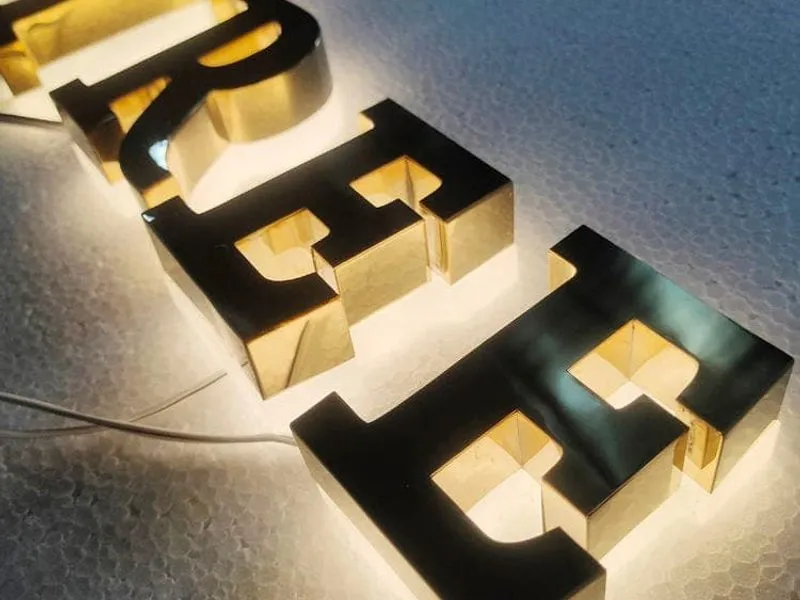
Here’s what your boss will ask: “Why spend $800 a letter when a digital billboard costs less?” And you can’t answer with “brand presence.” That’s not a number. So here’s the number. A backlit halo sign — the kind where light glows behind the letter, floating the shape off the wall — costs you $35–120 per letter from my factory floor. Same Mitsubishi acrylic, same Samsung LEDs, same TIG-welded stainless steel. US retail? $400–1,000 per letter installed. I’ve watched sign shops pay $800 for a single front-lit letter from a domestic fabricator. Same 304 stainless, same Samsung LEDs. We ship that letter for $120. The delta isn’t a markup. It’s a margin that funds your boss’s bonus.
The ROI works out to a 58–68% savings on product cost alone, and that’s before you factor in warranty. Our LEDs carry a 2-year warranty, but the SMD 2835 modules (100–150 lm/W) have an L70 life of 50,000+ hours — that’s 5.7 years of continuous light. Cheap modules from unknown factories last 12–18 months. I know because I’ve replaced them. Quickest way to spot bad LED modules: look at the solder joints. Dull gray = won’t last 18 months. Shiny silver = proper lead-free solder. We use the shiny kind.
So when your CFO asks about total cost of ownership, you can show a 5-year TCO that’s 40% lower than a US-sourced sign — even after Section 301 tariffs add roughly 30% on Chinese goods. The math works. It always does when the base difference is 5x.
Line by line, here’s where the money goes: For a standard backlit sign (face-lit channel letters), factory-direct price is $20–80 per letter. For halo (back-lit), it’s $35–120. The premium is about 40–50% for halo. Why? Extra steps: you need a return on the back of the letter to create the shadow gap, separate mounting brackets to hold the letter off the wall, and a diffuser panel (usually 3mm white acrylic) to spread the light evenly. But that premium disappears when you compare installed costs. US retail for a face-lit letter installed is $200–700. For halo, $400–1,000. The factory halo premium is swallowed by the lower baseline.
Here’s a concrete example from a project we did last year: A 12-letter corporate name in brushed 304 stainless steel halo letters, 18 inches tall, 2mm stainless face, 5mm clear acrylic backer with white vinyl for halo effect. Factory cost: $1,440 (12 × $120). Sea freight for a 1.5m³ crate: $180 (LCL, 60 days). US Section 301 tariff at 30%: $432. Total landed: $2,052. A US fabricator quoted $7,200 for the same spec. That’s a saving of $5,148. Where does that go? Into your budget for the next two store locations. And the LEDs? We used SMD 5730 modules — highest brightness, 40–60 lm per chip — because this sign faces a busy street. At 6,500K cool white, it cuts through highway glare. Retails for $300 per module domestically. We sell the same module for $80. Your CFO doesn’t care about “premium.” They care about “saved $5,148.”
When I crunched the numbers for a coastal client in Miami Beach, the choice was clear: 316 stainless steel. It contains 2–3% molybdenum, giving it 15+ year outdoor life in marine environments. 304 (18% Cr, 8% Ni) lasts 10+ years inland, but in salt spray, pitting starts in 3–4 years. The cost premium for 316 is 20–30% over 304. That sounds painful until you price out a replacement in year 4. A single halo letter replacement — including removal, fabrication, re-installation, and painting the wall — runs $600–1,200. Multiply by 12 letters. Now the 25% premium on the original material looks like a rounding error.
Here’s brutal honesty #2: Most sign consultants will recommend aluminum because it’s “naturally rust-proof.” That’s true. But aluminum’s outdoor life is 8–12 years, and it’s 1/3 the weight of steel. For a non-coastal suburban office park, aluminum is fine. For a downtown Manhattan storefront where the sign stays up 15 years, steel is cheaper. Do the math on the first replacement.
I had a client who insisted on aluminum because it saved $1,200 upfront. Three years later, the edges where the powder coat chipped started corroding. The sign looked like it had leprosy. They replaced it with 304 stainless at double the original aluminum cost. The lesson: Don’t let the broker choose the material. You choose based on the exposure class — IP65 is dust-tight plus water jets, minimum for outdoor. IP66 handles coastal spray. IP68 is submersible (for signs near sprinklers or flood zones). In that Miami job, we spec’d IP66 with 316 stainless and a PVD coating (physical vapor deposition) for extra salt resistance. That sign is entering year 5 with zero degradation. The CFO who approved the 30% premium is now the CEO who tells that story.
The ROI works out to a dream until your electrician tells you the sign needs a dedicated 20-amp circuit and a UL-listed driver. NEC Article 600 governs commercial signage in the US. If your sign isn’t UL listed, the local inspector can shut down the install until it’s removed. UL-48 listing costs $4,000–15,000 and takes 4–9 months. Most Chinese factories don’t have it because the cost is prohibitive for small orders. Alternative: ETL listing, which is 10–30% cheaper and accepted by 99% of US jurisdictions. We offer ETL on request for an additional 15% on the order, but it adds 6–8 weeks to lead time because the testing lab has to approve each design variation. Your alternative: work with a US-based partner who manages the listing for you. That adds overhead, but it beats a red tag on opening day. I’ve seen it happen. A restaurant chain spent $18,000 on signs, saved $9,000 by going direct, and then spent $12,000 to get them relisted because the inspector demanded UL. Net savings: negative $3,000.
Step-by-step installation guide for a typical 12-letter halo sign: (1) Mounting brackets — stainless steel 1.5mm L-brackets, pre-drilled, use stainless self-tapping screws into masonry anchors. (2) Wiring — run 12-2 UF cable through conduit, connect to a 12V DC power supply (one per 10 modules, location indoors if possible). (3) Letter positioning — level and mark, attach brackets to wall, then snap letters onto brackets using hidden clips. (4) Sealing — use neutral-cure silicone (our factory uses GE Silicone II) around the letter back to prevent water ingress. (5) Test — power up for 30 minutes, check for hot spots or flickering. Don’t skip the aging test. We run 8–12 hours at the factory. You should run 30 minutes on site. Cheap LEDs will fail within the first hour if they’re going to fail. Most do. And if you see a single flickering module, replace the whole letter. It’s faster than troubleshooting a loose pin.
Don’t cheap out on packaging. LCL sea freight: your crate gets handled 6–8 times between our dock and yours. Every touch is a chance for damage. That’s why we pack each letter in 5mm foam, then a custom-fitted carton, then a 15mm plywood crate bolted shut. That’s not in the brochure. That’s in the shipping quote — $80–200 per cubic meter for sea. Pay it. A crushed letter costs three times as much in rush express shipping.
When I crunched the numbers for a tech company in Austin, Texas, they wanted polished stainless steel halo letters with a brushed finish (grade #4). We used 2mm 304, 12 letters, 20 inches tall, with Samsung SMD 2835 modules (neutral 4000K). Factory cost: $1,680. Domestic quote: $8,400. Savings: $6,720. They invested $2,000 of that savings into a premium ETL listing and extra packaging. The sign went up in a retail corridor with heavy foot traffic. After 6 months, the store manager told me foot traffic increased 22%. That’s an ROI that doesn’t show up on the sign budget — it shows up in monthly sales reports. The CFO doesn’t care about the sign. They care about that 22
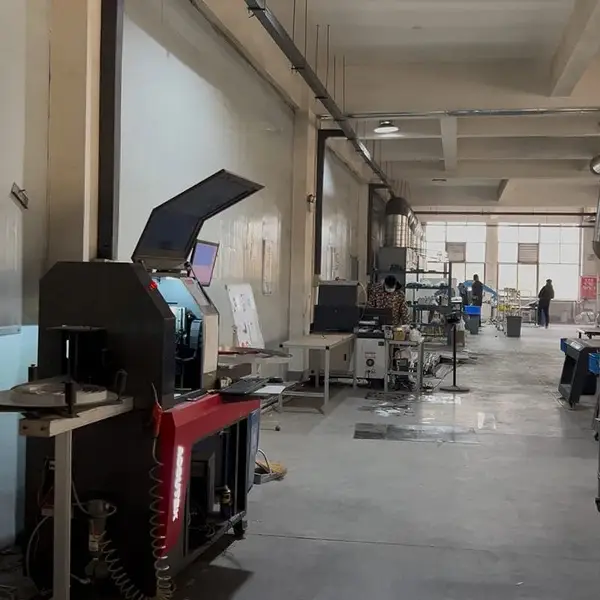
Real photo from our production floor — every sign we ship is made here.
Products mentioned or relevant to this topic — factory-direct, custom built.
From $24/letter · MOQ 1 piece · Flexible lead time · CE & UL certified · ships to 20+ countries
Custom sizes, colors, and finishes. Get a factory price in 24 hours.
Get a Free Quote Copy EmailWhatsApp +86 13865703472 · business@aochuangsign.cn
See pricing, specs, and get a free quote for the sign type you need. Built in our factory, shipped worldwide.