The receptionist sees it every day. The visiting VP notices it in under 7 seconds. And the new hire? They'll photograph it for LinkedIn before they even sit down. Corporate lobby signage isn't décor. It's a handshake in acrylic and steel. A single 48-inch stainless steel logo mounted behind the front desk can set the tone for a $50 million negotiation. Get it wrong, and the drywall behind it screams louder than your brand.
I've walked factory floors in Lu'an, China, where 50 workers cut, weld, and wire these signs for clients worldwide. I've seen what makes a lobby sign survive a decade of cleaning crews, HVAC drafts, and that one intern who thinks Windex solves everything. The difference between a sign that impresses and one that fades in 18 months often comes down to three decisions made before a single LED is lit.
Here's what actually matters.
A dimensional letter set behind your reception desk works 24/7. No salary. No benefits. No Monday morning attitude. But that's not the half of it. When a client walks into your lobby, they've already made 11 judgments about your company—most within the first 7 seconds. The sign you hang confirms or destroys them all.
Consider the math. A front-lit channel letter set spelling "ACME CORP" might cost $200–$500 factory-direct. Installed, maybe $700–$1,200. Over a 10-year lifespan, that's $120 a year. Less than a single client lunch. And I've seen multi-million dollar deals sour because the conference room monitor was glitchy and the lobby logo looked like it came from a mall kiosk. The human brain processes visual information 60,000 times faster than text. Your sign isn't being read—it's being absorbed.
But here's the problem: most buyers spec lobby signs based on a Pinterest photo. No material callout. No lighting specs. No understanding that the gorgeous brushed gold finish in that photo is PVD-coated stainless 304, not spray paint on MDF. In 15 years, I've watched sign shop owners field frantic calls from facilities managers whose "bargain" aluminum letters started oxidizing 14 months in. Cleaners used ammonia-based sprays. The anodized layer peeled like sunburned skin. That $900 installation became a $3,400 replacement. Cheap isn't cheap.
The thing is, a lobby sign doesn't just sit there. It gets scrutinized from 3 feet away. Fingernails touch it. Phone cameras magnify every weld seam. When you spec correctly—with 3mm brushed stainless, 6500K cool white LEDs, and a flush-mount stud pattern—the sign becomes architecture. Not an afterthought.
I'll say it plain: acrylic is not all created equal. Neither is stainless. And if someone sells you "outdoor-grade" PVC for a lobby sign, walk away. For indoor corporate applications, three materials dominate. Each has a personality, a price tag, and a failure mode you need to know.
Let's start with acrylic. The good stuff—Mitsubishi or Degussa—gives you 90–92% light transmittance and UV resistance that holds color for 5–8 years. The domestic alternative? 1–2 years before yellowing, especially near windows. And no, your cleaning crew won't notice until it's too late. Thickness matters enormously. For letters under 2.5m (most lobby signs), 3mm acrylic is fine. Go larger, or if the sign hangs from standoffs where vibration is possible, step up to 5mm. I've seen 2mm faces crack during installation because the stud mount was torqued too hard. The replacement set cost the same as the original—$40 per letter—but the downtime and scaffolding rental doubled the pain.
Stainless steel 304 is the workhorse. 18% chromium, 8% nickel. Density of 7.93g/cm³. That means heft. Lobby signs in 304 brass or brushed #4 finish look like they belong in a bank headquarters. Outdoor life? 10+ years. Indoors, with climate control, it's practically forever. But here's a factory-floor secret: PVD coating on 304—rose gold, black titanium—doesn't just look expensive. It adds a layer that resists fingerprints. For a lobby desk sign that's touched daily, that's gold. Literally costs 20–30% more than bare brushed, but your maintenance crew won't need to polish it weekly.
If your client is on a coast, or the lobby has an indoor water feature that spits chlorinated mist, you want 316. Marine grade. Contains 2–3% molybdenum. It laughs at salt air. The cost premium over 304? About 20–30%. For a $2,000 lobby sign, that's an extra $400–$600. Worth every cent when the alternative is pitting after 3 years. I've shipped 316 letters to a resort in Cancún where the humidity hits 90% daily. Five years later, they look like day one.
Aluminum is lighter—about a third the weight of steel—and naturally rust-proof. Outdoor life 8–12 years. Thicknesses from 0.040" to 0.063" (1.0–1.6mm). Powder-coated aluminum can match any Pantone. It's clean, modern, and cheaper than stainless. A 12-inch aluminum letter factory-direct might run you $10–$25. But it dents easier. In a high-traffic lobby where delivery carts bump the wall, think twice. Or use a heavier gauge and accept the cost bump.
So how do you choose? Here's a head-to-head based on real factory pricing and performance data from Aochuang Sign's 3,000m² production floor.
| Material | Best Use | Typical Thickness | Indoor Lifespan (Aesthetics) | Factory Price Per Letter (12") | Watch Out For |
|---|---|---|---|---|---|
| Acrylic (Mitsubishi/Degussa) | Front-lit face, halo-lit push-through | 3mm–5mm | 5–8 years before yellowing | $20–$80 (front-lit channel) | Solvent-based cleaners, thermal shock near HVAC vents |
| Stainless Steel 304 | Non-lit returns, brushed logos, PVD accents | 1.0–3.0mm | 10+ years (mirror #8 finish needs care) | $15–$40 (non-lit) | Fingerprints on mirror finish; chloride cleaners can pit |
| Stainless Steel 316 | Coastal lobbies, pool areas, humid environments | 1.0–3.0mm | 15+ years | $20–$50 (non-lit) | Cost premium; harder to source quickly |
| Aluminum | Lightweight wall signs, powder-coated shapes | 0.040"–0.063" | 8–12 years | $10–$25 | Denting in high-traffic zones; anodized layer can scratch |
Note: Front-lit channel letters with acrylic faces and aluminum returns combine materials. Factory prices listed include basic LED assembly. Shipping and tariffs extra.
You can hang the most beautifully fabricated dimensional letters, but light them wrong and you've built a glaring error. Lighting sets hierarchy. Warm 3000–3500K in a law firm lobby feels grounded, rich, like leather chairs and scotch. Cool 6000–6500K in a tech company lobby signals precision, future, speed. Corporate and retail usually land at 4000–5000K—neutral, professional, doesn't fight with the recessed ceiling lights.
Now, the LEDs. Not all SMD chips are equal. The industry standard for channel letters is SMD 2835, pumping 100–150 lumens per watt. You'll get clean, even illumination behind a 3mm acrylic face. Need RGB capability? That's SMD 5050 territory. If you're doing a super-bright halo-lit sign where the glow needs to punch against a dark accent wall, SMD 5730 chips deliver 40–60 lumens per chip. That's the sweet spot for backing logos that need to float.
Quality modules—think Samsung, Osram, or the Chinese brand Lan Jing—carry a real-world lifespan of 5+ years. At Aochuang, we run every assembled sign through an 8–12 hour aging test. That catches early failures before the crate gets nailed shut. Cheap LEDs? I've seen them fade and flicker inside 12–18 months. The difference in cost per module might be $0.50. Over a 200-module sign, that's $100 saved on a $2,000 job. Penny wise, reputation foolish.
And here's something nobody tells you: power supplies matter as much as the LEDs. We warranty LEDs for 2 years, but the power supply for 1 year. That's not because we're stingy. It's because voltage spikes, dirty power, and heat kill drivers faster than diodes. For a lobby sign that runs 10 hours a day, spec a Mean Well or equivalent IP65-rated supply. The $40 upgrade saves a $200 service call when the sign goes dark three months after the grand opening.
Halo-lit (back-lit) letters command a premium. Factory prices run $35–$120 per letter compared to $20–$80 for front-lit. Why? The returns are fabricated with exacting standoff depths—typically 1–1.5 inches—to cast an even glow on the wall. Light bleed is the enemy. You need opaque backs, sealed edges, and precise LED spacing. Get it right and the logo appears to levitate. Clients love it, and they'll pay the premium because the visual impact justifies the cost. And as a sign shop, your margin holds when you explain that halo-lit signs require 30% more labor in bending and wiring.
I'm going to give you numbers that might make you uncomfortable. A front-lit channel letter that costs you $50 from a factory in China will sell to an end client in Dallas for $350–$700 installed. That's not price gouging. That's logistics, design time, permitting, union labor, and risk. But if you're a contractor or an in-house facility manager buying 20+ letters, going factory-direct can save 50–65% on the product alone. The math gets interesting fast.
Take a full suite of halo-lit dimensional letters spelling "VENTURE PARTNERS" across a 12-foot lobby wall. Retail, installed, that could run $6,000–$12,000. Factory-direct for the letters, with IP65-rated modules and 3mm brushed acrylic faces, might land at $2,200–$4,000. Add $400 for air freight (about 10 days), and you're at half the price. Sea freight is cheaper—LCL at $80–$200 per cubic meter, but it takes about 65 days. Patience pays. If you're not on a tight deadline, a full container (FCL) at $1,200–$3,000 makes sense for large orders.
But the elephant in the room is the US Section 301 tariff—roughly 30% on many Chinese-made signs. That $2,500 order picks up a $750 surcharge. Still cheaper than domestic fabrication? Usually, yes, especially for complex stainless or custom LED work. But you must account for it. A good supplier will provide HS codes and commercial invoices that keep customs clean. You don't want a shipment held in Long Beach over a missing certificate.
Certifications are another piece. If you need UL 48 listing for the sign to pass electrical inspection, budget $4,000–$15,000 and 4–9 months for testing, plus quarterly audits. Many factories offer ETL as an alternative—10–30% cheaper and equally accepted by most AHJs. For EU markets, CE marking costs 20,000–50,000 RMB and takes 2–8 weeks. And for outdoor or wet-area lobby signs (like an interior courtyard entrance), IP65 is the minimum—dust-tight and protected against water jets. IP66 handles powerful jets, IP68 submersible. Don't over-spec, but don't under-spec either.
Understanding how a sign is made will make you a better buyer. It'll also help you sniff out BS when a sales rep says "we need 6 weeks for that." At Aochuang, a standard order for 50 dimensional letters leaves our Lu'an facility in 7–15 days. Here's the exact flow, with zero sugarcoating.
Day 1: Design Confirmation. You approve the art file. No surprises later.
Days 1–2: Laser Cutting. We cut returns and faces with a tolerance of ±0.1mm. That's the width of a human hair. Stainless goes under fiber laser; acrylic under CO₂. The edges come out flame-polished or ready for bending.
Days 1–2: Bending and Welding. TIG welding for stainless returns. Aluminum gets MIG. This is where craftsmanship shows—visible weld seams on a lobby sign are unacceptable. A skilled welder spends 20 minutes on a single 18-inch letter, grinding and filling until the seam disappears.
Days 1–2: Grinding and Polishing. Brushed #4 finish requires uniform grain, achieved with scotch-brite belts. Mirror #8 needs three stages of compound. PVD coating happens off-site if needed; add 2 days.
Day 1: Acrylic Face CNC. For push-through letters or clear faces, the CNC router cuts and drills. Edges get diamond-polished if the spec calls for it.
Days 1–2: LED Assembly. Modules are adhered to the back of the face or inside the channel. Wiring is soldered and heat-shrunk. For halo-lit, LEDs mount to the return, facing backwards.
Day 1: Sealing. Neutral-cure silicone seals the face to the return. Acid-cure silicone will corrode LED contacts over time—a mistake cheap factories make.
Day 1: Aging Test. Every single sign is powered on for 8–12 hours. If a module fails, it gets replaced before packaging.
Day 1: 100% QC Inspection. Dimensions, illumination, finish, and structural integrity are checked against a checklist.
Days 1–2: Export Packaging. Foam inner wraps, individual cartons, then a 9mm plywood crate. We've shipped signs to Belgium in December that arrived without a scratch. Packaging isn't where you save money.
That's it. Ten steps. Seven to fifteen days. And if you need ADA-compliant tactile lettering with Grade 2 Braille, we add a day for raster bead insertion on the acrylic backer. Mounting heights between 48–60 inches, non-glare finish—those are code requirements, not suggestions.
You want a lobby sign that outlasts the lease? Start with stainless 304, 2mm thick, brushed #4 finish. Back it with SMD 2835 5000K neutral white modules from a known brand. Use a Mean Well IP65 driver. For the face, if it's lit, 3mm Mitsubishi acrylic with UV inhibitors. The returns should be welded, not glued, with no visible seams. Mount it on hidden aluminum studs anchored to the wall substrate, not drywall screws into air.
Write the spec into your purchase order. "3mm Mitsubishi acrylic face, 6500K, 100–150 lm/W SMD 2835, stainless 304 returns, PVD titanium coating, IP65 power supply, 2-year LED warranty." When the RFQ comes back, you'll weed out the factories that were planning to quote domestic acrylic and no-name power supplies. The price might be 15% higher. It's still a third of retail.
And the classic mistake? Forgetting thermal expansion. In a lobby with floor-to-ceiling southwest glass, the wall can hit 110°F. Acrylic expands more than aluminum. Leave a 1/16" gap between letters and returns to prevent buckling. It's tiny. Nobody sees it. But your sign won't pop its face off in August. Little things like that are what separate a 2-year sign from a 10-year asset.
1. What's the best material for a corporate lobby sign that gets touched daily?
Stainless steel 304 with a PVD coating (black, gold, or bronze). The coating resists fingerprints and cleaning chemicals far better than bare metal. A brushed #4 finish hides minor scratches. Avoid mirror #8 unless you have a housekeeping staff that will polish it daily—it shows every smudge. Acrylic faces are fine if they're not at hand height, but if visitors or receptionists will touch the letters, metal lasts longer and cleans easier.
2. How long do LED-illuminated dimensional letters actually last?
Quality SMD modules (Samsung, Osram) have an L70 rating of ≥50,000 hours. That means after 50,000 hours—roughly 5.7 years of

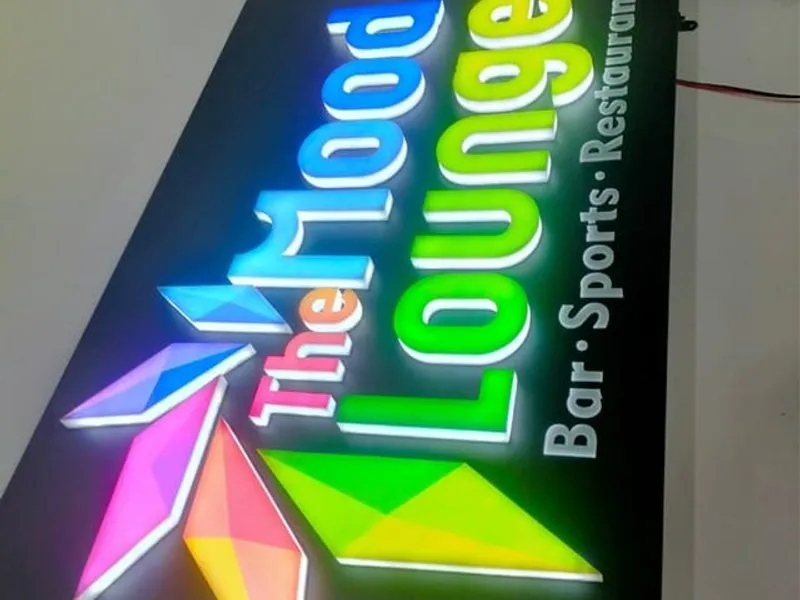
Real photo from our production floor — every sign we ship is made here.
Products mentioned or relevant to this topic — factory-direct, custom built.
From $24/letter · MOQ 1 piece · Flexible lead time · CE & UL certified · ships to 20+ countries
Custom sizes, colors, and finishes. Get a factory price in 24 hours.
Get a Free Quote Copy EmailWhatsApp +86 13865703472 · business@aochuangsign.cn
See pricing, specs, and get a free quote for the sign type you need. Built in our factory, shipped worldwide.