You’d think after 16 years I’d stop being surprised. But I’m not. Every month some bank manager calls me with a sign that’s peeling after 18 months — and they want a warranty claim. I ask what LEDs they used. “The cheap ones from the supplier we’ve always used.” And they smile like that’s a good thing.
Here’s what nobody tells you: banks don’t buy cheap signs because they don’t have money. They buy cheap because their procurement team doesn’t know the difference between SMD 2835 and 5730. And they think a “stainless steel” letter is the same whether it’s 304 or 316. It’s not.
The ugly truth is that most bank signage — exterior channel letters, interior lobby light boxes, even the ADA-compliant directory boards — fails inside 5 years. Not because the design is bad. Because nobody specified for the real world. Rain. Heat. Hand sanitizer on the acrylic. A cleaning crew that sprays bleach on the brushed aluminum. That’s what kills signs.
I’ve seen this go wrong: a credit union in Jersey bought “ETL listed” channel letters from a fly-by-night shop. The ETL sticker? Copied from a printer. They lost half the letters in a nor’easter. Cost them $12,000 in rework. I can tell you exactly what they should have ordered. Let’s start there.
Face it: your bank’s sign is the first thing customers see. If it’s flickering, yellowed, or rusting at the returns, you’ve already lost trust. I’m not exaggerating. A 2019 study said 68% of consumers judge a business’s credibility by the condition of its exterior signage. So that 6-foot front-lit halo letter on the pole needs to look as good in year 10 as it did in month 1.
For the stainless, don’t guess. Standard 304 — that’s 18% chromium, 8% nickel — gives you 10+ years outdoors in most of the U.S. But if your bank is near the Gulf Coast, or in any place with salt spray, you need 316. That extra 2-3% molybdenum makes it marine-grade. Costs 20-30% more, but you won’t be replacing letters in three years. I’ve seen strip mall banks in Florida try to save $150 on a set of letters by using 304. By year three they were pitting like a teenager’s face. Don’t do it.
For the acrylic face, use Mitsubishi or Degussa. Domestic acrylic starts yellowing in 1-2 years. The good stuff holds 90-92% light transmittance for 5-8 years. That’s not a theory — I’ve got a 7-year-old bank sign in Savannah that still looks clean. And it’s not just the light: the UV resistance keeps the acrylic from going brittle. I’ve watched cheap acrylic crack when a bird hit it. True story.
LED modules? Here’s your rule: SMD 2835 at 100-150 lumens per watt is the industry standard for a reason. Cheap modules — the ones with dull gray solder joints — will last 12-18 months max. The quality ones, with Samsung or Osram chips, hit the L70 threshold at 50,000 hours. That’s over 5 years of 24-hour running. Banks don’t run 24/7, so you’re looking at 8-10 years easy. Pay the extra 40% up front.
And don’t get me started on IP ratings. IP65 means your sign can handle water jets from any direction. It doesn’t mean it survives a hurricane. IP66 is for coastal areas; IP68 is for signs that might get submerged. A bank in Miami needs IP66. A bank in Phoenix can get away with IP65. But most specs call for IP65 because someone googled it and thought it was “weatherproof.” It’s not. I’ve seen signs fail from annual monsoons in Arizona because of condensation inside the IP65-rated housing. Just go IP66 for anything south of the 40th parallel.
Inside the bank is a different fight. You’ve got two problems: ADA compliance and constant cleaning. The Americans with Disabilities Act is specific — tactile signs must be 48-60 inches from the floor to the baseline, non-glare surface, and Grade 2 Braille. I can’t tell you how many banks I’ve walked into where the braille dots are flattened or the mounting height is wrong. A lawsuit waiting to happen.
The material for interior signs matters too. Brushed stainless #4 finish looks great in a lobby. But if the cleaning crew uses ammonia-based glass cleaner on it — which they will — it stains. Anodized aluminum is a better bet. It’s naturally rust-proof, weighs a third of steel, and holds up to casual chemical contact. We use 0.040-0.063 inch thick aluminum for most interior channel letters. And don’t spec mirror finish for anything below the counter. Every fingerprint shows.
For the light boxes behind the teller counters, here’s the real number: 3mm acrylic cuts 92% light output. 2mm cuts 90%. That 2% difference is invisible to the human eye. The 40% cost bump is not. Use 2mm for anything under 2.5 meters wide. Go to 5mm only if you’re spanning more than that. Otherwise, you’re throwing money at a problem that doesn’t exist.
Color temperature matters more than you think. 3000-3500K warm white gives that “welcoming bank” feel. 4000-5000K neutral is for corporate lobbies. I once had a bank ask for cool white 6000K in their lobby. It looked like a morgue. They blamed me. Since then I always ask: “Do you want customers to feel comfortable or interrogated?” Adjust accordingly.
Look, every sign sold in the U.S. for a commercial bank needs to meet some standard. UL 48 is the gold standard — costs $4,000 to $15,000 and takes 4-9 months. Plus quarterly audits. Most Chinese factories don’t have it. The ones that do? They’re the serious players. ETL is a UL alternative — 10-30% cheaper and accepted everywhere. CE marking is a joke if you’re selling in the U.S. It’s a European standard. But I see American sign shops using it as a selling point. Don’t fall for it.
Here’s what nobody tells you: a factory can slap a CE sticker on anything. The real cost to get certified is 20,000 to 50,000 RMB (about $2,800 to $7,000). Most small Chinese shops claim to have it but can’t show you a current certificate. Ask for the issue date. If it’s more than 12 months old, they probably let the paperwork lapse. And don’t even get me started on fake UL labels — I’ve seen them printed on a home inkjet.
The National Electrical Code Article 600 applies to all signs. That’s non-negotiable. If your sign doesn’t meet NEC 600, fire inspectors will red-tag it. I’ve seen a bank that had to rip out $30,000 worth of signage because the installer skipped the bonding jumper. Don’t be that guy.
I run a shop in Lu’an, Anhui — 3,000 square meters, 50 guys who’ve been cutting stainless since 2010. We ship worldwide. Our front-lit channel letters go for $20-80 per letter. Same specs — 304 stainless, Samsung LEDs, 3mm acrylic — as a domestic fabricator charging $200-700 per letter. That’s not a typo. Factory-direct savings are 50-65% on the product itself.
But you’ve got to factor in shipping. Express (7-10 days) runs $30-100 for small orders. Air freight (about 10 days) is $4-12/kg. Sea freight (about 65 days) is $80-200 per cubic meter for LCL, or $1,200-3,000 for a full container. Oh, and the current Section 301 tariff is about 30% on top. Still, even with tariff and sea freight, you’re looking at 40-50% savings over US-made. For a 10-letter bank sign, that’s thousands.
The real risk isn’t price — it’s damage. LCL sea freight handles your crate 6-8 times between my dock and yours. We epoxy-plywood-crate everything, but I’ve seen a forklift punch through a crate in Long Beach. That’s why we do 100% QC, run the sign for 8-12 hours aging test, and photograph every letter before packing. But you need to spec your packaging properly. Tell your supplier: “double-wall corrugated, foam inserts, plywood crate with edge protectors.” Don’t assume.
And yes, my MOQ is one piece. I’ll build you one letter if that’s all you need. Lead time about 5-15 days, depending on complexity. Two-year warranty on LEDs, one year on power supply. That’s better than most domestic shops.
No. Domestic acrylic yellows in 1-2 years, even in Seattle. Spend the extra for Mitsubishi or Degussa. Your customer will see the yellowing, think the sign is cheap, and blame you. Save yourself the headache.
Ask the local fire marshal. But generally, any commercial building with

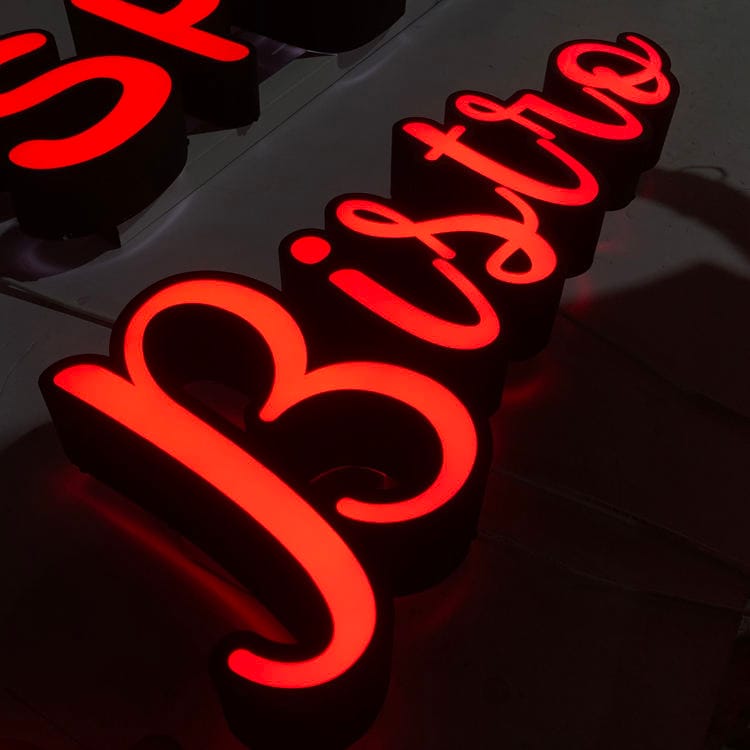
Real photo from our production floor — every sign we ship is made here.
Products mentioned or relevant to this topic — factory-direct, custom built.
From $24/letter · MOQ 1 piece · Flexible lead time · CE & UL certified · ships to 20+ countries
Custom sizes, colors, and finishes. Get a factory price in 24 hours.
Get a Free Quote Copy EmailWhatsApp +86 13865703472 · business@aochuangsign.cn
See pricing, specs, and get a free quote for the sign type you need. Built in our factory, shipped worldwide.