I've been building signs on factory floors since 2010. I've burned my forearms on hot acrylic and argued with a supplier in Lu'an over a 0.1mm tolerance at 11pm. So when someone asks me for the "best signage manufacturer in China," I don't hand them a top-ten list. I ask what they're actually installing, where, and who's going to inspect it.
Look, no single best exists. Hubs exist. Shenzhen and Guangzhou for LED modules and high-volume plastic. Wenzhou for metalwork. And smaller clusters like Lu'an in Anhui, where Aochuang Sign has run a 3,000m² facility with 50+ skilled workers since 2010. That's not huge. But huge doesn't weld your return bends.
That facility exports worldwide with an MOQ of one piece and a 7-15 day lead time. One piece. That matters when you're testing a finish before committing to a 40-letter hotel project. If you're ordering front-lit channel letters for a storefront, that's the starting point.
I've seen 20,000m² factories with 12% on-time delivery. Square meters don't solder your return bends. The real scale advantage is process discipline, not floor space.
Guangdong's a LED supermarket. You can buy a million modules a day and maybe 2% will actually meet the datasheet. Wenzhou does metal finishing that looks great in a photo and rusts in Iowa. Lu'an? Not famous. Factories like Aochuang Sign do the work importers want: laser cutting to ±0.1mm, TIG welding, CNC acrylic faces, and 100% QC before it leaves.
That's the scale advantage people miss. China's best signage manufacturers don't win because they're cheap. They win because they can source, cut, weld, and ship faster than your local guy can get a permit.
Nobody tells you this: You can audit a 3,000m² factory producing 50+ signs a week easier than a 20,000m² monster that bounces your order between subcontractors. I've done floor walks in both. The smaller one knows exactly where your letters are.
Material is the sign. Not the logo. Not the font. 304 stainless with 18% chromium and 8% nickel gives you 10+ years outdoor life. For stainless steel letters, that's your baseline. 316 adds 2-3% molybdenum and costs 20-30% more, but it's the only thing I'd sell to a Miami Beach hotel.
Acrylic? UV-resistant from Mitsubishi or Degussa lasts 5-8 years before yellowing. Domestic acrylic lasts 1-2 years. Light transmittance is 90-92%. A 2mm face cuts about 90% output, a 3mm face cuts 92%. Your customer won't notice the 2%. They will notice the 40% cost bump if you overspec.
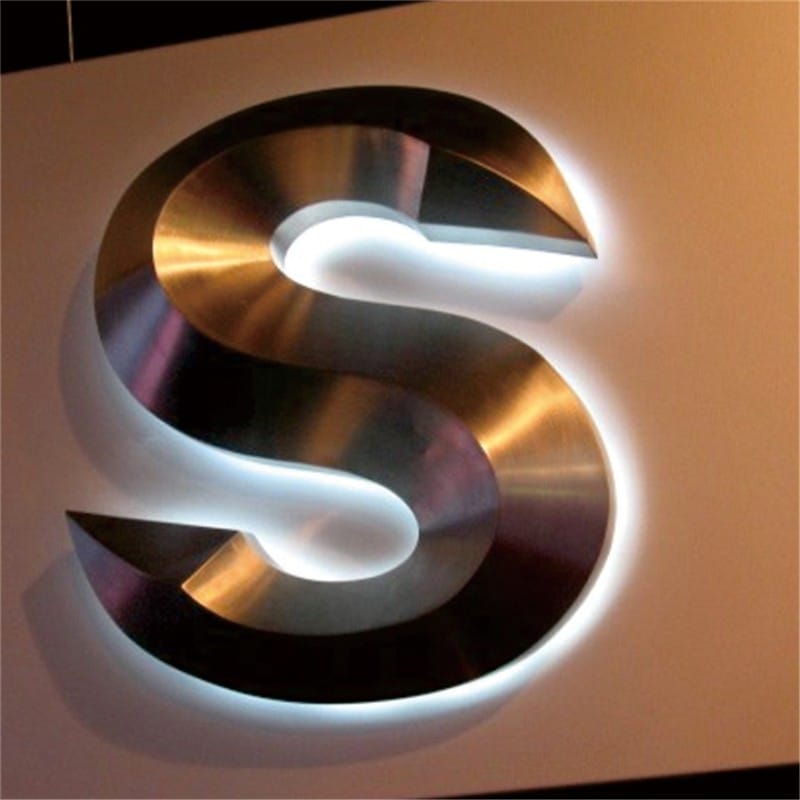
Backlit halo is premium architectural. If you're doing a law office lobby, back-lit halo letters with proper LED modules make the architect smile. But don't buy a halo sign with cheap LEDs squeezed behind the return. They'll fail at the solder joint in 18 months.
Aluminum weighs 1/3 of steel and lasts 8-12 years outdoors. Naturally rust-proof. Most extruded or fabricated aluminum signs use 1.0-1.6mm sheet. If you're mounting above a walkway, that weight saving matters more than the $4 per letter.
The ugly truth? A CE certificate doesn't mean what you think it means. CE marking costs 20,000-50,000 RMB and takes 2-8 weeks. Most factories will say they have it. Ask to see the certificate with today's date on it. Watch them go quiet.
For the US, UL 48 is the real bar. $4,000-15,000, 4-9 months, quarterly audits. ETL is 10-30% cheaper and accepted by most authorities. NEC Article 600 covers electric signs. If the factory can't produce a QUA number for their UL listing, they don't have one.
IP65 sounds impressive. Dust-tight and water jets from any direction. Doesn't mean your sign survives a Florida hurricane. IP66 handles powerful jets, IP68 is submersible. Aochuang Sign holds CE, RoHS, and ISO 9001. That's baseline export compliance, not exceptional.
I've seen this go wrong: A buyer in Toronto accepted a CE-only sign for a 277V circuit. The local inspector laughed. Then the buyer paid $2,100 for a retrofit. Ask your AHJ before you order, not after.
Factory prices, FOB Lu'an, before freight: front-lit channel letters $20-80 per letter. Back-lit halo $35-120. Stainless non-lit $15-40. 3D fabricated $40-120. Aluminum $10-25. Light boxes $80-250/sqm. Neon flex $30-200 per sign.
US retail installed is a different animal: $200-700 per front-lit letter, $400-1,000 for halo. I've watched sign shops pay $800 for a front-lit letter from a domestic fabricator. Same 304 stainless, same Samsung LEDs. We ship that letter for $120. That's factory-direct savings of 50-65% on product.
Then you add US Section 301 tariff of about 30%. Freight: LCL sea $80-200/m³, air $4-12/kg, express $30-100 for smalls. If you're buying three letters for a dental office, the savings evaporate into customs broker fees and your time. If you're buying twenty, it's real money.
Ask for the rejection and rework log. If the factory won't show it, walk. Aochuang's process includes 8-12 hour aging test and 100% QC inspection before export packaging. That's not marketing. That's me watching a 23-year-old QC tech hold a LED module with a magnifier checking solder joints.
Quickest way to spot bad LED modules: look at the solder joints. Dull gray means leaded solder and a module that dies in 12-18 months. Shiny silver means proper lead-free joints and a real 5+ year life from Samsung, Osram, or Blueview.
Nobody tells you this: LCL sea freight means your plywood crate gets handled 6-8 times between Lu'an and your dock. Every touch is a chance for damage. Specify export packaging: foam, carton, plywood crate. Don't let them ship in double-wall cardboard because you saved $9.
Ask for a live factory floor walkthrough video, with the date in the background. Not the edited showroom GIF. If they can't show you the laser cutter cutting your actual file, you're not buying from a factory. You're buying from a trading company with a nice website.
LED tech isn't standing still. SMD 2835 is the industry standard at 100-150 lumens per watt. SMD 5050 gives you RGB. SMD 5730 gives highest brightness at 40-60 lm/chip. L70 is ≥50,000 hours on decent modules. That's not the $9/meter strip from a warehouse.
For a chain rollout, IoT smart signs are now app-controlled, and DMX programmable systems let a nightclub chase color down an RGB running edge. Modular systems with plug-and-play LED modules and removable faces make service calls cheaper. That's the future—not a bigger screen, but a sign a dumb technician can fix in 20 minutes.
Sustainability is simple. UV-resistant acrylic lasts longer, which is greener than recycling. Powder-coated aluminum is naturally rust-proof and 1/3 the weight of steel. 316 stainless lasts 15+ years in marine environments, so you're not buying twice. I'll take a durable 304 sign over a "green" sign that yellows in two years.
Mistake one: buying on spec sheet price alone. You save $14 per letter on domestic acrylic, and in two years the sign looks like a smoker's teeth. That's the cheapest money you'll ever waste.
Mistake two: ignoring coastal environments. 316 stainless costs 20-30% more than 304. For a strip mall in Ohio, 304 is fine. For Miami Beach, pay for 316 or you're replacing letters in 3 years. I've seen this go wrong: a client bought 50 letters in 304 for a Naples, Florida restaurant patio. Three years later, pitting.
Mistake three: underestimating freight and customs. The cheapest quote often doesn't include ISPM-15 fumigation for wooden packaging, port fees, or the customs broker. Your $45 per-letter deal becomes $78 landed. Do the math before you wire the deposit.
Mistake four: assuming CE equals US compliance. It doesn't. UL is required in most US jurisdictions. CE alone won't pass. If you don't know your AHJ's requirement, you're not ready to import.
Do I need UL for my sign if the factory has CE?
If it's going up in the US, yes. CE means nothing to a US electrical inspector. UL 48 costs $4,000-15,000 and takes 4-9 months. If the factory says they have UL, ask for their QUA number and call UL. I'll wait.
What's the real lead time?
Production is about 5-15 days. Sea freight from China is about 65 days, air is about 10 days, express is about 5-15 days. If you need it in two weeks, you're paying air freight $4-12/kg. That's not the factory's fault. That's your project schedule.
Can you really do MOQ 1 piece?
Yes. We'll build one letter. But setup and laser programming get amortized across one unit, so the per-letter price is ugly. Buy 10 or 20 and the real pricing shows up.
Why is my sign yellowing after a year?
You bought domestic acrylic, which lasts 1-2 years outdoors. Mitsubishi or Degussa UV-resistant acrylic lasts 5-8 years. You saved $14. Congratulations. Bad move.

Real photo from our production floor — every sign we ship is made here.
Products mentioned or relevant to this topic — factory-direct, custom built.
From $24/letter · MOQ 1 piece · Flexible lead time · CE & UL certified · ships to 20+ countries
Custom sizes, colors, and finishes. Get a factory price in 24 hours.
Get a Free Quote Copy EmailWhatsApp +86 13865703472 · business@aochuangsign.cn